
Zelenskyy’s comparison of Canada to Ukraine is imperfect — but it matters
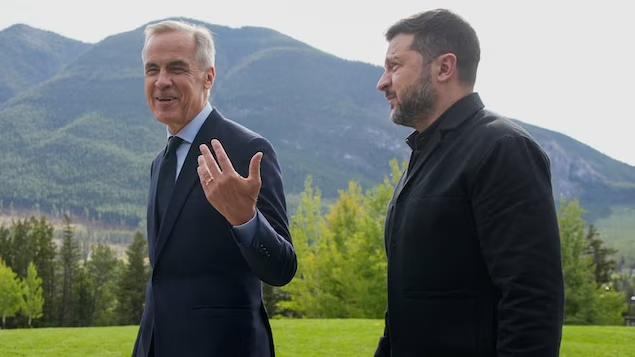
Prime Minister Mark Carney and Ukrainian President Volodymyr Zelenskyy walk together in Banff, Alta., last week. The Ukrainian leader urged Canada and the United States to keep talking, offering a stark warning of how bad things can get between neighbouring countries. (Todd Korol/Pool/Reuters)
Photo: (Todd Korol/Pool/Reuters)
Murray Brewster (new window) · CBC News
There was something extraordinarily refreshing about listening to Volodymyr Zelenskyy say the quiet part out loud.
Asked to comment on the deteriorating relationship between Canada and the United States, the Ukrainian president described it as strange and very dangerous before drawing — arguably — an imperfect comparison with his country and Russia.
It's very dangerous that there are some problems between neighbours. We are the example, Zelenskyy told CBC's chief correspondent Adrienne Arsenault in an exclusive interview (new window) at the end of his visit to Canada last week.
It's well known Zelenskyy has little patience for diplomatic euphemism and he has made something of a habit of dragging the unspoken into the open.
WATCH | Zelenskyy on U.S. 51st state threat:
U.S. threats to annex Canada 'dangerous,' Zelenskyy says
Ukrainian President Volodymyr Zelenskyy says U.S. threats to annex Canada are 'very dangerous' and urges the two neighbours to solve their differences.
But is it a fair and accurate comparison?
Talk to most Canadians and many are inclined to agree with the analogy at least on the surface, especially with the collapse of trade talks where Washington introduced last-minute demands (new window) — including a veto over Canada's third-party trade deals and a weakening of domestic cultural protections.
There is an important distinction, of course.
The United States has not threatened Canada militarily and no American divisions are assembling at the border. There is no Canadian territory that's been annexed.
The Ukrainian president was quick to urge Ottawa and Washington to keep the dialogue going to work out their differences, but three times referred to the ongoing trade war and the associated rhetoric as dangerous.
You won't find a Canadian political leader or senior official making the same comparison, at least in public.
In some of his language, Prime Minister Mark Carney alludes to it, saying how U.S. President Donald Trump wants to break us, so he can own us.
But he never completes the thought the way Zelenskyy did.
Former deputy prime minister Chrystia Freeland, who remains an economic adviser to Zelenskyy, has described the Trump administration as an existential threat to Canada's future, but never crossed into the territory of comparing the plight of her ancestral homeland with Canada.
Even former prime minister Jean Chrétien, in his fiery, "we bow to know no one" 9/11 speech last Friday (new window), didn't make the link.
One of the prominent Canadian voices to make the comparison is former vice-chief of the defence staff, retired vice-admiral Mark Norman.
Writing in the National Post (new window) during the early 2025 annexation controversy, Norman posed the question: Are we as Canadians any different than Ukraine is to Russia or Taiwan to China?
In a subsequent interview with CBC's Front Burner (new window), the former commander of the navy used his initial argument as the jumping-off point to examine what Trump's threats meant for Canadian sovereignty.
His message was: While an American invasion is not imminent, the annexation rhetoric and the way the trade war has unfolded should force Canadians to reconsider their assumptions.
What happens when you live beside a vastly more powerful neighbour that starts to treat your sovereignty as conditional?
WATCH | More about the trade war:
Can Canada actually win a trade war with the U.S.? | About That
How can Canada win a trade war with the U.S. when leverage isn't equal? Andrew Chang explains how Canada is retaliating against massive tariffs levied by a neighbour 13 times its economic size. (Photo credits: The Canadian Press, Reuters, Adobe Stock and Getty Images)
Interestingly, outside Canada, the comparison between Canada and Ukraine has been considerably more explicit.
In a March 2025 analysis story examining Trump's 51st state rhetoric, The Washington Post asked outright: "As Putin sees Ukraine … Trump sees Canada?" (new window)
The argument was that Russian President Vladimir Putin's relationship with Ukraine provides a disturbing parallel for Trump's rhetoric toward Canada.
A subsequent Post commentary put it even more directly, and argued that Trump talks about Canada much as Putin talks about Ukraine: as though it were a wayward province rather than a fully separate country.
The comparison resurfaced just recently with an article in The Atlantic (new window), which described Trump's approach to Canada as reflecting a worldview in which sovereign countries can be treated almost as properties to be controlled. The article explicitly drew a parallel between Trump's apparent disregard for Canadian sovereignty and Putin's attitude toward Ukraine.
Trump has threatened to force Canada into the union through economic coercion.
Canada built its postwar prosperity around extraordinary integration with the United States, including supply chains, energy, defence production, intelligence and continental security.
Carney is attempting to untangle that by diversifying trade, especially with Europe (new window).
Dominique Arel, chair of Ukrainian studies at the University of Ottawa, said you can draw some parallels in the sense that Ukraine was extraordinarily dependent on Russia for energy following the collapse of the Soviet Union and has been with a gun at its head since the 2014 annexation of Crimea trying to change that.
Everybody's learning the hard way that basically overdependence is actually a great security risk, said Arel, who noted that the recent collapsed trade talks between Canada and the U.S. looked very Russian-like, but it's tough to know what was in Trump's mind.
What was demanded by the United States was a direct attack on Canada's sovereignty. But is that just a negotiating tactic to put massive pressure without long-term consequences? It's a bit early to know that. But clearly, it's not much of a negotiation. It's basically an ultimatum, which you could draw parallels with Russia, of course.
Moscow viewed Kyiv's economic overtures toward the European Union as opening the door to security concerns and the possibility that NATO would be parked on its doorstep, Arel said.
For years, Moscow's proposition to Kyiv was essentially: You may technically be sovereign, but your sovereignty cannot be exercised against Russian interests.
Matt Schmidt, an associate professor and national security expert at the University of New Haven in Connecticut and former instructor at the U.S. Army War College, also said there are similarities, but important differences.
WATCH | Security expert weighs in on the comparison:
U.S. effort to make Canada a 'vassal state' lacks clear strategy, security expert says
Matt Schmidt, an associate professor and national security expert at the University of New Haven in Connecticut and former instructor at the U.S. Army War College, said there are similarities but important differences between the way the U.S. treats Canada and the way Russia behaves toward Ukraine. Russia, Schmidt argues, is more organized and focused about what it wants out of Ukraine.
What's driving this isn't rational economic thinking. What's driving this is an irrational belief that Canada is not a real nation, said Schmidt.
"Putin knew what he wanted and he was trying different different pathways to get it. I don't think that the president [Trump] knows what he wants. He's really just blurting out a sort of psychological impulse — a pressure in his mind — where he has to act like the big dog in the room.
And so he pops out with whatever is in there and then the rest of the administration races around and says, can we turn that into real policy?
He said the idea of dominating Canada doesn't have broad appeal among Americans, whereas in Russia the opposite is true where Ukraine is concerned.
He also said, militarily there's a big difference in that Russia wants to swallow Ukraine whole, while the U.S. is more interested in pulling the strings of its neighbours, including Canada.
Russia, Schmidt argues, is also more organized and focused about what it wants out of Ukraine.
I don't think there's a clear idea that goes beyond the Oval Office itself that says we have X goal in mind for Canada. We want to make it the 51st state, said Schmidt.
I think most people in the administration think that's crazy. And so there's no broader strategic plan to say, well, let's do this economically and let's make this threat militarily.
Related Stories
 Canada
Calgary man charged for alleged YouTube threat to kill Carney, RCMP says
28 minutes ago
 Canada
Carney says Canada will pursue ‘unique economic alliance’ with EU amid US trade spat
28 minutes ago
 Canada
Trump’s latest round of 50% tariffs on Canadian goods now in effect
58 minutes ago
 Canada
Chief says Canada blocking effort to take back control of child and family services
58 minutes ago
 Canada
Carney's announcements at investment summit include tax incentives to lure foreign investors
58 minutes ago
 Canada
TIFF 2026: The latest movie reviews from Toronto
58 minutes ago
 Canada
Davies, Crepeau to miss Canada's World Cup homecoming games in Toronto, Montreal
1 hour ago
 Canada
Alberta referendum pitches more control over immigration. Here's what you need to know
1 hour ago