
'Chaos' outside Centretown drop
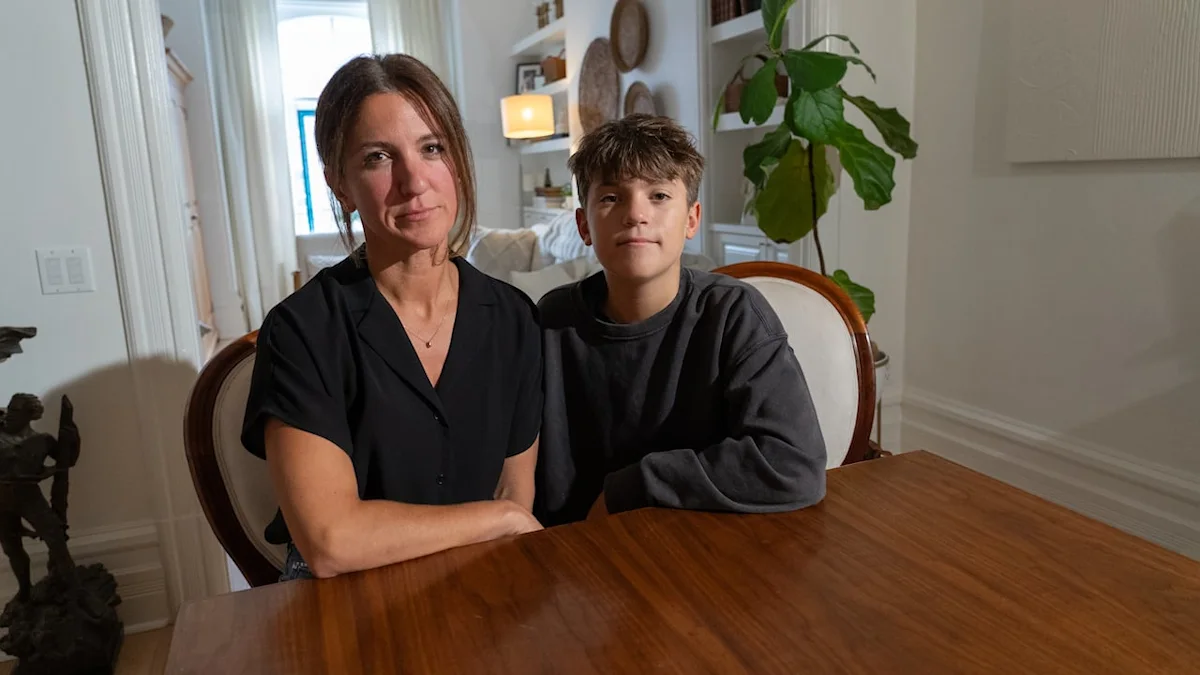
Shortly after Pamela Bowles's son Axel began attending Grade 7 at Glashan Public School on the edge of Ottawa's Centretown neighbourhood, she started to grow concerned.
Not about what was happening at the school, but just down the street.
"I noticed [a] tremendous amount of open drug use," the Centretown resident of eight years said.
In front of Centre 507, an adult drop-in centre located half a block from the school, Bowles witnessed "lots of rowdiness" and "swearing."
Axel told CBC News he's been yelled at and that someone once "jogged at" him while he walked to school with friends.
A few blocks away, Axel's sister saw someone with a knife chase another person, Bowles said.
While Bowles said she has compassion for people who are struggling, she also has questions.
"Why have we not laid out a plan that effectively will eradicate what is causing so much harm, and potential danger to the kids?" she asked.
Pamela Bowles, who lives a few blocks from the centre, says she grew worried after hearing from her son, Axel Mach, about some of the behaviour he witnessed during his walk to the school. (Francis Ferland/CBC)
That mix of emotions is felt by others, too.
Richard Leblanc, the longtime executive director of Centre 507, said he knows parents need to be able to walk their kids to school and feel safe.
"We also understand that that person laying on the sidewalk is someone's child, too," he said.
The situation facing this part of Centretown is not unique to the area.
This election, CBC Ottawahas been asking voters about their top concerns. Dozens of residents in downtown wards wrote to us and cited open drug use as their biggest issue, along with homelessness and petty crime.
But a collision of factors has made the challenges experienced by Centre 507's clients all the more visible to other Centretown residents in recent years.
"It's absolutely gotten worse," Bowles said.
Glashan Public School, seen on the right, is steps from the church building that hosts Centre 507, seen at the end of the street. (Guy Quenneville/CBC)
'Give our neighbourhood a bit of a chance'
Bowles wonders how Centre 507 can operate so closely to her kids' school. But both places are institutions with deep roots in the community.
A school was first built at the Glashan site, located on Arlington Avenue between Kent and Bank streets, in 1888. The current building went up in 1979.
Four years later, Centre 507 opened in what's now known as the Centretown United Church building at the corner of Arlington and Bank.
Supported financially by the City of Ottawa, Centre 507 offers its clients free meals, referrals and transportation to shelters, "housing-focused" case management and, for those who need it, harm reduction supplies and "a non-judgmental ear," according to the organization's website.
Leblanc has worked at the centre for two decades and said he's never seen the level of need as acute as it is now.
"There's been an explosion in substance abuse and an explosion in homelessness. We're catching up," he said outside the centre. "We're all doing the best we can."
Richard Leblanc is executive director of Centre 507. 'That person laying on the sidewalk is someone's child, too,' he said. (Francis Ferland/CBC)
Leblanc said he knows many of the people who hang around outside, noting that most them use the centre's services. Some live in community housing and others in rooming houses, but many are unhoused, he added.
While "a lot more people" are sleeping outside on Bank Street and using drugs in public throughout Centretown, "there's a large volume of people around our property," Leblanc said.
Why? Leblanc and others cite a number of factors.
As the Centretown Community Association pointed out in a post in April, Ottawa's social services for people experiencing homelessness and addiction are mostly concentrated in Somerset and Rideau-Vanier wards.
"While often assumed to reflect local need, evidence indicates that many at-risk clients are drawn downtown from across Ottawa and surrounding regions due to the lack of services elsewhere," the association wrote.
Spreading those services more widely throughout the city — an idea championed by the Centretown association and its sister groups in Lowertown and Sandy Hill — "would give our neighbourhood a bit of a chance," Bowles said.
The centre has operated inside the Centretown United Church building for over four decades. (Guy Quenneville/CBC)
In recent years, the city gave Centre 507 funding to increase its operating hours. The centre is open virtually 24/7 except for small windows when it's closed for cleaning.
Troster has been the councillor for the area for the last four years. She faces four challengers in this month's municipal election: Dillon Anderson, Robert Dekker, Nicholas Gollé and Michael Tay.
According to Troster, the hope was to expand hours at other drop-in centres across the city, but that didn't happen.
"So now we have one facility in one small church on a residential street across from a school that has this enormous overflow of people," Troster said.
The provincially ordered closure of supervised consumption sites by June 15 has complicated matters, observers add.
A week after that deadline, the centre said its community was going through a challenging time, citing the Ontario government's decision, which the province has defended as a move away from "enabling drug use."
"As Ottawa's only drop-in and respite program open overnight, [we] recognize that service closures across the community may increase demand for support," Centre 507 wrote.
To Bowles, the neighbourhood has felt like "an open drug market" since the closure of the safe consumption sites.
Troster said she's been pushing for provincial government representatives to come and walk the streets of downtown Ottawa "to see what the impact of their decisions has been."
"The reality is that we don't control the health-care system," she said.
Leblanc said Centre 507's outreach team walks the area in the morning and late afternoon, talks to clients and picks up discarded needles and pipes, prioritizing areas where kids walk to and from school.
"It's generally better if they're where our workers and our staff can support them," Leblanc said Centre 507's clients hanging outside.
Glashan Public School has a direct line to the centre, he added.
Leblanc and Centre 507 volunteers go out on patrol. (Francis Ferland/CBC)
Chris Lewis, who lives two blocks from the centre, said Bank Street between Gladstone Avenue and Catherine Street has become "a hot spot for illegal drug activity," one he partly blames on the presence of Centre 507.
Lewis reached out to CBC News on Aug. 4, hours after a man was stabbed that morning at the corner of Bank and McLeod streets and taken to hospital with non-life-threatening injuries.
"City police drive by the Centretown United Church at all hours of the day on their way to headquarters," Lewis wrote. "Yet [they] seem to turn a blind eye to the loitering and illegal drug use occurring in front of them at Centre 507."
CBC News asked the Ottawa Police Service (OPS) what's being done to help alleviate the pressures facing the area.
The police force said via email that it recognizes people's concerns, but that one of the challenges is "balancing enforcement with compassion" while working to connect people with shelter, treatment and counselling.
Since the introduction of "CORE hot spot policing" to the area this past May, officers have been actively addressing concerns about drug use, drug trafficking and outstanding warrants, OPS added.
Somerset ward Coun. Ariel Troster says the situation outside Centre 507 has become 'far too much for one small neighbourhood to deal with.' (Francis Ferland/CBC)
But there's a sense among the Somerset candidates running against Troster in the Oct. 26 municipal election that, while police are only part of the puzzle, they aren't doing enough.
Robert Dekker said he wants "a greater response" by OPS, including a community police centre (like those in other areas of the city) on Bank Street and in Chinatown, to help reduce crime and "the fears of the residents."
Dillon Anderson called for "Day 1" interventions against open drug use, "aggressive trespassing" and property damage.
Nicholas Gollé said in his own email to CBC News that while enforcement might only displace harmful activity and become "another problem" to address, "it cannot excuse leaving the present concern unmanaged."
Michael Tay pointed out that when a climate debate was held at Centretown United Church last month, there was a noticeably larger police presence, which raised a question for him.
"If we can provide that level of visible attention and public safety resources on certain days, why aren't we working toward a more consistent approach to address these issues for the people who live and work there every day?" he asked.
From left to right, Robert Dekker, Michael Tay, Nicholas Gollé, Dillon Anderson and Troster take part in a Somerset ward all-candidates debate hosted by Rogers TV last month. (Rogers TV)
Dekker and Anderson said Centre 507, which is largely operated out of the church's second floor, has outgrown the space.
Troster said the city needs purpose-built day centres in more than just one neighbourhood, and should consider running them itself.
"Because a lot of these small organizations don't have the resources to take on this incredible need," she said.
Leblanc of Centre 507 said what's needed is a greater investment in supportive housing and voluntary treatment centres, adding that "there's just not near enough resources to support all the people in Ottawa."
Bowles said she trusts in the people who are trying to solve the problem, but that it's just not happening fast enough.
"I'm not sure what the solution is, but something needs to be done."
Related Stories
 Canada
Canada 'stronger together' than apart, Carney says in Thanksgiving message ahead of Alberta visit
40 minutes ago
 Canada
Gloucester Celtic FC crowned Soccer Canada's 2026 national champions
40 minutes ago
 Canada
A giant pumpkin named Rocky gives a champion grower his California comeback
1 hour ago
 Canada
Demographic changes are reshaping Canada's economy
1 hour ago
 Canada
Rainfall warning issued for Montreal, Montérégie Tuesday
1 hour ago
 Canada
Rapid spread of invasive lizards on Vancouver Island could have 'serious' environmental impact: experts
1 hour ago
 Canada
Canada’s Carney calls for unity as Alberta prepares for secession vote
1 hour ago
 Canada
Ferry problem strands people on Grand Manan
2 hours ago