
Charges laid in decades
Charges laid in decades-old P.E.I. cold case murder withdrawn after key evidence lost
Police knew about missing knife, ligature as early as 2007 when the case was reopened
The man police accused of murdering Byron Carr in 1988 is now free. Here's what happened
All charges laid in the cold case murder of P.E.I. teacher Byron Carr have been withdrawn because crucial evidence — including a knife found at the scene and the towel used to strangle Carr — are missing.
"It’s obviously tremendously disappointing," Crown attorney Christopher White told CBC News after a brief hearing Tuesday morning in P.E.I. Supreme Court to formally withdraw all charges against Todd Joseph Irving, who previously used the last name Gallant.
"I can tell you that on the Crown prosecution end, a huge amount of work went into this file, a huge amount of our office’s resources, so it’s a tremendously disappointing result for sure."
Family of Byron Carr speaks out after murder charges in decades-old cold case withdrawn
CBC News first learned about the missing evidence at a bail hearing in July but couldn’t report on it because of a publication ban. White said Tuesday it was also new information to the Crown at the time.
At that hearing, police testified during questioning by Irving's lawyer that both the knife and the towel used to strangle Carr were missing.
But on Tuesday, interim Charlottetown police Chief Darren MacDougall told CBC News that police knew the evidence was missing as early as 2007 when the case was reopened.
"Yes, we knew these challenges existed but we hoped that our DNA evidence and other things that we were endeavouring to look into and utilize as tools would ultimately get us to where we needed to be," MacDougall said.
"We had significant forensic DNA evidence. We believed the evidence met the threshold to believe that Todd Gallant committed the offense.... We knew there were challenges, but ones we thought we could overcome."
Why were all charges dropped in the P.E.I. cold-case murder of Byron Carr?
At the July bail hearing, it was revealed that Irving's DNA was found on Carr’s body, on a pair of underwear left at the scene and on an extinguished cigarette butt placed in Carr’s navel.
His DNA was not found on the towel, nor or on a sock left at the crime scene that police said was likely used as a glove to prevent leaving fingerprints behind.
MacDougall said Tuesday that investigative procedures have evolved significantly since 1988, and that he's confident the force is following the current standards when it comes to the way evidence is collected, catalogued and stored.
He said he's not worried about the integrity of any other cases investigated by the force.
Genetic genealogy was key to the Byron Carr homicide investigation. Here's how it works
After 35 years, DNA evidence leads to 1st-degree murder charge in P.E.I. cold case
The P.E.I. Crown Attorneys' Office first announced the charges were being withdrawn in a statement released Tuesday morning. According to that statement, the office was informed by Charlottetown police in August that "a substantial portion of the physical evidence" related to the prosecution of the case could not be located.
White said a subsequent review by police also raised concerns about the "availability and viability" of evidence the Crown could rely on at trial. As a result, the Crown no longer felt there was a reasonable likelihood of conviction.
White declined to provide details about the concerns with the rest of the evidence, but did say the Crown was confident in its case until those concerns came to light.
He said there were no further prospects for litigation in this case.
Byron Carr was 36 years old when he was killed in 1988. (Submitted)
Irving, 59, was arrested and charged with first-degree murder and interfering with human remains in early 2024 — 35 years after Carr was found dead in his home. The 36-year-old teacher was found strangled with a towel and with multiple stab wounds on his body in November of 1988.
Irving had pleaded not guilty and spent more than two years in jail following his arrest before being released on bail. His jury trial had been scheduled to begin in November.
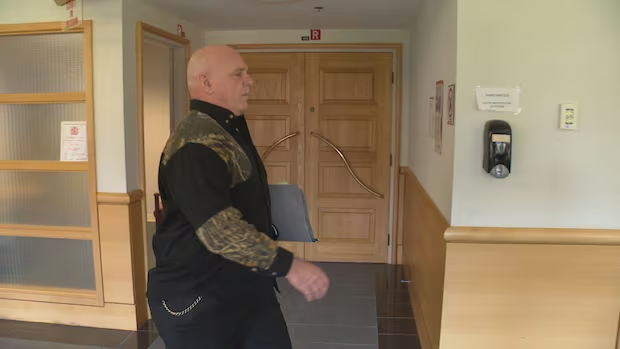
Irving, who briefly answered questions Tuesday as he walked out of the courthouse a free man, refused to say whether he intended to pursue legal action.
When asked what he planned to do next, he said, "Do like any good Islander does: get a job, go to work, put this in the past."
Accused in 1988 murder of P.E.I. teacher Byron Carr released on bail
P.E.I. judge to decide this fall on legality of DNA taken from Byron Carr murder suspect
With files from Nicola MacLeod and Wayne Thibodeau
Related Stories
 Explainers
Portal Innovations Venture Team Releases New Analysis on Capital Efficiency in Emerging Biotech Ecosystems
14 hours ago
 Explainers
Motion calls for overhaul to parking permit rules
3 days ago
 Explainers
Expedition hopes to find aviator Amelia Earhart's plane on remote island
4 days ago
 Explainers
Analysis: Trump's shock Russia deal highlights mounting pressure to curb fuel prices
5 days ago
 Explainers
Automate remediation post AWS DevOps Agent investigation
1 week ago
 Explainers
Mistral has released Mistral Large 4, scoring 38 on the Artificial Analysis Intelligence Index
1 week ago
 Explainers
Quebec election: Parti Québécois will form minority government in Quebec, CBC News projects
1 week ago
 Explainers
Nobel Prize awarded for revealing inner workings of the brain
1 week ago