
Community, culture the answer to combat HIV stigma: Indigenous people
Community, culture the answer to combat HIV stigma: Indigenous people
'The answer is not to focus on the disease but to focus on the people,' doctor says
Manitoba and Saskatchewan are home to some of the highest rates of new HIV infections in Canada, and the numbers show Indigenous peoples are disproportionately affected.
A Manitoba HIV Program update from late last year said nearly seven in 10 people admitted into the program from 2018 to 2021 self-identified as Indigenous.
Vanessa Roulette tested positive for HIV in 2018.
Roulette, who is Anishinaabe and from Lake Manitoba First Nation, in the Interlake region, says she was wandering the streets of Winnipeg and living in encampments around the time she was diagnosed.
She said using a dirty needle to get high is likely what led to her contracting HIV.
"I started crying. And I started screaming because I just knew … like, you could die. Like, that's how I grew up, knowing you could die from HIV."
Roulette was worried about what her family would think and, in particular, her brothers. She says she lived with a lot of stigma and shame, and because of that, she didn't want to visit her relatives' homes.
"You know how hard it is to be around people that don't have HIV? It's hard. Because for me, it's like, 'Am I dirty to them?'" Roulette said.
The mother and grandmother's life experience is similar to what the data is showing around cases in Manitoba.
Data from the Manitoba HIV Program shows a spike in Indigenous people being overrepresented starting in 2016, and more women being impacted starting in 2018.
As HIV cases spike, Brandon health groups bring testing directly to community
Dr. Marcia Anderson, a public health physician in Winnipeg, is worried that if the status quo remains, there will be more new cases diagnosed and fewer people on treatment for HIV.
"We've known that in Manitoba, more new cases are happening in Indigenous women, who are perhaps precariously housed, who have significant economic insecurity, who maybe use IV drugs, and who are pretty disconnected from health and social systems, who experience the most extreme forms of marginalization in society," Anderson said.
She said health-care systems will need to figure out how to do a better job of meeting people where they are at to respond to HIV in Manitoba, and to deliver treatment options in a way that is culturally safe.
"There are people out there right now who have HIV who don't know about it," said Anderson, who is also an adviser at the Mino Pimatisiwin Sexual Wellness Lodge in Winnipeg.
She said more testing will need to be done to get a better grasp on the issue and that self-testing kits could be a good option for people to know their status.
"An initial increase in projection is actually a good sign," Anderson said.
She believes addressing HIV will also need to include better access to housing, income and food security.
While Anderson believes more testing is needed in communities, she says one of the biggest challenges will be ensuring there are proper treatment pathways for people who test positive.
As the two provinces try to figure out how to reduce HIV rates, Indigenous people say education, community and culture are the keys to battling stigma for the disease.
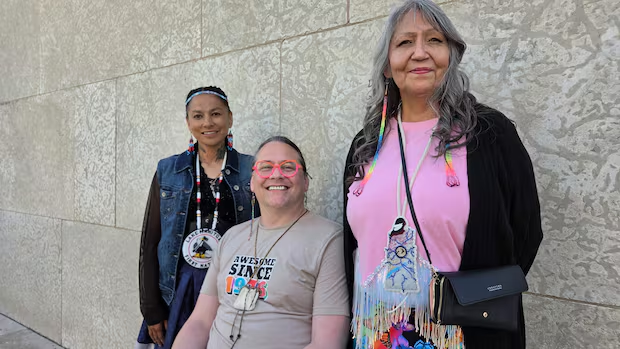
Danita Wahpoosewyan is Cree-Saulteaux and from Zagime Anishinabek, in southern Saskatchewan. She runs sharing circles for people struggling with addiction, and for people living with HIV at the Wellness Wheel Clinic in Regina. Wahpoosewyan is also a peer mentor for AIDS Programs South Saskatchewan.
She tested HIV positive in 2005 after using shared needles, and it didn't take very long for her status to become public.
"A day after my diagnosis, my whole family and my community knew I was HIV positive," said Wahpoosewyan, who turned 61 this year.
The situation of being outed made her want to help others in the community.
Wahpoosewyan started her own sharing circle in 2010 and has been a role model for many others living in Saskatchewan.
"Everyone in my community knew I was HIV positive. And it took a while for me to accept that," said Wahpoosewyan, who is a Sixties Scoop survivor.
"And now today, I can share my story about being HIV positive without having those feelings of shame and that guilt that I had in my early diagnosis."
She says she has lost many relatives to drug overdoses and a number have been diagnosed with HIV.
The federal government's HIV surveillance reports say Saskatchewan led the country in new HIV rates in 2023, 2022, 2021 and 2020.
Dr. Stuart Skinner, who founded the Wellness Wheel Clinic, said creating relationships with Indigenous communities is an important process the medical system can improve on.
"If we want to really address HIV, the answer is not to focus on the disease but to focus on the people," he said.
Skinner has been a part of sexually transmitted and blood-borne infection and HIV testing initiatives across Saskatchewan. He often partners with First Nations and organizations to get more people tested.
Saskatchewan 'committed' to addressing HIV rates but won't declare health emergency
Skinner estimates his organization has partnered with over 200 Indigenous communities and organizations for community-based testing events and said they have a hard time keeping up with the demand.
He said bringing in elders, traditional medicines and working on people's underlying traumas can help with treatment for people living with HIV.
Wahpoosewyan, who has been sober for 15 years, credits her family — including her sister and her daughter — for supporting her with her sobriety over the years.
"That's one of my biggest supports, is my family. I have a lot of family that believe in me," she said.
Daniel Sands is two-spirit and has been living with a positive diagnosis since 2015.
Sands is Cree-French, from Big Stone Cree Nation in Alberta, and has been living in Victoria, B.C., for most of their life.
Prior to being diagnosed, Sands had an addiction to methamphetamines and was diagnosed with the disease after having unprotected sex.
Sands said many people will have different paths after testing positive. They credit the medical system for being able to get their health back on track and said their medication is great.
"I take my meds and I'm undetectable, and I can't pass it on to anybody," Sands said of HIV.
Their advice for people who might be newly diagnosed is to connect with local HIV organizations and others living with the disease.
Sands says the disease forced them to live a healthier life and that going to places such as the Victoria Native Friendship Centre to reconnect with their culture has really changed their outlook on the diagnosis.
"Getting into culture and learning the language really helped feed my soul," Sands said.
Roulette knows life isn't going to get easier and wants to continue on her healing journey.
"Everything I have went through, I'm grateful, and I honour it," she said.
"Because if I didn't go through all that stuff, including catching HIV, I wouldn't know what I know today. I wouldn't be able to go and share."
Roulette wants to help others who are newly diagnosed or might be at risk of HIV.
Indigenous people fight high HIV rates with education, community
"I'm thinking that if I can come forward and be honest, it'll give maybe somebody else the opportunity to come out and say, 'Hey, you know what? If she can do it, I can do it,'" she said.
Roulette has shared her story at conferences, in First Nations and at a few organizations in Winnipeg since December.
Manitoba declares public health emergency as HIV rates rise
"There is no time to just sit there and cry around about your feelings. It is time to stand tall and move forward," she said.
This reporting by Lenard Monkman was supported by the Canadian Journalism Foundation Indigenous Health Journalism Fellowship, in partnership with the Canadian Medical Association.
Lenard Monkman is Anishinaabe from Lake Manitoba First Nation, Treaty 2 territory. He was an associate producer with CBC Indigenous.
Related Stories
 AI News
Tiny Desk: World Cup Concert Matchups!
24 minutes ago
 AI News
Dutch star announces tragic loss of unborn baby during World Cup
24 minutes ago
 AI News
Steve Clarke resigns as Scotland head coach after elimination from World Cup 2026
24 minutes ago
 AI News
World Cup 2026: Crystal Palace and Sunderland top Premier League goals after group stage
24 minutes ago
 AI News
27 flights, 24 matches: How Fifa's president is jetting around World Cup
24 minutes ago
 AI News
Everything you need to know about Lytham Festival
25 minutes ago
 AI News
JT donates tablets to enhance digital music access
25 minutes ago
 AI News
Short
25 minutes ago