
Confused by 'The Odyssey'? Here's your crash course before the movie
Confused by 'The Odyssey'? Here's your crash course before the movie
Catch up on the characters, plot, and themes of Homer's 2,800-year-old epic before seeing Christopher Nolan's "The Odyssey."
You already know everyone, right?
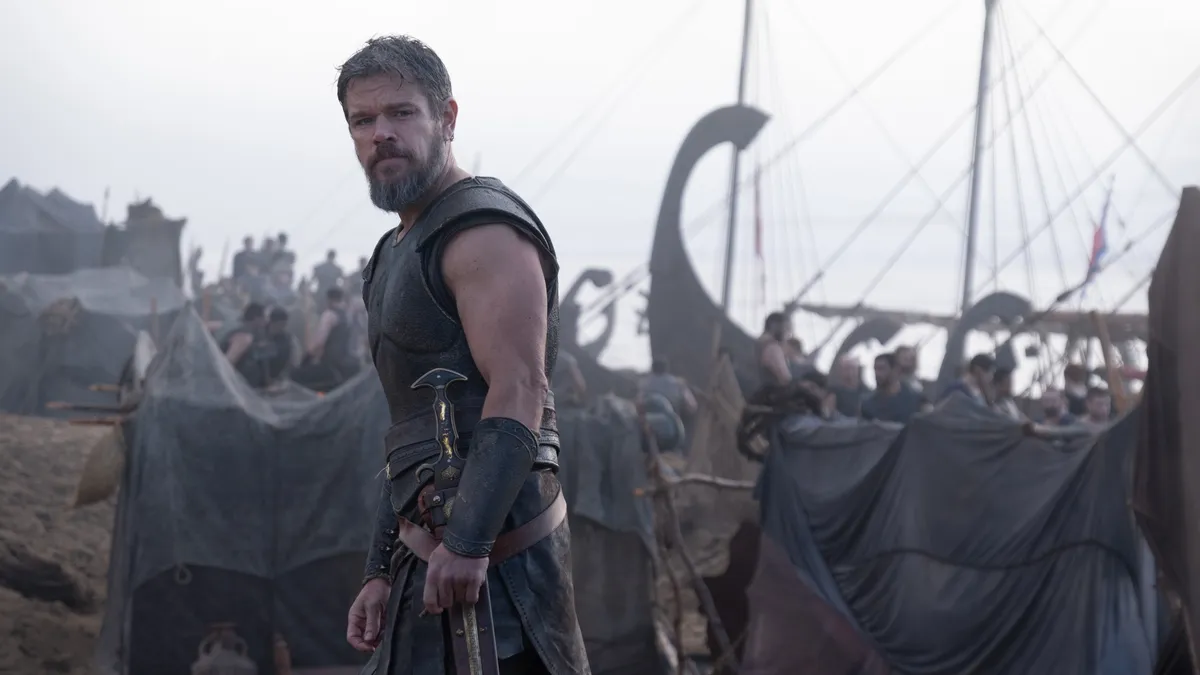
This strapping fellow who looks a bit like Matt Damon? Odysseus.
And this lovely lady with the Anne Hathaway smile? His wife, Penelope.
Or perhaps you don't know "The Odyssey" − the 8th century B.C. (probably) Greek epic poem by Homer (possibly), a blind (perhaps) bard who may or may not have existed.
We know everyone at this party. We know their lives, their loves, their backstories. And with the help of some prominent classical scholars, we can bring you up to speed, just in time for Christopher Nolan's much-anticipated epic "The Odyssey" (in theaters now).
The "Odyssey," on or off the screen, is worth knowing, says Seth L. Schein, professor emeritus at the University of California, Davis.
"It endures," says Schein, author of "The Mortal Hero" and editor of "Reading the Odyssey: Selected Interpretive Essays."
"One of the reasons it's so attractive to people is that the 'Odyssey' makes it possible − makes it easy − for us to identify with the characters, and the dangers they go through, and the motives they have," Schein says.
The "Odyssey" is above all an adventure story. The original adventure story.
And it's also the original sequel.
It's the follow-up to the "Iliad" − the earlier blockbuster about the Trojan war, supposedly written by this same Homer at more or less the same time.
But the story about the war hero Odysseus, whose journey home with his men is beset by sea storms, shipwrecks, gods, monsters and shady ladies, set the template for literature, comic books, science fiction and Hollywood epics for centuries to come. "Robin Hood" has "Odyssey" DNA in it. So does "Star Trek." So does "Lord of the Rings." So does almost any action or fantasy saga you can think of.
"There was a film-writing manual that claimed the 'Odyssey' as a kind of fundamental template for plot-making," says Sheila Murnaghan, professor of classical studies at the University of Pennsylvania and author of "Disguise and Recognition in the 'Odyssey.' "
"And of course it is a remarkably plotted work."
So let's dive in. We'll start with the people. Then the plot. Then − underlying them both − the principles.
The three main characters − drumroll − are:
Strong. Brave. Cunning. Wants more than anything to get home to his wife.
Odysseus' son. Early 20s. Wants more than anything to reunite with dad. Ultimately goes out looking for him.
His wife. Wants more than anything to get her husband back. She's loyal. But also crafty. Her challenge: to keep faith in her husband's return, while also keeping her slew of odious suitors at bay. "What's she's really doing is holding open a place for him to return to," Murnaghan says. "She takes on a very important role."
The crew. Eurylochus (Himesh Patel) and Polites (Andrew Howard) are among those who play Spock and McCoy to Odysseus' Captain Kirk. Nolan's film borrows an additional character from Virgil's "Aeneid" (a later entry into the Troy franchise, circa 30 B.C.): Sinon, played by Elliot Page.
The monsters. Guillermo del Toro can't hold a candle to Homer when it comes to monsters. Most famous is Polyphemus, aka. Cyclops (Bill Irwin): giant, one-eyed and with a taste for human flesh. But there's also the Sirens − half bird, half woman − whose song lures mortals to their death. Not to mention the six-headed Scylla, and Charybdis, a monstrous whirlpool. Odysseus has to sail his ship between them. Hence the household phrase for two bad alternatives: "between Scylla and Charybdis." Well, maybe not common in your household.
The femme fatales. Odysseus, manly and strong, is catnip to all kinds of scheming women. The nymph Calypso (Charlize Theron) snares him in her love nest for seven years. The sorceress Circe (Samantha Morton) turns his crew into pigs. In Nolan's "Odyssey," there are two additional lovelies, both played by Lupita Nyong'o, and merely mentioned in Homer: Helen of Troy, whose abduction started the Trojan war, and her sister Clytemnestra, who connives to murder her husband Agamemnon.
The bad guys. The loutish suitors, who in Odysseus' absence take over his palace, eat him out of house and home, make unwanted advances to his wife and scheme to murder his son, are the real villains of the "Odyssey." Antinous (Robert Pattinson) is the boldest.
The gods. Zeus, Hermes, Athena (Zendaya) and Poseidon play major roles in the "Odyssey," as both allies and antagonists to the hero.
The servants. It's hard to get good help, then as now. Eurycleia (Kare Fuglei) and Eumaeus (John Leguizamo) are among the good servants. Melanthius (Logan Marshall-Green) and Melantho (Mia Goth) are the unreliables. "The loyal slaves are very important," Murnaghan says.
The plot (spoiler alert!) in a nutshell
Odysseus, the Trojan war hero − deviser of the wooden horse − is ready to go home. Unfortunately, he has defiled the local temples. Poseidon is pissed. And he decrees that Odysseus, his fleet and his 600 men will have to take the long way back to Ithaca. Ten years.
At home, wife Penelope is pining. Odysseus is presumed dead. And there are 108 − count 'em − suitors lining up to be her next husband. They're turning her house into a pigsty, and she can only stall them for so long. Her son, Telemachus, now grown, resolves to go out and look for his father. The suitors resolve to kill the son.
Meanwhile, for the returning Odysseus, it's one bummer after another. Calypso traps him. The Cyclops tries to eat him (he and his men managed to stab him in his one eye). The Sirens nearly lure him overboard. He must thread the needle between the Scylla and Charybdis. He must survive the enchantments of Circe, two shipwrecks, a visit to the underworld. The gods throw the book at him.
Just barely, and with the help of Athena, Odysseus reaches home. The last survivor of his crew. He comes disguised as a beggar. Penelope, in the end, recognizes him. So does Telemachus, now returned from his own odyssey. Every suitor in the place is dismembered. And that − in 700 B.C. − is what is known as a happy ending.
"To the Greeks, this was popular entertainment, " Murnaghan says. "It was very vivid to them."
A great story teaches great lessons. You can learn a lot about the values of the ancient Greeks from the "Odyssey." As for instance:
Hospitality. The gods (Zeus especially) insist that all strangers be well-treated. King or beggar, it makes no difference. The suitors raid Odysseus' larder, live off his bounty, but are disdainful of Odysseus himself when he shows up in rags. That does not end well. "Hospitality is a key value in the 'Odyssey,' " Murnaghan says. "How you treat a stranger − even if you don't know who they are, even if they're storm-battered. You wash them, you offer them food, you offer them a way to get home, even before you ask who they are."
Loyalty. Son to father, servant to master, crew to captain, wife to husband − faithfulness is highly prized. Husband to wife, maybe not so much.
Strength. Physical strength, courage, are key virtues. Odysseus himself is quite the strongman. The final challenge of the suitors is a strength test. Can they string Odysseus' bow? Are they able to bend the wood back? They are not. "Odysseus is incredibly tough, physically," Schein says.
Cunning. Brawn counts, but so do brains. Odysseus is clever − and not altogether scrupulous − as he spins stories, outwits monsters, and even makes up false identities for himself. It's not lying, if the hero does it. "He has those qualities of strength and courage and martial ability, but he also has this other side of being a trickster," Murnaghan says.
Piety. Odysseus gets into trouble in the first place by insulting the gods, thus making an enemy of Poseidon. Then his crew, despite being warned, kill and eat the cattle of the sun god Helios. Zeus strikes them dead. Long story short: Don't mess with the higher-ups.
Property. Penelope is trying to save herself for her husband. But she's also trying to save his estate, which the parasitical suitors are squandering. "There is an economic basis for this," Schein says. "When the gods let Odysseus get away with killing all these suitors − he kills 108 − they do so largely because it's in defense of his property. It's almost like the poem is celebrating private property."
Home. Dorothy said it: "There's No Place Like Home." But Homer said it first.
"Wanting to return home, even wanting to return home post-war to a family that defines your identity, is a very widespread pattern," Schein says. "That's not limited to our culture. Or to people who have read the 'Odyssey.' "
Related Stories
 AI News
Mafia law gives Italian families right to break free from life of crime
4 minutes ago
 AI News
Messi has a message for World Cup critics of Argentina: 'Nothing was handed to us'
4 minutes ago
 AI News
New York issues air quality alert days before World Cup final
4 minutes ago
 AI News
Argentine superstition ramps up ahead of World Cup final
5 minutes ago
 AI News
U.S. airstrikes hit Iranian bridges, following Trump's threats to strike infrastructure
5 minutes ago
 AI News
‘You can taste the smoke’: New Yorkers on air quality as fires burn across Canada
7 minutes ago
 AI News
Alberta NDP Leader Naheed Nenshi says he'll seek Calgary seat in next election
7 minutes ago
 AI News
Small private plane crashes at Montreal Metropolitan Airport
7 minutes ago