
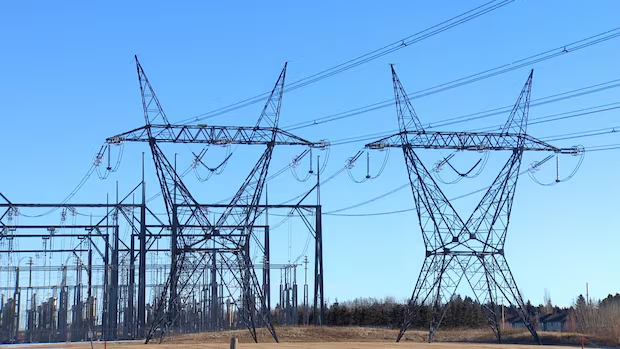
Could a single Maritime power grid make electricity more reliable?
Could a single Maritime power grid make electricity more reliable?
Some experts are pushing for an Independent System Operator (ISO) to unite electricity across the provinces
When Canada's premiers met in Prince Edward Island back in July, leaders from the Maritime provinces had power on their minds — just not the political kind.
During those meetings, the premiers of P.E.I., Nova Scotia and New Brunswick signed a non-binding agreement known as a memorandum of understanding, or MOU, pledging to co-operate on a regional road map for electricity transmission by next spring.
A key component of that MOU was for the three provinces to explore the possibility of a Maritime-wide independent system operator, or ISO.
‘It will save money,’ says N.S. premier of regional electricity operator
Maritime provinces to consider regional electricity operator
The idea — a regionally integrated power grid — is one the Halifax-based Ecology Action Centre has been pushing for years.
"When we're making decisions about … how do we make sure that the grid is stable out to 2050, those kind of planning initiatives should incorporate the kind of resources we have across the Maritime region," Thomas Arnason McNeil, the centre's senior energy co-ordinator, told This is P.E.I. host Mitch Cormier.
"I think it is encouraging that we're starting to have the conversations now before we walk too far down the road. I do have faith that it is something that can happen quickly, in large part because it needs to happen quickly."
The MOU notes that demand for power is rising — the federal government is planning for energy use to double by 2050 — and the Maritime provinces are aiming for efficiency through resource sharing.
An independent energy system operator would work at arm's length from governments and power utilities. The idea is that it would work on behalf of electricity customers, not private for-profit private businesses like Nova Scotia Power, N.B. Power or P.E.I.'s Maritime Electric.
It would also make decisions about how best to generate that energy in a way that makes sense for the entire grid — whether it's building new transmission lines or generating power from wind, solar or battery storage.
'We haven't got much time': N.S. energy system operator takes on challenging renewables target
N.S. grid operator to open new, broad search for energy technology, including batteries
Nova Scotia launched its own ISO last year, carving out some responsibilities from the private utility and giving them to a new non-profit entity. The Independent Energy System Operator is gradually taking over the procurement of new energy generating projects and decisions about power dispatch, among other jobs.
"You're going to look at the whole system and say, 'OK, brass tacks: where do we need to build generation, where do we need to build transmission lines, how do we make decisions that are in the best interest of ratepayers across the region?'" Arnason McNeil said.
"[With] a systems operator that operates at arm's length from a private utility, at arm's length from government, you're able to make decisions about electricity that are not perceived as having a conflict of interest."
Planning 5 minutes — and 5 years — ahead
When it comes to examples of how an independent system operator could run, Arnason McNeil said, there's no need to look very far — just south of the border from the Maritimes, in fact.
ISO New England is an independent entity that's responsible for the power grid and wholesale electricity market for most of the region's six states — a service area with a population of 15 million customers.
Formed in 1997, it orchestrates how energy flows between sellers and customers on a minute-by-minute basis, but also over the long term.
"Any time anyone in New England is using power, there is a group of operators in our control room in Massachusetts making sure that the supply and demand across the region is balanced," said Matt Kakley, ISO New England's manager of media relations and strategic communications.
"But then we also, in the day to day, are looking 10, 20 years into the future and trying to project what we anticipate we'll need so that we can ensure that we have that supply and balance, not just in the next five minutes, but in the next five years."
The non-profit is funded by a tariff on wholesale energy transactions, Kakley said, so it doesn't make any money from electricity rates in the markets it's responsible for. He added that the competition in that wholesale market also helps keep power rates lower for customers.
It's the ISO's job to synthesize all the electrical generation and use among all six New England states. It's tasked with creating decades-long plans for power supply and demand, as well as for transmission infrastructure.
"If you suddenly have a portion of the region that is experiencing a lot of population growth, you want to make sure that that portion of the system is able to accommodate that new electricity demand," Kakley said.
"[We're] making sure that everybody is operating from a shared understanding of where we are and where we're headed."
Ottawa kicks in funding to get the ball rolling on new power cables between P.E.I. and N.B.
Whether the Maritime governments can make an ISO happen remains to be seen, and Arnason McNeil knows creating a region-wide energy grid will take time.
But he's encouraged by the fact that the conversations have started.
"Frankly, we are so far behind places like New England at this stage when it comes to regional co-operation on electricity and reliability that I do think that we need to think really big and really ambitiously, and I think we do see that reflected in the memorandum of understanding," he said.
"But man, we've got to have these conversations right now because we're going to be caught flat-footed if we're trying to do things like phase out coal and build offshore wind and build onshore wind and solar and batteries."
Stephen Brun is the copy editor for digital news at CBC Prince Edward Island. A graduate of UPEI and Holland College, he has been a writer and editor for a number of newspapers and websites across Canada for nearly two decades. You can reach him at stephen.brun@cbc.ca.
Related Stories
 Canada
Adam Zivo: It is in Canada's interest to forge deeper ties with Ukraine
10 minutes ago
 Canada
‘We’re in a rush’: Ottawa businesses want Canada
10 minutes ago
 Canada
The troubled Nova Scotia ferry that had a massive comeback
10 minutes ago
 Canada
Sister of woman killed on highway calls on province to twin the T.C.H.
1 hour ago
 Canada
What Trump's 'most favoured nation' drug pricing policy might mean for Canadians
1 hour ago
 Canada
India's high commissioner to Canada says 'both countries need each other'
2 hours ago
 Canada
Canadian detained at U.S. border, questioned for hours about voting as permanent resident
2 hours ago
 Canada
Major incident in village near RAF base
2 hours ago