
Cyber, Artificial Intelligence (AI) and Smart Technologies Drive Kenya
Cyber capabilities, Artificial Intelligence (AI) and SMART technologies are increasingly shaping military operations, national resilience and the future security environment. For modern Defence Forces, technological adaptation is therefore becoming as critical as conventional military capability in maintaining operational advantage and responding effectively to emerging threats.
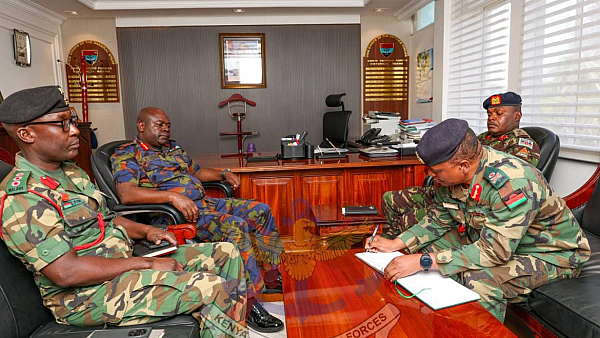
The Kenya Defence Forces (KDF) hosted a 30-member delegation from the Malawi Defence Force Senior Command and Staff Course Number 05 for a regional study tour in Nairobi, strengthening defence cooperation while advancing professional knowledge exchange on emerging technologies and national security.
Led by the Commandant of the Malawi Defence Force Command and Staff College (MDFCSC), Major General Vincent Peter Moyo, the delegation paid a courtesy call on the Vice Chief of the Defence Forces (VCDF), Lieutenant General John Omenda, at Defence Headquarters. Discussions explored areas of mutual interest and opportunities to deepen military-to-military cooperation between Kenya and Malawi.
Central to the study tour was a strategic presentation under the theme, “Approaches to Leveraging Cyber Domain Capabilities and SMART Technologies in Building National Resilience.” The session examined how Defence Forces can harness emerging technologies while strengthening institutional preparedness against evolving cyber and asymmetric threats.
Major General Moyo commended the presentation, noting that it demonstrated Kenya’s growing integration of technology into everyday life through innovations such as M-Pesa, digital public transport booking systems and electronic payments.
He observed that contemporary security challenges are increasingly asymmetric and technology-driven, requiring Defence Forces to continuously adapt their training, capabilities and operational approaches. Militaries that fail to keep pace with technological transformation, he noted, risk losing operational relevance and advantage.
Welcoming the delegation, the Chief of Training, KDF, Brigadier Alex Nteere, underscored the importance of Professional Military Education in developing adaptive leaders capable of operating effectively within increasingly complex security environments.
Brigadier Nteere urged military institutions to proactively embrace emerging technologies, particularly AI, drawing parallels with the initial introduction of computers into workplaces, which was similarly accompanied by uncertainty and resistance.
He highlighted AI’s potential to strengthen personnel management, analyse large volumes of information, identify trends and patterns, and support the assessment of possible courses of action during operational planning. He further emphasised that technological advancement must be supported by resilient institutions, appropriate structures and sound policy frameworks capable of addressing emerging cyber risks.
During the strategic presentation, Lieutenant Colonel Mukugi examined regional and international cyber and SMART technology ecosystems relevant to national security and defence operations. He assessed vulnerabilities associated with expanding digital connectivity and networked systems across military and civilian sectors.
The presentation also explored approaches to protecting critical infrastructure through governance frameworks, resilience mechanisms and inter-agency coordination. Industry, innovation ecosystems and public-private partnerships were highlighted as important force multipliers in strengthening cyber capabilities and national resilience.
The session further examined the integration of cyber capabilities, SMART technologies and Combined, Joint, Interagency, Intergovernmental and Multinational (CJIIM) effects into military planning and decision-making.
The study tour strengthened Kenya–Malawi defence relations while demonstrating the growing convergence between military education, defence diplomacy and technological transformation. Through sustained professional exchanges, the two Defence Forces are strengthening institutional resilience, developing technologically adaptive leaders and enhancing preparedness for an increasingly digital and contested security environment.
Related Stories
 AI News
Norway seeks temporary ban on smart glasses amid privacy concerns
41 minutes ago
 AI News
Coke and Pepsi conned us into believing litter was our fault. This trick is even worse
45 minutes ago
 AI News
Snap election called amid housing crisis
1 hour ago
 AI News
Mosti’s Cradle Fund sees overcrowding in applicants as 70% are AI
1 hour ago
 AI News
Why SpaceXAI Is Rebranding As SpaceXSI
1 hour ago
 AI News
How artificial intelligence could help protect wildlife, animals and fragile ecosystems
1 hour ago
 AI News
Accept ‘bad things’ in return for benefits of AI, says Sam Altman
2 hours ago
 AI News
OpenAI steps up safety, promises earlier disclosure after Australian hack
2 hours ago