
Francis Halzen, Belgian physicist based in U.S., awarded Nobel prize for pioneering work on neutrinos
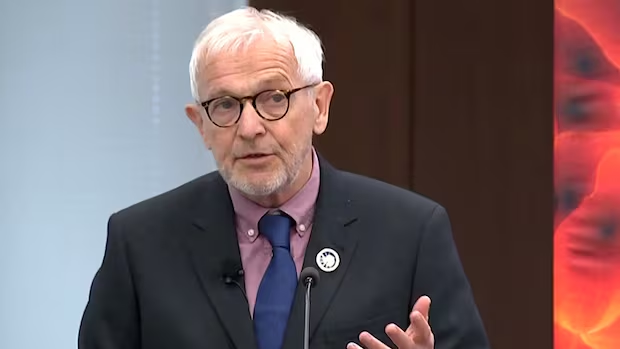
Belgian physicist awarded Nobel Prize for pioneering work tracking neutrino particles at South Pole
Francis Halzen helped develop the IceCube Neutrino Observatory in Antarctica
Belgian American particle physicist Francis Halzen was announced as the winner of the 2026 Nobel Prize in Physics on Tuesday in Stockholm.
Halzen, 82, was recognized for "decisive contributions to the IceCube Neutrino Observatory and the discovery of high-energy neutrinos of astrophysical origin," the award-giving body said. The observatory is located at Amundsen–Scott South Pole Station in Antarctica.
Halzen realized that ice at the South Pole could be used to track neutrinos, sometimes known as "ghost particles" for the way they pass through the Earth and our bodies without a trace, only interacting with matter extremely rarely.
"The messengers bring information from the cosmos," Eva Olsson, of the Royal Swedish Academy of Sciences, told a news conference. "They open the door to distant galaxies and tell us about the processes of exploding stars."
The winners of the Nobel physics prize are selected annually by the Royal Swedish Academy of Sciences and receive a prize sum totalling 12 million Swedish crowns ($1.7 million Cdn).
Canadian lab tracks neutrinos to study mysteries of universe
IceCube detector in Antarctica observes high-energy neutrinos
The IceCube, which covers an entire cubic kilometre, became operational in 2011 — the culmination of a vision for the South Pole observatory, the academy said, that began in the late 1980s.
Halzen, affiliated for several decades with the University of Wisconsin–Madison in the U.S., told the academy by phone he was "delighted" and "surprised" by the announcement, which came as he was attending a conference in Italy.
In 2014, the U.S.-based Smithsonian magazine, dubbed Halzen "Neutrino Man" when giving him one of its Ingenuity Awards.
Neutrinos are omnipresent, tiny cosmic particles with a mind-bogglingly small mass. They spew from stars like the sun and trillions zip through our bodies every second.
Scientists can't glimpse the mysterious ghost particles on their own. Instead, they measure what happens when the tiny particles collide with other bits of matter, producing flashes of light or charged particles.
A view of the IceCube Neutrino Observatory at the South Pole is seen in this undated handout image. (Marc Jacquart/IceCube/NSF/Reuters)
Halzen studied a rare gang of neutrinos that scientists consider messengers from the cosmos, offering clues to how the universe evolved.
"Francis Halzen has led an international team of researchers and engineers who have provided us with a fantastic instrument," Mark Pearce, chair of the Nobel Committee for Physics, said in a statement. "His tenacity and scientific vision has paved the way for a new kind of astronomy."
The discovery of neutrino oscillations was recognized by the Swedish academy in 2015, with Canadian scientist Dr. Arthur McDonald sharing in the Nobel physics prize that year.
The Nobel Prize in Chemistry will be announced Wednesday, the literature prize on Thursday and the peace prize on Friday. The economics prize will be announced Oct. 12.
The Nobel Prize was created by wealthy Swedish chemist and entrepreneur Alfred Nobel, who in his will dictated that the bulk of his estate should be used to fund "prizes to those who, during the preceding year, have conferred the greatest benefit to humankind."
Nobel Prize in Medicine awarded to scientists who pioneered work in optogenetics
Mark Carney for Nobel Peace Prize? Probably not, but his name's out there
Nobel is best known as the inventor of dynamite, but also wrote poetry and drama and could speak Russian, French, English and German by the age of 17. The five original prize categories reflect the interests closest to his heart.
The Nobel prizes are presented to the laureates on Dec. 10, the anniversary of Nobel's death.
With files from CBC News and The Associated Press
Related Stories
 Business
AngelNV Opens 2026 Entrepreneur Bootcamp With $400,000 Startup Investment Opportunity
1 hour ago
 Business
Liberia Participates in the 2nd Economic Community of West African States (ECOWAS) Startup Awards
1 hour ago
 Business
CrowdStrike Launches Fourth Cybersecurity Startup Accelerator With AWS and Nvidia
1 hour ago
 Business
Norwegian princess Märtha Louise and husband sue ex
2 hours ago
 Business
British Business Bank backs multi-fund VC Fuel Ventures with €11 million investment
2 hours ago
 Business
FET Appoints Amariko as Dynacon Representative in Japan
2 hours ago
 Business
What Europe’s EU Inc. framework for boosting competitiveness can and should learn from startup fraud in the US
3 hours ago
 Business
This robotics startup raised $75 million to automate drug manufacturing. See the pitch deck.
4 hours ago