
Giant underwater Kelvin wave could 'pack a punch' for B.C. in mid
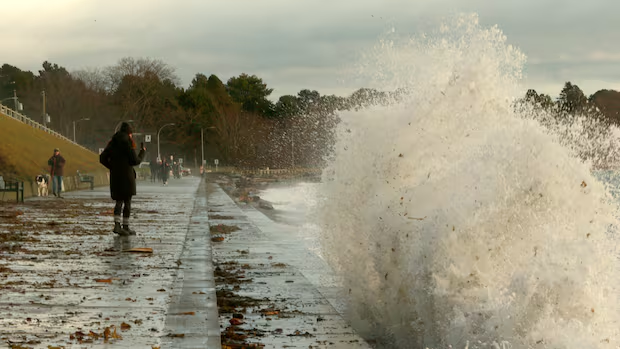
Giant underwater Kelvin wave could 'pack a punch' for B.C. in mid-October
El Niño phenomenon could worsen the effects of storm surges and high tides
A giant underwater wave of water connected to this year's El Niño weather pattern is moving up the west coast of the Americas, raising alarm bells among scientists about how climate change is magnifying the impacts of the naturally occurring phenomenon.
The so-called Kelvin wave is not unexpected. But like El Niño as a whole, it is happening on top of human-caused climate change that has already warmed the oceans and atmosphere.
A smaller wave already reached B.C. earlier this summer, and the next one is expected to arrive within one to two weeks, according to Bill Merryfield, a research scientist at Environment and Climate Change Canada.
"We actually did already see over 30 centimetres in some locations in June. And so the coming wave looks like it'll be a stronger one," Merryfield said.
The Kelvin wave is a naturally occurring weather phenomenon, just like El Niño itself. In normal years, winds blow from east to west along the equator in the Pacific Ocean, generally pushing water from South America toward Asia.
During El Niño years, however, those east-to-west winds weaken or can reverse direction, allowing water to move east instead.
"When these Kelvin waves reach the coast of South America, there's nowhere further east for this pile up of water to go. And so it splits and starts running up and down the coasts of the Americas" and eventually all the way up to Canada, Merryfield said.
Sea-level monitoring data collected at Tofino, on Vancouver Island's Pacific coast, shows the impact of the earlier Kelvin wave in June.
Rather than a giant tsunami-like wave, the Kelvin wave temporarily raises sea levels.
"You can think of it more like a very broad, hundreds of miles wide, but very shallow bulge in the height of the ocean surface, so by maybe a foot or so," University of California climate scientist Daniel Swain told CBS News last month.
What will it do to the West Coast?
Merryfield said the impacts are most pronounced during king tides, particularly high tides that happen when the gravitational pull of the sun and moon combine to produce higher-than-normal tides.
"So if you put that 30 centimetres of sea level rise on top of a king tide, and then maybe you add a winter storm to that, which causes a storm surge, that's when you really start to get into trouble," he said.
"This extra foot or so of sea level rise due to El Niño can pack a punch."
El Niño-fuelled heat could kill half a million people by February: study
Those surges could be intensified by another effect of El Niño, further raising sea levels along the B.C coast. El Niño can strengthen northward winds along the coast, pushing even more water toward shore.
These compounding effects — the Kelvin wave, stronger northward winds and winter storms, on top of climate change already raising sea levels and intensifying extreme weather — could worsen flooding and erosion along the coast. Strong El Niños in the past have caused widespread erosion on California's beaches.
Local authorities there are placing emergency sand on beaches and expect the Kelvin wave to raise water levels six to 12 inches, the Associated Press reports.
The impacts of the Kelvin wave — and El Niño more broadly — could extend far beyond this season, Merryfield warned.
The oceans absorb much of the excess heat trapped by greenhouse gases, moderating global warming as humans continue to burn fossil fuels. During El Niños, however, some of that stored heat is released from the ocean into the atmosphere.
This will likely lead to 2027 becoming the warmest year on record "by quite a significant margin," Merryfield said, echoing similar warnings from other climate research organizations and scientists.
Inayat Singh covers the environment and climate change at CBC News. He is based in Toronto and has previously reported from Winnipeg. Email: inayat.singh@cbc.ca
Related Stories
 Canada
Former head of German foreign intelligence suspected of 'treasonous espionage'
34 minutes ago
 Canada
US
35 minutes ago
 Canada
‘Spit on our sacrifice’: Canadian veterans fume after Trump and allies take jibes at military
35 minutes ago
 Canada
Emera to acquire Canadian Utilities in $14.3B all
1 hour ago
 Canada
National dental plan hits roadblocks. A new report highlights problems for patients
1 hour ago
 Canada
A plague alert in Russia? What it means for Canada
1 hour ago
 Canada
Trump draws backlash after he suggests Iran could ‘take out’ Los Angeles or San Diego
2 hours ago
 Canada
Federal government phasing out seed research in Indian Head, Sask.
2 hours ago