
GOLDSTEIN: Our economy? Now for the bad news
See more Toronto Sun on Google — save as a Preferred Source
Let's start with the good news.
Statistics Canada reported Friday that the Canadian economy grew by 3.3% on an annualized basis in the second quarter (April to June) of this year, its best performance since 2023 and highest in the G7.
The federal agency also revised an earlier finding that the economy contracted by 0.1% in the first quarter (January to March) to a 0.3% increase.
That means Canada did not experience a technical recession — two consecutive quarters of negative growth — after the economy contracted by 1% in the fourth quarter (October to December) of 2025.
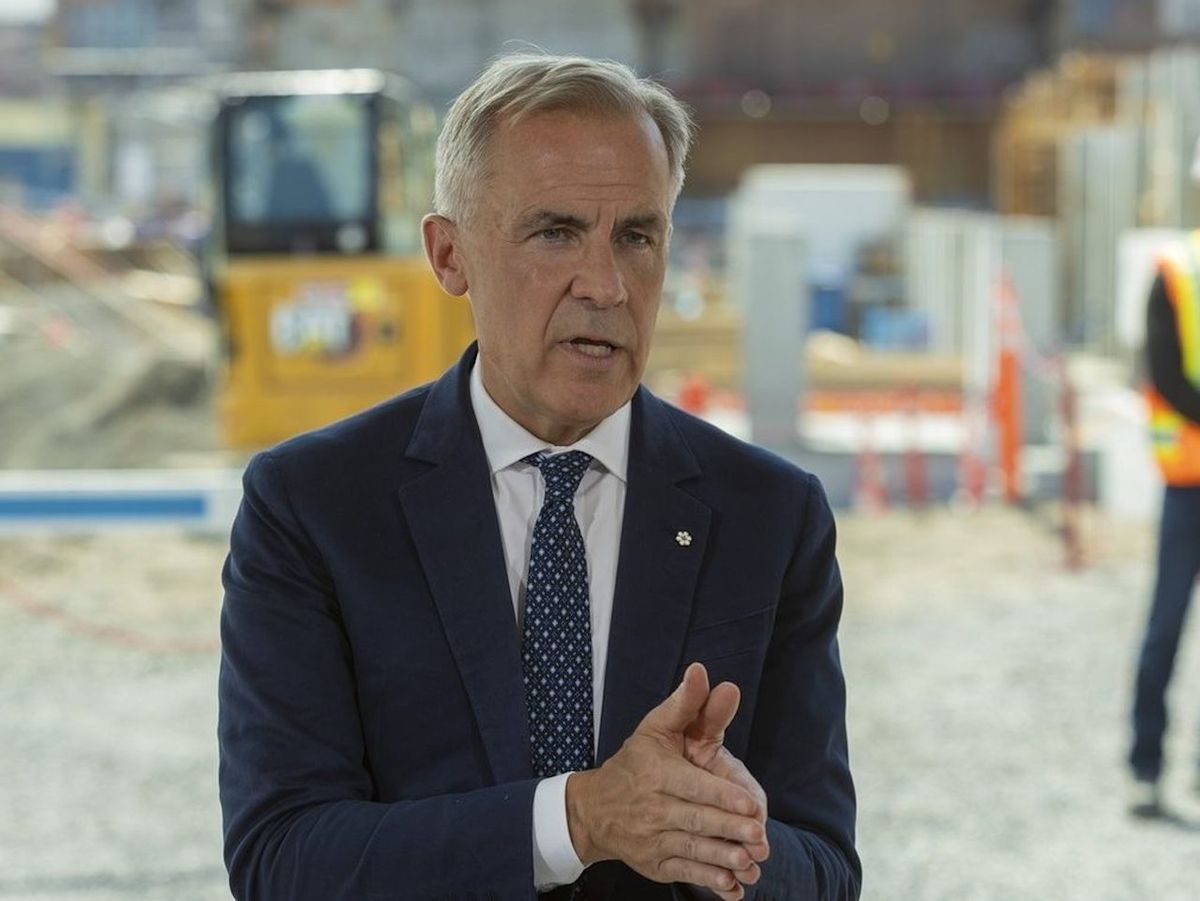
In response to the positive economic news, Prime Minister Mark Carney posted on X that: "We have the right plan to build Canada strong. We are on track and it is working", citing a headline in the Financial Post reading, "Canada's economy posts fastest growth in three years, Statistics Canada also makes upward revision to first-quarter GDP."
Nothing unusual there. Governments of all stripes take credit for good economic news while blaming factors beyond their control when the numbers are bad.
But one positive snapshot of the state of our economy does not tell us the whole story.
Early indications are, for example, that July's economic numbers were flat, with continuing uncertainty because of the collapse of trade negotiations between the Carney government and U.S. President Donald Trump's White House.
But the longer-term bad news story, as Carney himself said on Feb. 25, 2025 while running for the Liberal leadership is that: "Our economy was weak before we got to the point of these threats from President Trump."
Indeed, from 2015 to 2024, the era of the Justin Trudeau Liberal government that preceded Carney, Canada's real (inflation-adjusted) GDP per capita — a widely accepted measure of our standard of living — was second-worst among the 38 industrialized nations belonging to the Organization for Economic Co-operation and Development.
At 1.4% economic growth we outpaced Luxembourg at -0.9%, but fell far short of the OECD average of 13.6% growth, and the G7 average of 12.6%.
While declining GDP per capita has been a long-standing issue preceding the Trudeau era, the Liberals themselves have pointed to the enormity of the problem, which isn't going to be fixed by one quarter of positive economic news.
In her 2022 budget speech, then finance minister Chrystia Freeland linked it to Canada's low productivity rates, describing it as the "Achilles heel" of the Canadian economy.
Low productivity, which Carolyn Rogers, senior deputy governor of the Bank of Canada, described as a "break the glass" emergency in 2024, does not mean Canadian workers are lazy compared to other countries.
It means they aren't being give access to the education, training and technologies they need to work more efficiently, because of a lack of business investment in Canada.
"Most Canadian businesses have not invested at the same rate as their U.S. counterparts," Freeland's budget said.
"Unless this changes, the Organization for Economic Co-operation and Development projects Canada will have the lowest per-capita GDP growth among its member countries" from 2020 to 2060.
Despite acknowledging this, the Trudeau Liberals pursued policies that made the situation worse, two of which — runaway immigration and profligate public spending — were cited by Carney, when he described the Canadian economy as weak, even before Trump's tariff hits.
Carney is now attempting to undo the economic damage the Trudeau government caused by diversifying the Canadian economy beyond our historical reliance on the U.S., as well as investing in major infrastructure projects in which government funding is intended to, as he puts it, "catalyze" private sector investment.
As part of that effort, Carney is holding what he describes as a first-ever "Canada Investment Summit" in Toronto on Sept. 14-15, convening "the world's largest investors, including top CEOs, entrepreneurs, and prominent global business leaders" to "attract new investment into Canada to advance Canada's nation-building projects, create new career opportunities for Canadians, and grow our economy."
All good, but keep in mind that it will take a long time to turn around the economic Titanic the Trudeau government left us with.
EDITORIAL: Hold Canada's fire on energy exports
LILLEY: Trade war theatre helps Carney, Ford and Trump but hurts everyone else
Related Stories
 Economy
Canada’s GDP rises 3.3% in 2nd quarter, but US trade war could halt that momentum
21 hours ago
 Economy
Disaster of Trump’s war in Iran laid bare six months on: Thousands dead, economic chaos and a region in flames
22 hours ago
 Economy
Canada’s economy grew a strong 3.3% annualized in second quarter, as first quarter revised higher
1 day ago
 Economy
Canada's economy posts fastest growth in three years
1 day ago
 Economy
GDP results for June and second quarter to be released Friday by StatCan
1 day ago
 Economy
How 50% U.S. tariffs will impact the average British Columbian
4 days ago
 Economy
New Fed chair faces critical test at Jackson Hole as inflation fears mount
5 days ago
 Economy
Asian shares mostly decline as bond market pressure mounts
5 days ago