
How 50% U.S. tariffs will impact the average British Columbian
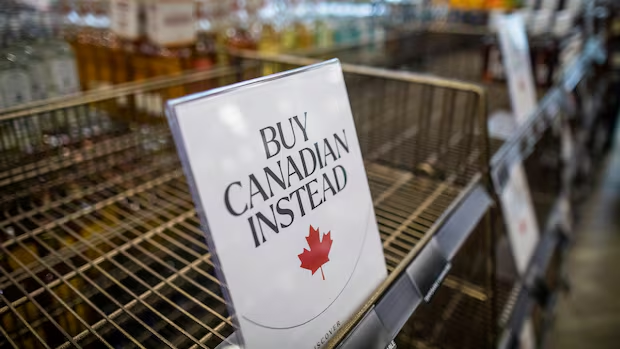
How 50% U.S. tariffs will impact the average British Columbian
Job losses likely in targeted sectors, as B.C. is among most exposed provinces to incoming duties
As the U.S.-Canada trade war ramps up in the wake of 50 per cent U.S. tariffs on certain Canadian goods, questions remain about how British Columbians will be impacted by the new duties.
B.C. is among the provinces most exposed to the new tariffs, as the newly-tariffed items represent more than 13 per cent of the province's total exports to the U.S., a rate higher than any other province.
The federal government is set to announce retaliatory tariffs starting Sept. 8, as well as support for targeted industries and workers, on Tuesday.
Bryan Yu, chief economist at Central 1 Credit Union said that while the average British Columbian is unlikely to see immediate impacts at the grocery store due to the tariffs, Canadian counter-tariffs will likely make their presence felt when residents buy goods in targeted sectors.
Yu said industries that will now face steep duties exporting to the U.S. — like plastics, appliances, pulp and paper — will likely lose workers and revenue.
If Canadian counter-tariffs target the same industries in the U.S., Yu said the average British Columbian could face price hikes on appliances and paper products, for instance.
"If they really need a certain appliance from the U.S., they might have to pay more, or they're going to look elsewhere," he said.
Yu said the tariffs will ultimately have an inflationary effect on the Canadian economy as a whole.
"What we're seeing right now is that the Canadian economy has shown a bit of resilience coming into this. We've seen relatively steady growth in the last couple of months and quarter," he said.
"That's, at least, a little bit of a sign that the economy is still kind of moving along — but it's going to hit a rough patch."
New U.S. tariffs an 'economic attack' on B.C., Canada: Eby
Ryan Mitton, the B.C. director of legislative affairs for the Canadian Federation of Independent Businesses, said that while job losses may only be felt in tariffed sectors like forestry, they will have a downstream effect.
"It's also the general store, the pharmacy, the equipment contractor that helps serve those workers and provides a valuable part of that community," Mitton said.
"When one mill closes, we feel the impact across the entire town."
Mitton said that any government support should be broad-based, and not look to unduly exclude businesses based on employee count.
Douglas King, a lawyer at the Together Against Poverty Society, said low-income Canadians shouldn't be forgotten as governments announce support measures.
"When these kind of economic crises happen, the government tends to go into austerity mode and freeze things like benefits," he said.
"So whereas prices and inflation increase, those benefits that support our most vulnerable Canadians don't go up with them."
Pandemic-like response needed: minister
B.C. Jobs Minister Brenda Bailey said the government was able to step up with emergency measures to keep businesses afloat at the start of the COVID-19 pandemic, and it would look to similar measures that support industries and workers.
She said the province would look to "fill in any gaps" in support once the federal government announces details on its grants and loans for businesses.
Economists have estimated up to 11,000 job losses in B.C. alone due to the tariffs. Bailey said that while job cuts were expected, it's hard to know what the exact numbers would be yet.
Tens of thousands of jobs, half a point off GDP: Canada-U.S. trade war by the numbers
Ottawa set to reveal tariff counter-measures as Trump, Ford trade insults
She touted $88 billion in proposed major project investments in B.C., and ongoing efforts to diversify trade beyond the U.S., as reasons for hope.
"Trade diversification is how we get out of the circumstance of being reliant on the U.S., and that's what we're going to continue doing," she said.
With files from Bismah Mughal and The Early Edition
Related Stories
 Economy
‘Clear and present danger’: fuel prices could rise by 30c a litre across Australia under IMF scenario
1 day ago
 Economy
IMF warns global economy ‘could soon test the limits of resilience’
1 day ago
 Economy
Nobel memorial prize in economics awarded to Robert E. Hall and Michael Woodford
1 day ago
 Economy
Nobel Prize for economics awarded to 2 U.S. academics
1 day ago
 Economy
ELDER: The anti
3 days ago
 Economy
Moneycontrol Pro Weekender | Artificial intelligence, real inflation
4 days ago
 Economy
Mayawati slams feel
4 days ago
 Economy
Could the UK really rejoin the EU?
6 days ago