
Government pushes back against AI data centres ‘naysayers’

The Government continues to push back against growing criticism over its proposed artificial intelligence data centres, with Tertiary Education and Skills Training Minister Professor Prakash Persad accusing opponents of being “naysayers” who complain regardless of the outcome, while Penal/Debe Regional Corporation Chairman Gowtam Maharaj sought to reassure the public that any risks associated with the project would be properly managed.
The comments come amid increasing public debate following last week’s signing of three Memoranda of Understanding (MOUs) between the Government and United States organisations.
Two of the agreements seek to establish large-scale artificial intelligence infrastructure and data centres in Trinidad and Tobago, while a third focuses on restarting steel production at Point Lisas using strategic metals.
Under one MOU, Ernst & Young LLP intends to partner with third parties to develop a 300-megawatt data centre, while a second agreement with Hummingbird AI Holdings LLC proposes a 150-megawatt AI infrastructure and data centre, with the potential to expand to 500 megawatts.
Initial commercial operations are targeted for the first quarter of 2028, subject to due diligence, regulatory approvals and further negotiations.
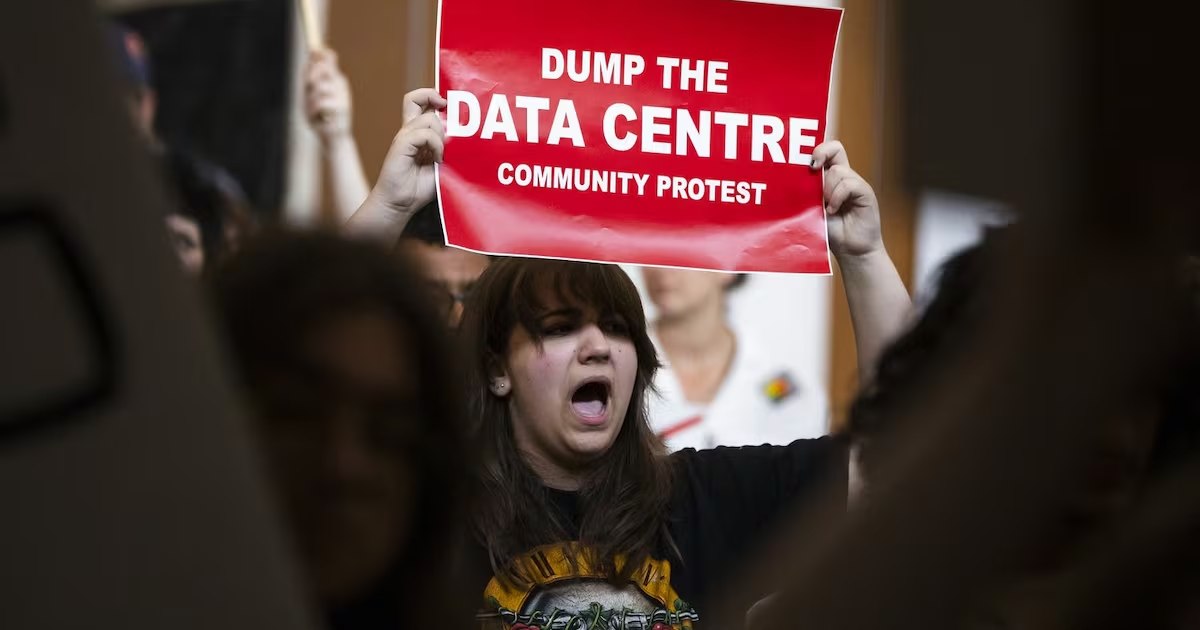
The projects have prompted concern from some members of the public and environmental advocates over their potential impact on water resources, energy demand and surrounding communities.
A petition has also begun circulating online calling for Government to suspend approvals pending further review.
Responding to questions from reporters yesterday following the launch of ICT short courses at the MIC-IT campus in Clarke Road, Penal, Persad dismissed suggestions that there was cause for alarm, saying many of the concerns were premature.
“Well, firstly, as you said, nothing has been defined as that. So I think maybe some of these issues are a bit premature.”
The Minister then took aim at critics questioning the project.
“They’re always the naysayers. They’ll complain there are no jobs, and if you do something that creates jobs, they’ll complain about that also.”
Persad argued that the proposed facilities could deliver significant economic benefits.
He added that the projects could also generate foreign exchange.
Addressing environmental concerns, Persad stressed that no project would proceed without complying with all statutory requirements.
“Before you do any large construction project, you need to get the environment reclaimed. You need to get the CEC certificate. So that is going to happen.”
He maintained that the country’s regulatory framework would ensure the projects are properly scrutinised.
Asked about the petition calling for approvals to be suspended, Persad declined to comment further.
“I think the Minister of Public Utilities addressed that concern adequately.”
His remarks follow assurances from Public Utilities Minister Barry Padarath over the weekend that the proposed AI data centres would be developed within a Special Economic Zone in Debe, with short-, medium- and long-term plans already in place to meet their water requirements.
Padarath said the Government intends to construct man-made ponds within the economic zone to satisfy the projects’ initial water demand before transitioning to proposed desalination plants in Moruga/Tableland and Mayaro.
He maintained that the developments will not affect water supplies to residential or commercial customers, saying multiple ministries have been coordinating the initiative from the outset.
Meanwhile, Maharaj also welcomed the proposed investment, saying South Trinidad stands to benefit from much-needed employment opportunities.
“We are very excited. Any activity that brings jobs to our people, we are very, very much appreciative and in acceptance of it because regions here and neighbouring regions, people are in need of jobs.”
Responding to concerns over the safety of the proposed facilities, Maharaj said the objective of modern industry is to manage risk, not eliminate it entirely.
He expressed confidence that the relevant authorities would ensure the necessary safeguards are implemented before any construction begins.
A data centre is a centralised physical facility that houses thousands of networked computers, servers, and data storage systems.
According to the International Energy Agency, it acts as the backbone of the internet, storing and processing the digital information required for cloud computing, video streaming, and modern digital applications. Data centres consume immense amounts of power primarily due to high-density computing hardware (like AI-focused GPUs) and the massive cooling infrastructure required to prevent them from overheating.
High-density computer chips generate intense heat. To maintain optimal performance and prevent equipment failure, facilities require massive, continuous cooling systems. Cooling can account for up to half of a data centre’s total energy use.
Related Stories
 AI News
Bill Gross bets AI can help mass
1 day ago
 AI News
Nigeria records 93% rise in AI micro
1 day ago
 AI News
The Italian gelato maker using AI to invent new flavours
1 day ago
 AI News
Closing the Gap Between Agentic CX Pilots and Production
1 day ago
 AI News
New Brunswick data centre debate highlights cross
1 day ago
 AI News
How to Structure an AI Agent Referral Fee Agreement Between Startups
1 day ago
 AI News
No, AI didn’t delete a Swedish reality TV series
1 day ago
 AI News
There is no AI in Armageddon. Artificial intelligence is a tool, not an apocalypse
1 day ago