
Government to help 20,000 firms adopt AI technology
Government to help 20,000 firms adopt AI technology
The Ministry of Economic Affairs yesterday said it expects to help more than 20,000 companies adopt artificial intelligence (AI) technology by 2028, up from its previous target of 14,000 set in October last year when an industrial competitiveness task force was launched.
The ministry has helped 9,249 companies adopt AI since October last year, 93 percent of which are small or medium-sized enterprises, Industrial Development Administration Director-General Chiou Chyou-huey (邱求慧) told a news conference in Taipei.
Service-sector firms accounted for 60 percent of the total, led by the wholesale, retail and food service segments, while manufacturers made up the remaining 40 percent, mainly in the metal products and machinery sectors, Chiou said.
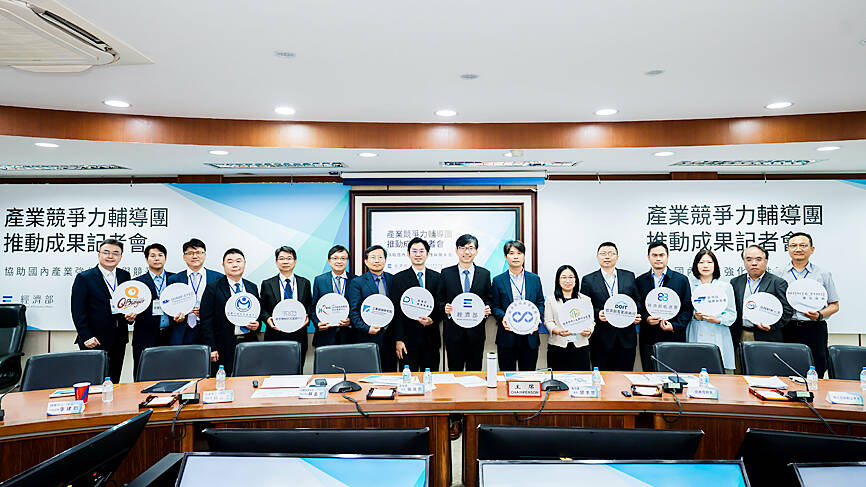
Industrial Development Administration officials and industrial representatives attend a news conference at the Ministry of Economic Affairs in Taipei yesterday.
Photo courtesy of the Industrial Development Administration
Many small and medium-sized enterprises and traditional industries have struggled to adopt AI due to high costs and technical barriers, he said.
The ministry’s program helps firms undergo the AI transformation through a three-stage process, Chiou said.
The first stage provides diagnostic consulting to assess companies’ operational needs, with the government subsidizing NT$190,000 (US$5,904) of the cost and participating companies contributing NT$10,000, he said.
The second stage provides a grant of NT$100,000 for AI hardware and software deployment, along with NT$120,000 in training vouchers, he said.
The third stage offers research-and-development grants of up to NT$5 million per project, or NT$40 million for consortium projects, to help companies deepen AI adoption, he added.
Companies participating in the program have so far generated about NT$32.3 billion in output value by improving production processes, reducing defect rates and enhancing research and development efficiency, Chiou said.
AI adoption among participating companies has risen to 38.5 percent, and the ministry aims to increase that figure to more than 50 percent and generate NT$50 billion in output value by 2028, he said.
Asked whether AI adoption could lead to massive layoffs, Chiou said the experience of participating companies suggests otherwise, as many traditional industries continue facing labor shortages.
AI is mainly being used to replace repetitive tasks, and those positions are difficult to fill, rather than replacing workers, he said, adding that companies adopting AI with the expectation of cutting jobs would “regret it.”
The government encourages businesses to use AI to boost productivity, preserve experienced workers’ knowledge and increase employees’ value, rather than reduce headcounts, he added.
For yacht builder Kha Shing Enterprise Co (嘉信遊艇), the retirement of veteran workers has made knowledge transfer a key challenge for the 50-year-old company, but the adoption of AI enables young workers to quickly access information for design, materials management and pricing, while reducing rework and quotation errors, company president Howard Gung (龔俊豪) said.
Related Stories
 AI News
LTM inaugurates global delivery and AI competency center in Kolkata
54 minutes ago
 AI News
Scura, Wigfield, Heyer, Cammarota & Gonzalez Highlights Responsible Use of Artificial Intelligence in NJ Legal Practice
1 hour ago
 AI News
Google AI Week gives Killeen businesses hands
1 hour ago
 AI News
Artificial Intelligence Stocks To Consider
1 hour ago
 AI News
AI’s worst disasters will arrive unannounced | Letters
2 hours ago
 AI News
Anthropic Holds Talks With AI Chip Startup MatX To Accelerate Chip Development
3 hours ago
 AI News
Anthropic warns infostealer malware is hijacking Claude sessions to drain usage
3 hours ago
 AI News
Caterpillar is bringing to AI deployment what it learned from automating mining
3 hours ago