
Groq’s $350M Round Resets Its Valuation at $3.5B
In a San Francisco-dated release on August 17, 2026, Groq’s official financing announcement set out a $350 million Series A led by Disruptive, with planned participation from Nvidia, at a $3.5 billion valuation. The transaction remains subject to customary closing conditions, so Nvidia’s prospective investment should not yet be treated as completed.
Bloomberg Law’s independent account placed the new valuation at roughly half Groq’s September 2025 peak of $6.9 billion and tied the reset to the company left after Nvidia licensed its technology and hired much of its senior talent. The comparison captures a sharp decline in headline value, but it also spans two materially different versions of Groq.
The $3.5 billion figure values a different Groq
The earlier valuation covered an integrated chip-and-cloud company. Groq’s September 2025 financing notice recorded a $750 million raise at a $6.9 billion post-money valuation and identified both its proprietary Language Processing Unit, or LPU, and GroqCloud as central assets.
Measured directly against that peak, the new valuation is 49.3% lower. That arithmetic does not mean investors repriced an unchanged business: technology rights, personnel and strategic focus moved after the Nvidia transaction. It does mean the remaining cloud-centered operation now carries substantially less equity value than the combined chip-and-cloud challenger did eleven months earlier.
TechCrunch’s report on the round described Groq’s position that this is a valuation for the post-licensing company rather than a conventional down round. The distinction explains why the financing has been labeled Series A despite Groq’s earlier late-stage rounds, but it does not erase the comparison with the former peak.
The investor relationships also illustrate the change. Disruptive remains the lead backer, while its chief executive, Alex Davis, is Groq’s executive chairman. Nvidia has moved from being the incumbent challenged by Groq’s proprietary hardware to being a technology licensee, infrastructure supplier, commercial partner and prospective shareholder.
The Nvidia agreement split technology from cloud operations
The business reset began on December 24, 2025. Groq’s licensing-agreement notice states that Nvidia received a non-exclusive license to its inference technology, while founder Jonathan Ross, president Sunny Madra and other team members agreed to join Nvidia to develop and scale the licensed work.
The arrangement was not structured as an acquisition of the entire company. Groq remained independent, and GroqCloud continued operating, leaving a viable business outside Nvidia even as important technology and senior personnel moved into the chipmaker’s organization.
That surviving business has been repositioned as a neocloud: a specialized operator that deploys computing infrastructure and sells access to AI capacity. Groq’s experience operating LPU systems remains part of its technical foundation, but the current expansion is no longer primarily a bet that its own accelerators will displace Nvidia hardware.
The funding is intended to finance a larger compute footprint
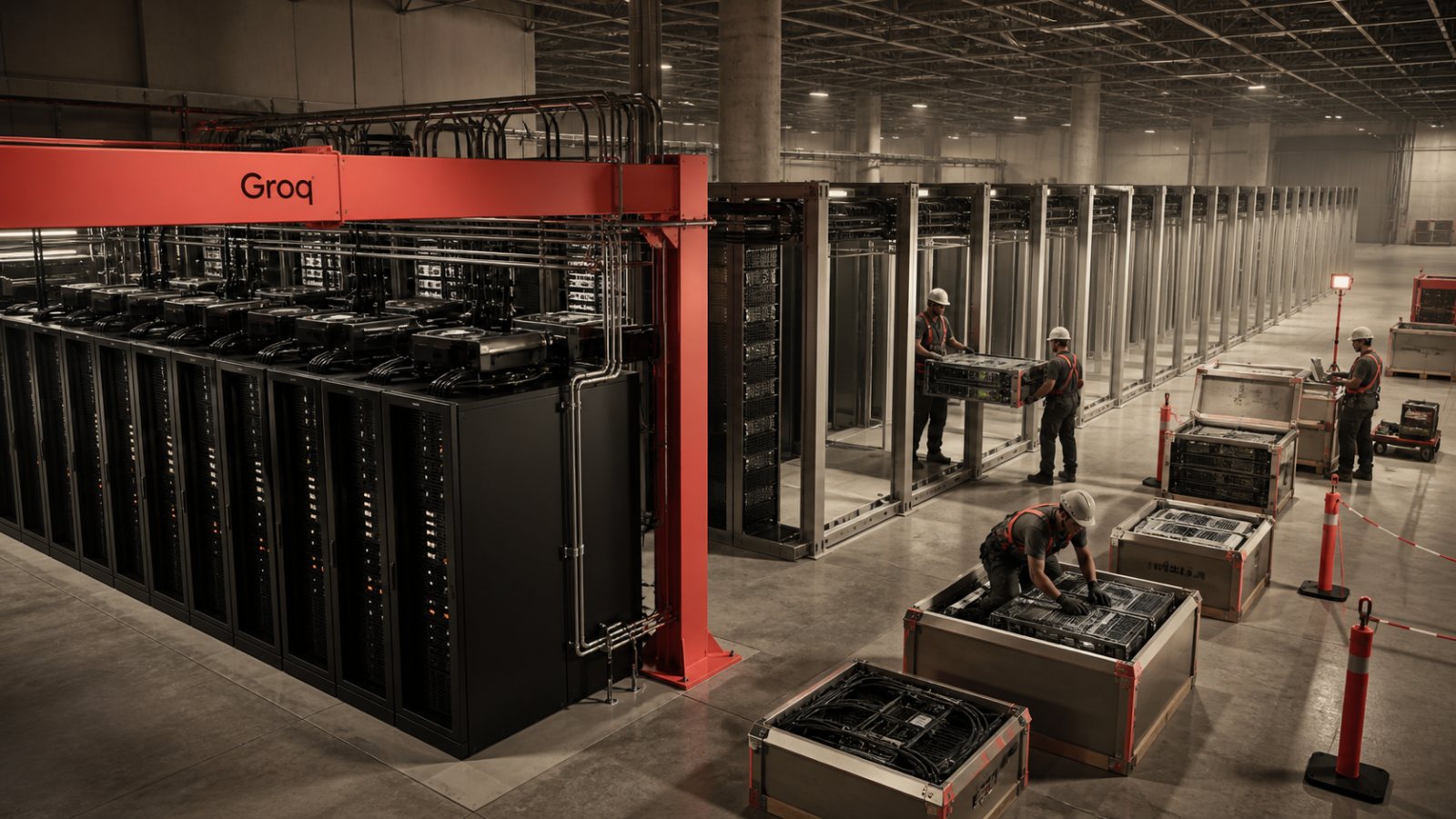
The capital requirement follows directly from the new model. Groq operates 13 data centers across North America, Europe, the Middle East and Asia-Pacific, with a stated footprint of 54 megawatts and a target above 200 megawatts during 2027. Its latest capital is intended to support medium and larger clusters of Nvidia accelerated computing for training and inference.
The target implies adding more than 146 megawatts of capacity based on the disclosed starting point. Groq also counts the Series A alongside $650 million raised in June, taking its recent financing to $1 billion, and identifies more than six million developers among the users of its infrastructure.
Those figures describe the scale of the plan, not its economics. Data-center capacity requires spending before all installed systems generate revenue, while returns depend on utilization, electricity, financing costs, hardware life and customer pricing. Public materials for the round do not disclose Groq’s revenue, margins, debt structure, customer concentration or how much of the planned capacity is supported by contracted demand.
The valuation now rests on cloud execution
Groq’s central investment case has therefore changed. The old company was valued partly on whether a proprietary accelerator could win inference workloads from Nvidia; the reorganized company must demonstrate that it can operate a durable cloud business inside Nvidia’s ecosystem while expanding its physical footprint severalfold.
The $3.5 billion valuation reflects that narrower proposition. It assigns meaningful value to Groq’s infrastructure, operating experience and customer base, but far less than investors assigned to the integrated company before the licensing transaction.
As of August 24, the known position is a $350 million Series A led by Disruptive, planned Nvidia participation and a 2027 capacity target above 200 megawatts. The next material evidence will be completion of the financing, confirmation of Nvidia’s investment, deployment beyond the existing 54 megawatts and operating data showing whether demand can support the buildout.
Related Stories
 Technology
Two Malaysian Startups Land on Forbes Asia's 100 to Watch List
3 hours ago
 Technology
Africa must harness technology to fix healthcare crisis
3 hours ago
 Technology
Carpenter Technology CEO sells 109,283 shares, retains 466,697 shares
4 hours ago
 Technology
Perplexity’s on
4 hours ago
 Technology
French Entrepreneur: Saudi Arabia is a Launchpad for Technology into Global Markets
5 hours ago
 Technology
Apollo chief economist says ‘China Shock 2.0 is here’ and it’s bad news for American companies
5 hours ago
 Technology
AI
7 hours ago
 Technology
NIST Researchers Supersize Quantum Technology to Help Detect Faint Photons
7 hours ago