
Here’s what First Nations stakeholders want from Vancouver’s next mayor and council
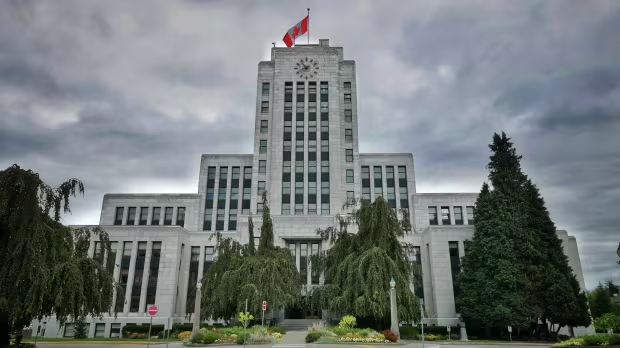
Here’s what First Nations stakeholders want from Vancouver’s next mayor and council
CBC News asked Vancouver mayoral candidates how they plan to support Indigenous people
Voters across B.C. will head to the polls on Oct. 17 to elect new municipal leaders, the people residents think can best handle the issues that matter most to them.
For some, that means housing affordability, for others, community safety is top of mind. First Nations stakeholders have their own set of priorities for whoever is elected this fall.
CBC News spoke to them about what commitments they're looking for, and asked Vancouver's mayoral candidates how they plan to support Indigenous people.
At least 15,000 Indigenous people live in Vancouver, according to 2021 census data from Statistics Canada, and according to the City of Vancouver's website, Vancouver has the second largest urban Indigenous population in Canada.
Chairperson Sxwíxwtn Wilson Williams of the Squamish Nation said he wants to ensure the priorities of his nation are a part of the future of Vancouver for decades to come.
“We need to keep hammering down on relationships and meaningful inclusivity in regards to their [the city] vision,” said Williams. “So it does matter who gets in and elected.”
Squamish, along with their co-partners at the MST Development Corporation — made up of the Musqueam, Squamish and Tsleil-Waututh Nations whose home territories reside in and around Vancouver — are looking to further develop parcels of the city that have long historical significance to the three nations, and want to see support for the Jericho and Heather Lands development projects.
The Squamish Nation recently finished phase one of the Sen̓áḵw project at Kitsilano Point.
'Welcome to Sen̓áḵw': A sneak peek inside Canada's largest Indigenous-led housing development
The area was a summer fishing village for the Squamish people, before they were forcibly removed by 1913, according to the Sen̓áḵw website.
“People are understanding that, ‘Wow Squamish lived here,’ and there's a history here and a lot of people are intrigued,” said Williams.
The Jericho Lands project is proposed to be built over the next three decades covering 36-hectare of land south of West 4th Avenue between Discovery and Highbury streets.
Several new towers would be built, including 13,000 homes across various income levels, a promise of about eight hectares of park space, about four hectares allocated to sports fields and playgrounds, and approximately 360 daycare spaces.
The project has received backlash from area residents called the Jericho Coalition, a grassroots advocacy group in favour of scaling down the development.
Williams said the development has had real challenges from residents fearing change, and accusations of it being an "economic grab” for MST.
The Jericho Lands give First Nations a say in Vancouver's future. But some say the development is too large
“It's very important that we maintain some momentum that we've created with the City of Vancouver and strengthen the government-to-government relationship regardless of what the election outcomes are,” said Williams.
The second large-scale project within the city is the Heather Lands development of 8.5 hectares of land west of Queen Elizabeth Park, which aims to build 2,600 homes below market for middle-income earners.
“I also want this to be a priority for the City of Vancouver, because we need housing,” said Whonoak Dennis Thomas, elected councillor for the Tsleil-Waututh Nation.
2,600 new homes to be sold at 60% market value in Heather Lands project
Thomas said the Tsleil-Waututh Nation has had a good working relationship with the city and wants to see continued support for the Jericho and Heather Lands projects from the incoming mayor and council.
“These projects are not only meant for the three nations, we're the rightful landowner again, but we are such good hosts that we want all Vancouverites to have an affordable place to live, work, play and learn,” he said.
CBC News reached out to the Musqueam Nation for an interview but did not hear back by deadline.
Tashia Kootenayoo, CEO of the Metro Vancouver Aboriginal Executive Council (MVAEC) and the Metro Vancouver Indigenous Service Society, said city council needs to be actively involved in conversations with police and service providers around missing and murdered Indigenous women, girls and two-spirit people.
“Murdered and missing Indigenous women, girls and children remains a huge community safety issue,” said Kootenayoo, a member of the Alexis Nakota Sioux Nation, about 69 kilometers northwest of Edmonton. “It is obviously wider than just the city of Vancouver, however there is a concentrated epidemic happening on the Downtown Eastside.”
According to the City of Vancouver's website, the city is working on creating a city-wide response protocol for when a MMIWG2+ person goes missing from Vancouver. It is also working on educating city staff and piloting a self-evaluation tool for departments to measure progress on this issue.
Cultural programs for urban Indigenous girls can help address MMIWG crisis, advocates say
Kootenayoo also wants to see increased funding for Indigenous services provided in Vancouver. She said funding has stayed “flat and stagnant” while the demand for their services has increased.
“Maintaining funding and not being able to prioritize growing it, you're asking them to do more with less,” said Kootenayoo.
What mayoral candidates are promising
CBC News asked mayoral candidates to respond to the same five questions around supporting First Nations, Indigenous individuals and organizations in Vancouver.
These responses have been edited for length and clarity.
1. As mayor, how will you support urban Indigenous people?
Kareem Allam, Vancouver Liberals: Urban Indigenous are overrepresented in homelessness, child welfare, the justice system and major gaps in culturally safe services. As mayor, I will:
Muhammad Ahmad, Bright Future Vancouver: Urban Indigenous people need to have a real voice in the decisions that affect their lives. That means being involved from the beginning, not being asked for feedback after decisions have already been made.
As mayor, I would work directly with MVAEC and urban Indigenous organizations to improve access to housing, culturally safe community services, youth and family supports, healing and wellness programs, and Indigenous cultural spaces.
I would also set up a regular process with urban Indigenous leadership to bring their priorities directly to the mayor's office and track what the city is actually doing. I want Indigenous communities helping shape city policy.
Colleen Hardwick, TEAM for a Livable Vancouver: We will support urban Indigenous people within the city’s jurisdiction and by focusing on core city responsibilities, while working with the provincial and federal governments for more housing and services.
Pete Fry, Green Party of Vancouver: Vancouver has one of the largest urban Indigenous populations in the country, yet too many face systemic discrimination and disproportionate barriers in housing, health care, employment, community safety, and access to cultural spaces. As mayor, my priorities would be:
Rebecca Bligh, Vote Vancouver: As mayor, I will engage Vancouver's urban Indigenous community and Vancouver's three host First Nations distinctly, because these are different relationships with different obligations.
For the urban Indigenous community, during development of city-owned and faith-based land, we will work directly with urban Indigenous organizations, including MVAEC member agencies, so affordable housing reflects community priorities. We recognize the overrepresentation of Indigenous people, and Indigenous women and girls specifically, among those experiencing homelessness in the Downtown Eastside, and will prioritize resourcing that addresses this directly. We will also invest in urban Indigenous economic development, procurement access, and employment pathways alongside housing and health responses; the city's approach cannot be built on crisis response alone.
This work also has a provincial dimension. I will engage the First Nations Leadership Council, which speaks for First Nations across the province, alongside other First Nations such as Tahltan Nation and Nisga'a Nation, because urban Indigenous well-being is connected to the strength of home nation relationships, not city services alone. Culturally specific programming and housing solutions need to reflect that diversity of origin, rather than treat urban Indigenous Vancouverites as one undifferentiated community.
Ken Sim (incumbent), ABC Vancouver: Vancouver is home to a large and diverse urban Indigenous community, and as mayor, I want to ensure people feel supported, heard and connected to opportunity in our city.
We’ve made meaningful progress. This year, Vancouver became the first municipality in Canada to adopt a formal Urban Indigenous Engagement Framework, developed with input from more than 200 urban Indigenous participants. We are also bringing Indigenous voices directly into decisions on issues like housing and neighbourhood planning, including dedicated engagement with urban Indigenous residents as part of our work in the Downtown Eastside.
My focus is on continuing to build strong relationships and delivering practical results on the issues that matter in people’s daily lives, including housing, public safety, health and wellness, economic opportunity and access to services.
Reconciliation is an ongoing responsibility, and we will continue to keep that work moving forward.
2. MVAEC noted that there has been no recent increase in city funding for their partners. Would you review the funding allocated to Indigenous organizations?
Kareem Allam, Vancouver Liberals: Yes, and I will advocate at the Metro Vancouver table to ensure neighbouring municipalities are doing the same. The demand for services is going up and the dollars being spent are being eaten up by inflation and outcomes are being negatively impacted. Funding should be indexed to inflation to ensure new progress in breaking down systemic barriers aren’t regressing.
Muhammad Ahmad, Bright Future Vancouver: Absolutely.
I would ask city staff to work directly with MVAEC and Indigenous service organizations to review Indigenous funding early in our first term. That should include looking at inflation, population growth, demand for services and the actual cost of providing culturally appropriate support.
If organizations are being asked to do more while their core funding stays the same, city hall needs to take a serious look at that.
Reconciliation must show in the budget as well.
Colleen Hardwick, TEAM for a Livable Vancouver: We will review funding for non-profits to make sure the city is getting value for money and that we are focused on core responsibilities.
Pete Fry, Green Party of Vancouver: Yes. I would review current funding levels for Indigenous organizations and work with Indigenous partners and the city’s Urban Indigenous People’s Advisory Committee (where I served as a council liaison) to ensure city investments reflect community needs and priorities.
Rebecca Bligh, Vote Vancouver: We commit to a public review of city funding allocated to Indigenous organizations within the first year of the term, measured against the Vancouver Test, with results reported back to MVAEC member agencies directly. Women Transforming Cities' research on the TRC calls to action found that lack of dedicated resourcing and lack of training are the two barriers B.C. municipalities report most often in advancing this work. Our review will name both barriers explicitly rather than treating this as a line item to revisit only when budgets allow.
Ken Sim (incumbent), ABC Vancouver: City council set a clear path this year by committing to fiscal responsibility and stability by delivering a zero per cent property tax increase, while maintaining the current level of community grants.
The mayor has committed to pursuing another zero per cent property tax increase next year, where funding allocations and envelopes for granting partners will be decided on by council.
3. Do you support MST Development Corporation's Jericho Lands and Heather Lands developments?
Kareem Allam, Vancouver Liberals: Yes. I consulted on this project to MST and may be conflicted from being able to vote on the projects.
MST have been a client of my firm in the past, and as mayor I will likely require the advice of the auditor general to ensure I have no overlapping conflicts as some files I have worked on for MST are currently in front of the city.
Muhammad Ahmad, Bright Future Vancouver: Yes. I support the right of the Musqueam, Squamish and Tsleil-Waututh Nations to pursue economic development and build long-term prosperity for their communities.
The Jericho Lands and Heather Lands are also an opportunity to show what Indigenous-led development can look like in Vancouver, bringing together housing, community infrastructure, sustainability, cultural recognition and economic opportunity.
As mayor, I would want the city to be a constructive partner by coordinating infrastructure, reducing unnecessary delays and working directly with MST leadership throughout the process.
Colleen Hardwick, TEAM for a Livable Vancouver: TEAM supports MSTDC to develop their lands, however, the public has not been satisfied that the Jericho Lands in particular has been planned properly within the local context, so the Jericho Lands will be reconsidered through neighbourhood-based community planning.
Pete Fry, Green Party of Vancouver: Yes I support the developments, and at council I voted in favour of these projects and their subsequent policy amendments.
Rebecca Bligh, Vote Vancouver: Both developments reflect the kind of partnership we want to build on. As a councillor, I supported the Jericho Lands Policy Statement, approved unanimously by council in January 2024. On Heather Lands, I have been one of the more consistently engaged voices on council, including voting in favour of the most recent Heather Lands rezoning while several colleagues abstained, and pressing the province directly on its funding commitments to the project's affordable home ownership targets.
Both developments are a working example of government-to-government partnership at civic scale, the model we want to extend elsewhere in the city.
Ken Sim (incumbent), ABC Vancouver: Yes, we support the MST Development Corporation’s vision for both the Jericho Lands and Heather Lands. These projects represent an important partnership with the Musqueam, Squamish and Tsleil-Waututh Nations, and are meaningful examples of advancing reconciliation through economic self-determination and long-term opportunity.
They are also significant city-building projects for Vancouver. Together, they will deliver thousands of new homes, including rental and social housing, alongside new parks and public spaces, child care, community amenities, shops and services, and new employment opportunities.
These developments give us an opportunity to advance reconciliation while addressing some of Vancouver’s biggest challenges, particularly housing and affordability, and creating complete communities that will benefit Indigenous and non-Indigenous residents for generations.
4. As mayor, how do you plan to work with the Squamish, Tsleil-Waututh and Musqueam Nations?
Kareem Allam, Vancouver Liberals: I have worked with all three nations, have developed decades-long relationships with each of the three nations. I will maintain the city’s UNDRIP task force government-to-government protocols. I also commit to regular joint council meetings with all three nations and regular mayor, spokesperson, chief and chief, meetings.
Muhammad Ahmad, Bright Future Vancouver: Government-to-government. Musqueam, Squamish and Tsleil-Waututh are not simply another group of stakeholders. They are governments and the host nations on whose unceded territories Vancouver is located.
I would continue the city's work implementing UNDRIP, maintain direct council-to-council relationships and make early engagement the standard when decisions involve land, development, infrastructure, environment, culture or other matters affecting the nations.
That relationship also needs to continue through changes in political leadership by bringing reconciliation into city hall.
Colleen Hardwick, TEAM for a Livable Vancouver: We are happy to work cooperatively with local Indigenous governments.
Pete Fry, Green Party of Vancouver: I have built productive relationships with the Squamish, Tsleil-Waututh and Musqueam Nations and look forward to strengthening them through regular personal, government-to-government and council-to-council engagement. Together, we can advance housing, economic development, community safety, climate action and reconciliation in ways that benefit both the host nations and all Vancouver residents.
Rebecca Bligh, Vote Vancouver: I will work with the Musqueam Indian Band, Squamish Nation and Tsleil-Waututh Nation on terms each First Nation has set for itself.
Tsleil-Waututh Nation evaluates projects in its territory against its own stewardship policy. Squamish Nation already has a reconciliation protocol agreement with the City of North Vancouver, built on Squamish principles, including listening and engaging, following the ways of the Squamish, and protecting Squamish rights and title. Musqueam Indian Band has moved from litigation toward negotiated rights recognition agreements with the federal government.
I commit, within the first six months of the term, to opening discussions with each of the three First Nations toward a comparable protocol agreement with the City of Vancouver, built on terms each First Nation defines for itself, not a template the city writes and asks them to sign.
Ken Sim (incumbent), ABC Vancouver: Over the last four years, we have worked hard to build strong, respectful relationships with the Musqueam, Squamish and Tsleil-Waututh Nations, both through our work as governments and through the personal relationships we have built with nation leadership.
Together, we developed Vancouver’s first five-year UNDRIP action plan, strengthened how our governments work together, and advanced major partnerships on projects like the Jericho and Heather Lands.
As mayor, I want to continue building on that foundation. That means regular dialogue, working together on shared priorities, and making sure the nations are partners in the decisions shaping Vancouver’s future. Reconciliation is ultimately about relationships, and I’m proud of the trust we have built and am committed to strengthening it in the years ahead.
5. Is there anything else you would like to share regarding your approach to supporting Indigenous peoples in Vancouver?
Kareem Allam, Vancouver Liberals: Our relationships with Indigenous people is critical to unlocking prosperity, enriching our culture and enhancing the knowledge sharing required to make progress on our biggest challenges.
Muhammad Ahmad, Bright Future Vancouver: I believe Vancouver needs to move from symbolic reconciliation toward reconciliation that people can actually see.
That means looking at housing, land, funding, opportunities for Indigenous businesses to work with the city, cultural spaces, Indigenous languages and visibility, environmental stewardship and how city hall makes decisions.
It also means listening. I will not pretend that I have every answer about what Indigenous communities need. Those answers should come from Indigenous people themselves. My responsibility as mayor would be to make sure there is a genuine place at the table, that commitments have resources behind them and that city hall follows through.
I believe every Vancouverite should be able to belong, build a future and have a government that listens. That starts with respecting the peoples who have called these lands home since long before Vancouver existed.
Colleen Hardwick, TEAM for a Livable Vancouver: [There was no response sent to CBC News for this question.]
Pete Fry, Green Party of Vancouver: I strongly objected to the 2025 leaked memo from the mayor's office and ABC Vancouver proposing the relocation of Indigenous residents of the Downtown Eastside to their "home" communities. Beyond the concerns it raised about legal and human rights and self-determination, I believe the solution lies in good housing, access to health care, and culturally appropriate supports and services where people choose to live.
Rebecca Bligh, Vote Vancouver: [There was no response sent to CBC News for this question.]
Ken Sim (incumbent), ABC Vancouver: I’m proud of the progress we’ve made over the last four years.
We have focused on building genuine relationships, listening and turning those relationships into action. That includes our government-to-government partnership with the Musqueam, Squamish and Tsleil-Waututh Nations, as well as strengthening our engagement with Vancouver’s diverse urban Indigenous community.
There is always more work to do, and we will continue approaching that work with respect, openness and a willingness to listen. I want Vancouver to continue being a city where Indigenous peoples have the opportunity to thrive and help shape our shared future.
Jackie McKay is a Métis journalist working for CBC Indigenous covering B.C., and winner of a 2025 Canadian Screen Award for best local reporter. She was a reporter for CBC North for more than five years spending the majority of her time in Nunavut. McKay has also worked in Whitehorse, Thunder Bay, and Yellowknife.
Related Stories
 Canada
Carney says results from plan will take time
21 minutes ago
 Canada
Hamed Shafia, convicted of murdering sisters and woman, granted absence from prison
21 minutes ago
 Canada
Neighbourhoods in Regina and Saskatoon to lose door-to
21 minutes ago
 Canada
What would a Canada
21 minutes ago
 Canada
Trump claims Denmark agrees to give U.S. ‘permanent control’ over Greenland security
53 minutes ago
 Canada
Trump claims deal struck with Denmark to give U.S. security control over Greenland
53 minutes ago
 Canada
Supreme Court says it invalidated Liberal MP's 1
1 hour ago
 Canada
Windsor, Ont., police now charging people using illegal drugs in public despite prosecution uncertainty
1 hour ago