
Higher education adapts to artificial intelligence
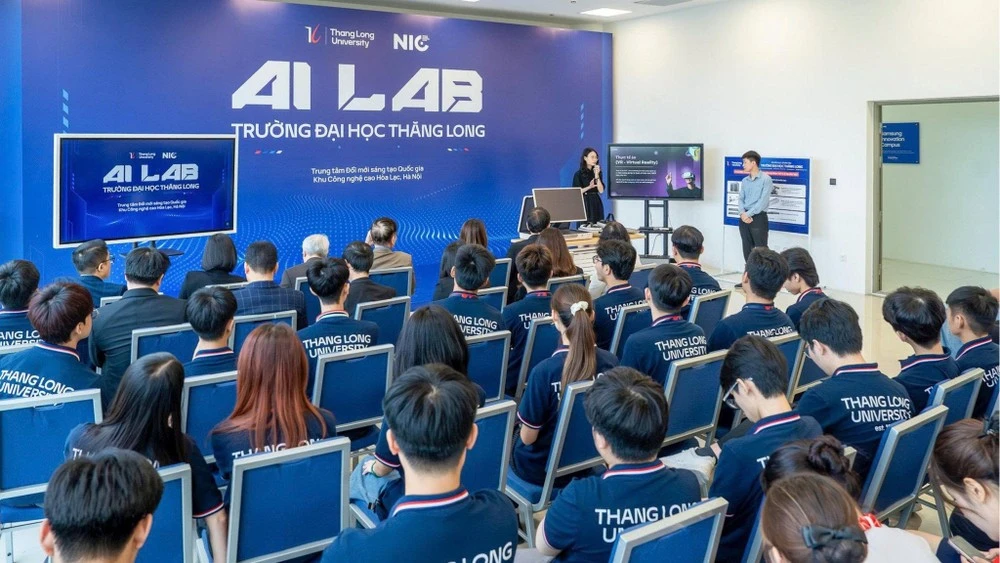
Urgent need to renew and update expected learning outcomes
According to Dr Nguyen Thanh Hung, Head of the Training Department at Ha Noi University of Science and Technology, it is first necessary to renew training programmes towards an interdisciplinary orientation and integrate AI-related content into curricula. In addition to specialised knowledge, today’s labour market requires strong interdisciplinary knowledge, digital skills and AI skills at different levels. Therefore, higher education institutions need to quickly renew and update expected learning outcomes and curricula to provide learners with sufficient knowledge and skills in AI.
Together with curriculum renewal, the application of educational technology and AI in teaching and learning needs to be linked with the renewal of teaching methods, shifting from teaching for memorisation to teaching for discovery and creativity. This transformation requires a shift from the traditional approach to a learner-centred one, encouraging students to actively explore, think critically and develop creative ideas. At the University of Social Sciences and Humanities under Viet Nam National University, Ha Noi, 80% of lecturers have received basic AI training, aiming to improve digital and AI capacity and effectively apply AI in teaching and scientific research.
According to Assoc. Prof. Dr Do Van Hung, Dean of the Faculty of Information Management at the University of Social Sciences and Humanities, universities need to proactively develop governance frameworks and capacity for using AI in scientific research, instead of focusing only on controlling or detecting AI use.
Universities need to issue guidelines on the use of AI in research and scientific publication, clearly defining activities where AI use is permitted, must be disclosed, and is not allowed.
It is necessary to build safe AI systems and platforms that ensure data sovereignty; provide AI capacity training for lecturers, researchers, postgraduate students and doctoral candidates; and develop research databases and controlled Vietnamese-language learning resources.
Basis for universities to gradually renew governance
Dr Le Anh Duc, Head of the Training Management Department at the National Economics University, said AI is not only forming a new field of training but also directly affecting curriculum content, expected learning outcomes, teaching methods, assessment and the professional competency requirements of learners. In this context, integrating AI into higher education should not be understood simply as adding several modules, but should be approached as a process of redesigning training programmes towards developing AI capacity for all students, while integrating AI according to the characteristics of each discipline and providing intensive training for technology-related fields.
In Viet Nam, the requirement to integrate AI into higher education is becoming increasingly urgent, not only under the impact of technological change and the labour market, but also in the context of the national legal and policy system gradually forming a new governance framework for AI, digital transformation and higher education.
Circular No. 54/2026/TT-BGDDT regulating training programmes at higher education levels was issued in the context of curriculum renewal requirements becoming increasingly closely linked with digital capacity, artificial intelligence and labour market needs. This marks an important policy shift, creating a basis for higher education institutions to review their training programmes towards strengthening learners’ adaptability to rapid changes in science, technology and occupations.
Accordingly, AI integration into training programmes should be considered in connection with expected learning outcomes, training content, teaching methods, assessment, lecturer capacity and quality assurance conditions. In addition to equipping students with the capacity to use and work with AI, universities must also uphold principles of ethics, transparency, accountability, data protection and learners’ rights.
According to Deputy Minister of Education and Training Le Quan, in the context of rapid technological development, restructuring training programmes is an important and urgent task. Programmes need to be designed in an open manner, improving learners’ ability to adapt to the labour market. Learners can choose their majors according to their abilities, interests and career orientations, but regardless of the field they study, they need to be equipped with technological capacity.
AI is strongly changing training methods and human resource requirements, so AI should not be taught only as a separate subject, but needs to be integrated into each discipline and each training programme.
Regarding teaching and learning methods, Le Quan said the issue is not to restrict or ban the use of AI in classrooms, but to change the way teaching and learning are organised. The goal of higher education is to train people who know how to use and master technology, possess problem-solving thinking and creativity, rather than merely exploit AI to search for answers.
In addition, AI is creating major changes in the development of learning materials, lesson design and the organisation of learning activities. This requires lecturers to shift from transmitting knowledge to developing learners’ capacity and designing learning activities linked with the expected learning outcomes of each module and training programme.
The Ministry of Education and Training will study the development of indicators to assess the level of AI application at higher education institutions. This will serve as a basis for universities to gradually renew governance, improve operational efficiency, reduce indirect costs and create additional resources for university development.
Related Stories
 AI News
Mainframe shops tap AI for system insights and recommendations
1 hour ago
 AI News
OpenAI Brings Epic Health Records to ChatGPT for Clinicians
2 hours ago
 AI News
Pythian’s AI Model Via Google Gemini Drives ‘Million
2 hours ago
 AI News
The latest AI news we announced in August 2026
2 hours ago
 AI News
Pentagon official overseeing military AI sold millions worth of stock in AI firm
4 hours ago
 AI News
Anthropic Ships Claude Fable 5.1, More Than Doubling Its Predecessor on Key Benchmark
4 hours ago
 AI News
:Claude: Fable 5.1 and Mythos 5.1
5 hours ago
 AI News
OpenAI to launch new model with ‘stronger safeguards’ after hack
5 hours ago