
How Canada used the Indian Act to target Indigenous leaders
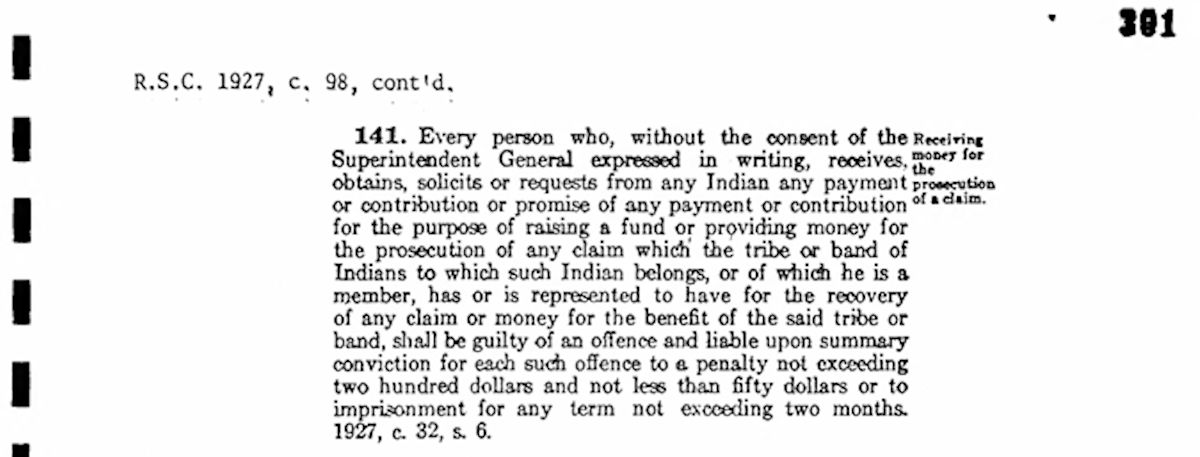
For nearly 25 years, from 1927 to 1951, Section 141 of the Indian Act made it illegal for Indigenous Peoples to fundraise or hire lawyers to pursue land and rights claims against the Canadian government without permission from the Department of Indian Affairs.
Scholars and those who study Canada's settler colonial legal history know about this provision. However, until recently, no one had dug into the archival record to find out how it was actually used.
We looked at government records to find out how Section 141 was understood and enforced. We found that it was more than just a bureaucratic rule; the government also used it to monitor, pressure and try to silence certain leaders.
Our archival research project is the first to study Section 141 systematically. It uncovered internal memos, RCMP investigation reports and correspondence that showed how Canadian officials targeted specific Indigenous leaders who challenged colonial authority.
From 1927 to 1951, Section 141 of the Indian Act created a legal 'blackout' period that essentially barred Indigenous Peoples from pursuing land claims and sovereignty through the courts. (Government of Canada Publications)
Read more: How the Indian Act's 'blackout period' denied Indigenous Peoples their legal rights
A weapon against Indigenous organizing
Framed as protecting Indigenous people from "exploitation by unscrupulous persons" by the Deputy Superintendent of Indian Affairs Duncan Campbell Scott, Section 141 could block claims before they could reach the courts. Internal files reveal that government officials interpreted this power very broadly.
Part of a memo from Deputy Superintendent General of Indian Affairs Duncan Campbell Scott to Prime Minister R.B. Bennett, Sept. 30, 1931. (Library and Archives Canada)
In one September 1927 exchange, the Department of Justice told Indian Affairs the provision applied to every step in preparing a legal claim, including collecting funds and gathering evidence.
All of this required prior government permission. The office of Indian Affairs was also given unchecked discretion to deny consent even if "arbitrary or unreasonable."
This transformed Section 141 from simple red tape into a tool for pre-emptive suppression. Our research shows that its enforcement was strategic. The government targeted specific leaders who it saw as not playing by colonial rules. This included leaders who did not work within the boundaries of the Indian Act or respect the authority of the Crown to control land.
Canadian government officials monitored, investigated and sought to discredit such Indigenous leaders. They often used surveillance and political interference rather than prosecution.
Frederick Loft and the League of Indians of Canada
Onondeyoh Frederick Ogilvie Loft, a Kanienʼkehá:ka leader from Six Nations, founded the League of Indians of Canada in 1919. This was the first pan-Indigenous political organization in Canada advocating for land rights and fair treatment.
In 1931, Loft circulated letters encouraging Mississauga chiefs to contribute to a legal fund. He argued that only a ruling from the Privy Council could force Canada to honour its treaty obligations.
RCMP officers tracked his activities, Indian agents warned chiefs against associating with him and internal correspondence accused Loft of "exploiting the Indians." Formal charges were never laid. The cost of transporting witnesses alone made prosecution impractical. Instead, the investigation itself became the punishment.
In Duncan, British Columbia, John Elliott — a Cowichan leader and member of the Allied Tribes of B.C. — faced direct prosecution. In 1930, Elliott wrote to the Nisga'a Nation encouraging them to collect funds to support a legal claim for Indigenous land rights. His organizing efforts drew the attention of Indian Affairs, which charged him under Section 141.
Elliott was interrogated by the RCMP and did not deny his actions. According to police records, he was "pleased" to be charged under section 141 because he wanted to speak about his community's concerns in court.
However, the case fell apart due to strong community support and technicalities. The magistrate hearing the case ruled that Elliott's confession was inadmissible because he has not been properly read his rights.
The RCMP also had difficulty securing witnesses willing to testify against him. Without a confession or sufficient witness testimony, the prosecutor had to withdraw the charges. Elliott's case shows what happened when Section 141 met community resistance.
In 1934, Albert Edward Thompson, a Peguis leader and founder of the Manitoba Indian Brotherhood, was investigated for supporting an Indigenous political organization uniting communities in Canada and the United States known as the League of Nations of North America Indians.
Officials saw his efforts to unify Indigenous nations and demand better treatment from the Canadian government as a direct challenge to Crown authority.
When Indian Affairs discovered that Thompson was encouraging chiefs to contribute funds to this initiative, officials determined that he had "left himself open to prosecution" under Section 141.
However, they chose not to lay charges. Instead, Indian Affairs expanded RCMP surveillance. They sent Thompson's name to multiple police agencies and sent officers to warn Indigenous leaders not to join his cause.
In the early 1940s, Jules Sioui, a Huron-Wendat leader, organized a national Indigenous meeting in Ottawa under the Comité de Protection des Droits Indiens. Indian Affairs saw his efforts as a threat and investigated whether he was violating Section 141.
Sioui was never charged, likely because his fundraising was not technically prohibited as it wasn't for a court challenge. Still, that didn't stop officials from using Section 141 as a pretext to monitor his activities and discredit him.
Internal memos described the Wendat leader as "not an elected chief" and "not recognized as a spokesman of the Indians" by the government. They also described him as someone who "possesses no Indian traits or characteristics" despite having Indian status.
Part of a memorandum from the Director of Indian Affairs to the Deputy Minister of Justice, Sept. 25, 1943. (Library and Archives Canada)
Government officials sent warnings to chiefs, calling Sioui a radical agitator and illegitimate leader in an attempt to undermine his credibility.
A video about Jules Sioui and the Comité de Protection des Droits Indiens from APTN News.
The lasting impact of Section 141
Section 141 was repealed in 1951, but our research shows that it did more than stall legal claims. The records we uncovered show that officials treated the provision as a flexible tool. They used it as a threat, a means of surveillance or a pretext depending on which community leader they were targeting.
That said, the government records tell only one side of the story. The Indigenous voices in these files are filtered through RCMP reports, Indian Agent correspondence and Department of Justice memos.
We don't know from these records how Loft's and Thompson's communities responded to the surveillance, whether John Elliott's supporters refused to testify out of loyalty or fear, or what Sioui understood about the campaign to discredit him.
While contemporary legal cases have acknowledged the historical impact of Section 141, courts have struggled to translate this recognition into meaningful remedies.
Today, as Canada tries to address its colonial past, understanding how that history shaped today's systems is essential to fixing what remains broken.
This article is republished from The Conversation, a nonprofit, independent news organisation bringing you facts and trustworthy analysis to help you make sense of our complex world. It was written by: Amy Swiffen, Concordia University; Keith Cherry, University of Victoria, and Kris Millett, Mount Saint Vincent University
Inuit children in Nunavut face a preventable food security crisis
Namibia's Shark Island: Europe's push for green hydrogen risks compromising sites of colonial genocide
Removing babies is still harming First Nations families, almost two decades after the apology to Stolen Generations
Amy Swiffen receives funding from the Social Sciences and Research Council of Canada.
Keith Cherry receives research funding from the Social Sciences and Humanities Research Council of Canada.
Kris Millett receives funding from the Social Sciences Research Council of Canada.
Related Stories
 Canada
FBI adds man accused in Nijjar assassination to most wanted list
59 minutes ago
 Canada
MLT Aikins advises on acquisition of 13 orthodontic clinics across Canada
59 minutes ago
 Canada
Live music venue History Ottawa to open next week on Rideau St.
1 hour ago
 Canada
Hamilton steel plant to lay off hundreds of workers as U.S. tariffs prompt ‘survival’ move
1 hour ago
 Canada
Crows are being given naloxone after suspected drug overdoses in Prince George
1 hour ago
 Canada
Opinion: Who pays for Alberta’s dual
1 hour ago
 Canada
High income tax rates hurt Canadian NHL teams by driving away top talent: report
1 hour ago
 Canada
New York prosecutors reopen investigation after student files lawsuit over alleged gang rape at Cornell University
2 hours ago