
How ‘Industry 5.0’ integrates human expertise with artificial intelligence
How ‘Industry 5.0’ integrates human expertise with artificial intelligence
Physical AI can improve the efficiency of a manufacturing process, allowing staff to focus on aspects that require critical thinking
[The content of this article has been produced by our advertising partner.]
The European Commission defines Industry 5.0 as placing human-centricity, sustainability and resilience at the core of industrial progress. In practice, this means AI-powered robots take on repetitive, physically demanding or hazardous work while people focus on critical thinking and higher-value decisions.
The future of manufacturing is about using intelligent technology to help people be better at what they do, while making operations more adaptable. This is where physical artificial intelligence (AI) and agentic AI become particularly important.
Physical AI gives digital intelligence the ability to act in the real world. By combining robotics, sensors, edge computing and simulation, machines can move beyond traditional fixed automation.
They gain multi-modal perception whereby an AI system can process different types of data to augment human processing, decision making and adaptive learning, allowing them to respond to changing conditions in real time.
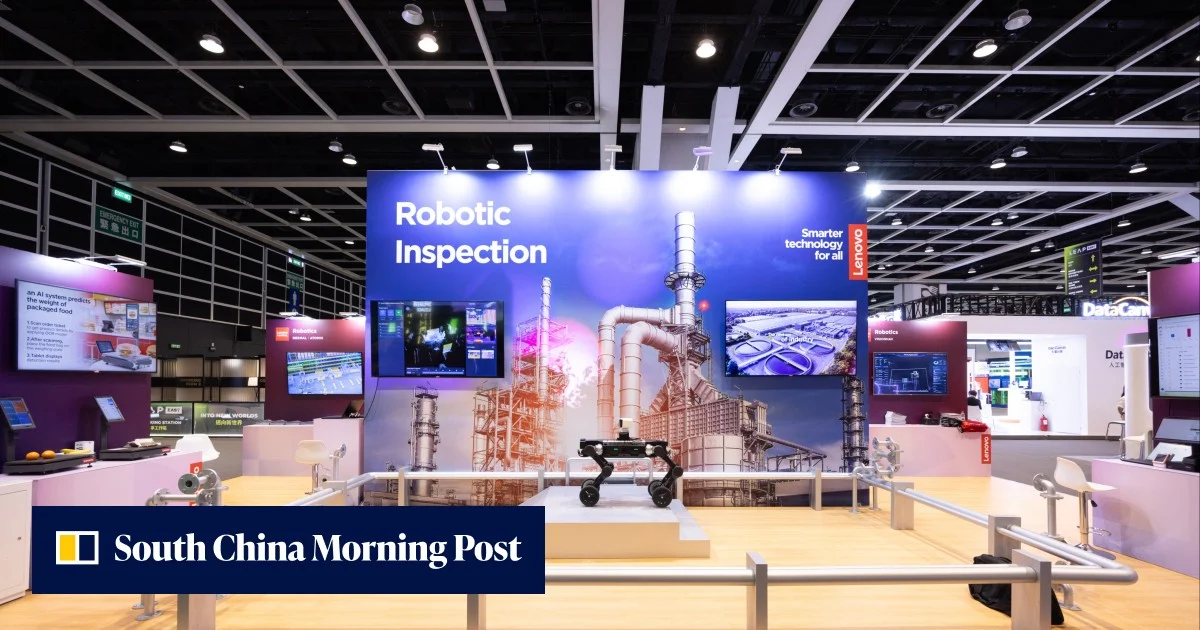
A strong example is Lenovo’s robotic inspection solution, designed to navigate complex or hazardous environments with minimal human intervention. It helps reduce employee exposure to risk by carrying out tasks in unsafe conditions, remote locations, or during night shifts – supporting staff well-being, strengthening workplace safety and enabling greater operational visibility and continuity.
While physical AI handles the sensing and acting, agentic AI connects that action to decisions and workflows across the wider operation. It can reason across data, coordinate processes and determine what happens next.
Together, they can turn what a machine detects on the factory floor into a meaningful operational response.
This also changes the relationship between people and machines. Traditional industrial automation often relied on separating the two. Physical AI makes shared environments viable because machines can perceive proximity, movement and changing conditions. Systems can slow down, change direction or adjust behaviour when people enter shared operating spaces.
Lenovo’s pick‑assist autonomous mobile robot (AMR) combines human intelligence and the dexterity of human hands with AMR payload capability and movement endurance. The complementary strengths of human and machine help drive higher productivity.
In this model, safety and productivity do not have to be trade-offs.
The same principle applies right across smart warehouses. AI can make logistics more responsive, identify quality issues earlier and help detect emerging safety risks.
We see this in practice at a leading logistics company based in Singapore. By integrating AI and autonomous robots into its warehouse operations, the company achieved up to 40 per cent faster order processing, alongside a 30 per cent reduction in energy consumption. It shows that efficiency and sustainability can reinforce each other.
Yili Group illustrates another side of this shift. As a large-scale producer of a wide range of dairy products, the company manages consumer goods with short shelf lives. AI-driven customer insights and supply-chain control can help turn fragmented information into more timely decisions.
In Industry 5.0, sustainability is increasingly tied to this kind of operational intelligence. When organisations can see how equipment, energy and materials are being used, they can optimise those resources continuously.
Lenovo’s Smart Energy Efficiency Solution applies AI to energy-intensive systems including HVAC (heating, ventilation and air-conditioning), chillers, boilers, air compressors and lighting. At Lenovo’s global headquarters, the platform has reduced electricity consumption by 34 per cent year on year.
But intelligent operations depend on the right foundations. Manufacturers still face fragmented systems, limited training data, and the cost and risk of deploying AI in live environments.
Ultimately, the infrastructure behind AI matters as much as the technology itself. The real challenge is to make AI useful, reliable and scalable where people actually work.
Yet, a smart factory remains vulnerable if its broader supply chain is reactive. True Industry 5.0 resilience requires intelligence across suppliers, planning, manufacturing, logistics and fulfilment.
This is where Lenovo iChain is an extension of the Industry 5.0 model. It connects data, decisions and execution across the supply chain, helping organisations move from reacting to disruptions, to anticipating them.
Powered by AI, Lenovo iChain can increase the efficiency of the production process, while still catering to evolving customer needs.
When incorporating it within Lenovo’s own supply chain, which encompasses more than 30 manufacturing sites, the company was able to improve the accuracy of its delivery system by 30 per cent and reduce its order-to-ship lead times by around 20 per cent.
This more reliable supply chain lessens the need for buffer inventory, which saved the company over US$150 million in 2025.
That approach reflects a broader experience we have built over years of managing a complex global supply chain and it has been recognised externally, with Lenovo ranked No 5 in research and consulting firm Gartner’s 2026 Supply Chain Top 25 list.
We learned the value of this resilience through experiences from global events that reinforced the need for continuous visibility, scenario planning and faster responses to emerging risks.
Winning in the Industry 5.0 era won’t belong to the most automated companies. It will belong to the ones that see where technology can make people better at what they do: helping their business stay adaptable, sustainable and resilient.
The views and opinions expressed are those of the sponsor and do not necessarily reflect the official policy or position of South China Morning Post Publishers Limited. Any content provided by our sponsors are of their opinion, and is not intended to malign any religion, ethnic group, club, organisation, company, individual or anyone or anything.
Related Stories
 AI News
Chinese AI tool told researchers how to make bioweapons
29 minutes ago
 AI News
OpenAI launches ‘dots,’ personal AI assistant ‘built to handle everything’
29 minutes ago
 AI News
Jimmy Kimmel Rips Trump’s Push to Rename AI ‘Super Intelligence’: OpenAI Must Be ‘Very Excited’
58 minutes ago
 AI News
AI bosses sign ‘morally binding’ safety accord after lunch with Trump
58 minutes ago
 AI News
2027 Hangzhou Artificial Intelligence Exhibition | April 27
1 hour ago
 AI News
President Donald Trump hosts tech titans to discuss the future of artificial intelligence
1 hour ago
 AI News
Malaysia ramps up regulations on AI tech
2 hours ago
 AI News
US government’s new order replaces ‘artificial intelligence’ with ‘Super Intelligence’; federal agencies
2 hours ago