
How policing, social services can respond to wastewater data, drug trends in Saskatchewan
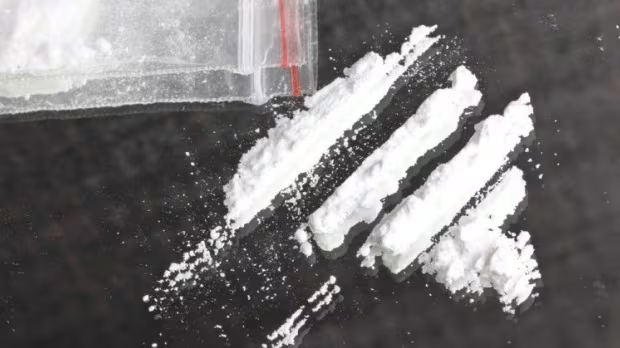
How policing, social services can respond to wastewater data, drug trends in Saskatchewan
Police chief in Prince Albert says recent Stats Canada survey can help police become more efficient
When Prince Albert's Police Service chief of police Patrick Nogier first heard the results of a Statistics Canada survey on drugs in wastewater, he says it was a lot to unpack.
Nogier immediately knew that the service needed to change their approach on drugs.
"We cannot continue to put more officers on the street to try and combat some of these problems we're having. Policing is very expensive," said Nogier.
"We need to become more efficient in the way that we police and this is where things like data that we're collecting from wastewater analysis can help us be more efficient."
Among the eight Canadian cities monitored in the survey, Prince Albert recorded the highest levels of methamphetamine. The city also experienced the most significant fluctuations in concentrations of both cocaine and methamphetamine.
Conducted from January 2024 to March 2026 across catchments covering approximately 9.2 million people, the study offers insight into overall drug presence.
"Wastewater can tell us a lot about drug use and the community. Simply because people who use drugs, they will excrete these drug residues and their metabolites in their urine and stool, which then end up in community wastewater systems," said Sianne Kuang, a StatCan analyst.
Kaung said they collected the data at various participating wastewater treatment sites.
"We have over 14 of them across the 8 cities that we collect in and and those data are analyzed for the concentrations of 10 different substances of public health interest and concern," Kaung said.
Nogier said the wastewater collection data helps PAPS become more efficient.
"It validates where some of our efforts have been with respect to what's our response to supply versus demand. And when I say supply, that's when our efforts are focused on individuals using drugs within our communities," said Nogier.
What Canada's wastewater reveals about drug use in 8 cities
He also said police are also focusing on who is supplying these drugs into the community.
"What we do know from our experience is that it is inevitably linked to firearms coming into our communities, predisposition to use firearms in our communities, victimization and trauma associated to it," said Nogier.
"The illicit drug trade is generating a lot of interest from individuals coming into communities where you do have a healthy and thriving acute community."
For Nogier, it's important to make sure that police are connected and working from evidence, such as the wastewater data, to make important steps moving forward.
Barb Fornssler, an associate professor and researcher at the School of Public Health at the University of Saskatchewan, was also paying attention to the results.
Saskatoon was 3rd in the results when it came to methamphetamine and cocaine.
"It's really important that we have an understanding of what's going on at a population level in our communities. And what's useful here, I think more than anything is, is having that indicator of what's happening in Saskatoon, what's happening in Prince Albert," said Fornssler.
Fornssler said it's important to continue expanding surveys like this one to understand what's happening in other communities across the province, and she said this testing can help fill gaps.
"When we saw Prairie Harm Reduction close, we lost drug testing data that was going on in the city of Saskatoon that would often give us information about like, is there a blend of crystal meth and fentanyl going on right now? And, this kind of information is harder to to get now," Fornssler said.
From conversations she's had with people who use drugs, she said it all comes down to social drivers: People use methamphetamine to keep moving because they don't have a safe space to sleep at night, or use it to decrease their appetite because they don't know where their next meal is.
"It's a sad thing to hear that the use of that substance may be coming from other needs like housing or shelter availability, food availability and security," said Fornssler.
Saskatoon firefighters respond to 90 overdoses in 3 days
She hopes being able to see the wastewater data can be a way to gauge what's happening in Saskatoon.
"Then, hopefully we can provide some policy and system planning responses that are specific to the substances of use at this time," she said.
Randi LaRocque is a Métis woman working as a reporter with CBC Saskatchewan. She can be reached at randi.larocque@cbc.ca
Related Stories
 Community
Canine conundrum: This N.L. biologist has ideas on what these animals could be
4 hours ago
 Community
‘Refusing to meet Trump was an easy no’: Colin Kaepernick on being ‘blackballed’ for taking the knee, racism, and why he’s still ready to play
10 hours ago
 Community
Sask. celebrates Culture Days for 16th year
15 hours ago
 Community
Over $370K raised for 81-year
1 day ago
 Community
Yom Kippur shooting outside Canadian synagogue was 'hate
1 day ago
 Community
Yukon government struggling to keep rural health centres open
1 day ago
 Community
Boy, 14, charged with 2nd
2 days ago
 Community
Belleville synagogue shooter had means to carry out 'mass casualty' event: police chief
2 days ago