
Immigration is on the ballot. Here’s what some of Alberta’s multicultural communities say about the referendum
Immigration is on the ballot. Here’s what some of Alberta’s multicultural communities say about the referendum
Ethnic media reps say immigration ballot questions spark confusion, worry
Heading into Alberta’s upcoming referendum, the question on Alberta independence easily gets the most attention.
But 10 questions are on the ballot this October, five of which concern immigration — something that has been overshadowed since the separation question was announced in May.
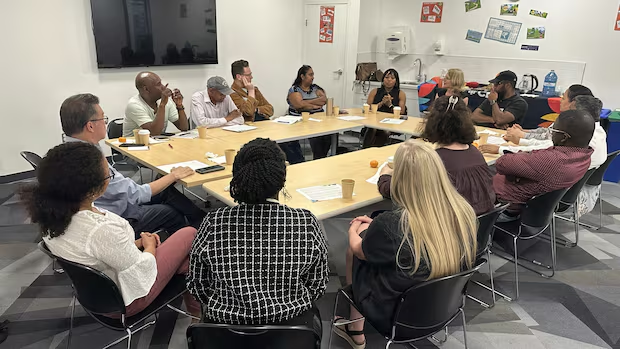
To find out more about how Calgary’s multicultural communities feel about these proposals, CBC News collaborated with several local ethnic media organizations for a roundtable discussion at a southside library.
The group found the questions confusing — both because of how they are worded, and because they said it’s unclear what the province is trying to accomplish.
They also said many in Calgary's ethno-cultural communities are so focused on just making it day to day, they don’t know about the looming referendum. That’s despite the fact the changes being pitched could significantly impact future immigrants and people with temporary immigration status.
And they said the wording of the questions is so complicated, it’s likely some Calgary residents will simply vote yes or no without understanding the implications.
“People are not knowledgeable enough. They're not aware,” said Michael Techlemariam, who hosts an Eritrean radio show in Calgary and was one of five local ethnic media representatives at the meeting.
“It's not going to be a good thing for a lot of immigrants, [especially from] third world countries who live in Alberta.”
The questions on October’s referendum ballot include whether the province should take more control over its immigration system, focus on economic immigrants, require all residents to have “an Alberta-approved immigration status” to be eligible for social services, and show proof of citizenship before voting in elections.
If all five were to pass, Alberta could require temporary residents — such as international students or temporary foreign workers — to have lived in the province for at least 12 months before they can qualify for provincial social supports like childcare subsidies, and charge a “reasonable fee or premium” for temporary residents to use the public health care and education systems.
CBC collaborated with local ethnic media to get an initial sense of how some communities are responding, and what questions they have.
The media involved were CJSW's Eritrean host Michael Teclemariam, REDFM's Fijian host Jagrita Chandra, Dozie Anyaegbunam of The Newcomers podcast, Fairchild Radio's Brian Wong, and Jay Chowdhury of the Asian Media Federation of Canada.
Each local program invited several other community members to join the roundtable discussion.
As the group went through the referendum questions, they raised further questions about each point.
For example, how many kids would miss a year of school while their parents work and pay taxes in Alberta but are still not eligible for public services, asked Tesfai Dimtzu, a Calgary father.
And why does Alberta need a referendum to focus on economic immigration, when it already has the Alberta Advantage Immigration Program. Or to require people to show proof of citizenship to vote? asked Bethia Kinyua, a local immigration consultant.
Political discourse around immigration has some fearing for their futures
“You can’t vote without being a Canadian citizen, and you wouldn’t be able to get on the voters registry,” Kinyua said. “I’m not clear on what the impact would be outside of what feels like othering of people that are Canadian by choice, they’ve chosen to make Canada home.”
It makes you wonder how much of the motivation is political versus policy based, said Jagrita Chandra, a radio host for the local Fijian community.
Several people said they would like Alberta to be focused on growing the economy for everyone instead.
Province says changes would strengthen social services
On a website promoting the referendum questions, the provincial government says the changes would help strengthen social services for Albertans while saving taxpayers money, tying Alberta’s rapid growth to federal immigration policies.
The province estimates that delivering social services to temporary residents is costing Alberta taxpayers more than $1 billion per year, including $600 million for the 45,544 children of temporary residents.
Fact check: Danielle Smith’s comments on temporary residents
In a separate statement sent to CBC by email, the premier’s office said provincial income taxes paid by temporary residents is an estimated $150 million annually.
During the roundtable discussion, several people said the federal government has done a poor job of managing immigration. They pointed to long waitlists for federal immigration programs, such as the Hong Kong permanent residency pathways, and said poor planning has led to many scrambling to find jobs and housing.
‘We all think that things are expensive’
But Teclemariam, who has called Alberta home for 35 years, said the federal failures do not mean he wants Alberta to take over. The language of the questions suggests many people he cares about would be left out of Alberta-run immigration programs.
“They only want to bring people whose education level is high, work [experience and training] is high, so they might not bring a refugee that needs to be helped from a third world country. That's not going to be a great thing.”
The framing of the questions makes it feel like the government is scapegoating immigrants when the real problems are economic, said Anyaegbunam, who came to Canada from Nigeria in 2021 and hosts The Newcomers podcast.
Inflation, rising house prices and the increasing cost of living generally have stressed many Albertans. Groceries alone have increased by nearly 50 per cent since 2020.
“We all think that things are expensive," Anyaegbunam said. "But we don't fix that by basically allowing … people who probably have agendas that I don't know anything about to define what happens for the country.”
“[Immigrants] give as much as they take. They actually even probably give more than they take.”
Many see the referendum as a rural issue
Jay Chowdhury, station manager for RED FM and founder of the Asian Media Federation of Canada, said he’s not surprised many community members are tuned out of the referendum debate. Many are still learning English, and (like many non-immigrant Albertans), they are preoccupied with their personal lives or not interested in politics.
Plus, many in the South Asian community see the referendum as an issue that has nothing to do with them, said Chowdhury. Separatism feels like a preoccupation outside of the cities, and outside of ethno-cultural and urban communities. It feels distant, and that feeling colours the whole referendum.
“Ethnic people especially, they think it is rural generated, rural driven. The ownership is rural. Therefore there's nothing to do with us,” he said.
“But it's one Alberta. It's one referendum, it's one vote. Everybody will vote.”
With files from Emma Kilburn-Smith
Related Stories
 Canada
Trump says NBC's Welker will be reported to FCC
54 minutes ago
 Canada
Berlin Dispatches: The world watches Canada as it stands up to Trump
54 minutes ago
 Canada
Opinion: It’s easier to support a trade war if you can afford one
54 minutes ago
 Canada
Geoff Russ: Praying for a friendly U.S. president is a terrible strategy for Canada
1 hour ago
 Canada
On the road with pro
1 hour ago
 Canada
‘A modern Dickie Dee bike’: Sask. boy serves up sweet treats with a side of nostalgia
1 hour ago
 Canada
Arrest made after man threatened and gun fired
2 hours ago
 Canada
Alberta candle company halts U.S. sales as tariffs add complexity for small businesses
4 hours ago