
India
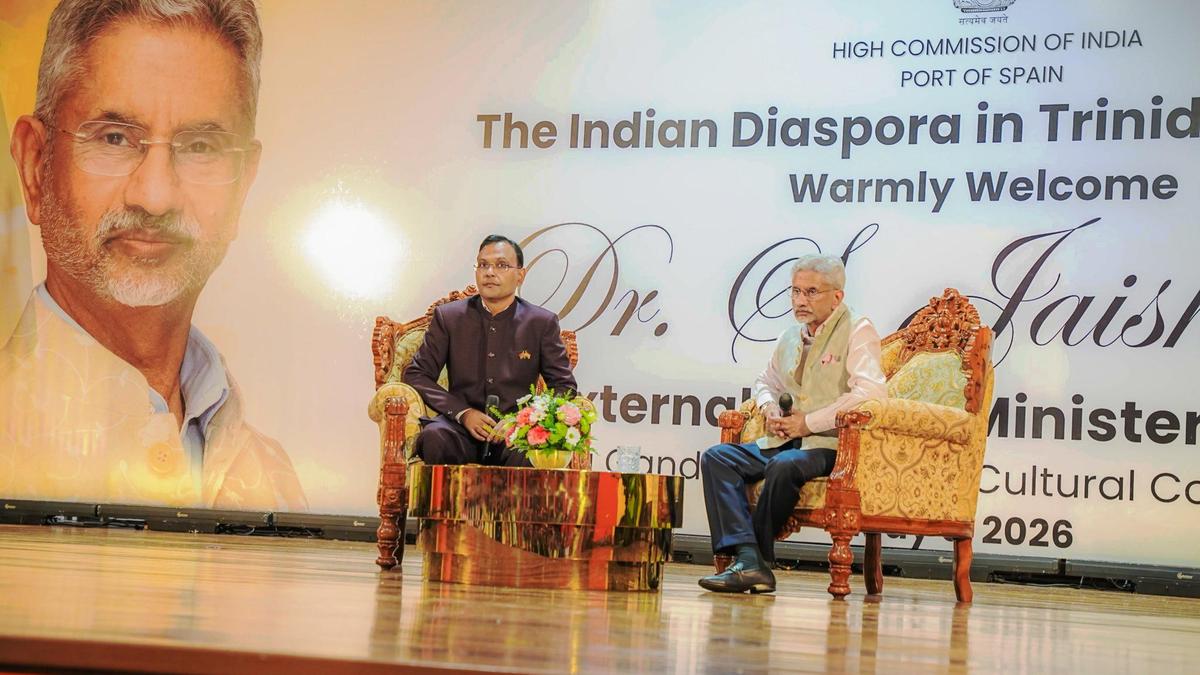
External Affairs Minister S. Jaishankar said an archival cooperation agreement between India and Trinidad and Tobago would help members of the Indian diaspora trace their ancestral roots and reconnect with families, as he underlined New Delhi's efforts to preserve the legacy of the Girmitya community.
Girmitya refers to Indian indentured labourers transported by the British to colonies in Fiji, South Africa, Mauritius, and the Caribbean between the 19th and early 20th centuries.
Addressing a gathering at the historic Nelson Island on Saturday (May 9, 2026), Mr. Jaishankar recalled the arrival of the first Indian indentured labourers in Trinidad and Tobago 180 years ago. He paid tribute to their “fortitude, determination and resolve” in building new lives under difficult circumstances.
He said the immigrants had carried with them their traditions, faith and way of life, adding that it was fitting for such history to be preserved as a heritage site.
Mr. Jaishankar said Prime Minister Narendra Modi attached high importance to creating a database of the Girmitya community and conducting research on its legacy.
He said India was working towards establishing a dedicated Girmitya Studies Centre on Modi’s directions.
Referring to a Memorandum of Understanding (MoU) signed between the National Archives of India and Trinidad and Tobago, Mr. Jaishankar said he hoped the agreement would help many people in the Caribbean nation in "tracing their ancestral roots and reconnecting with their families in India".
He also noted that the Indian High Commission in Trinidad and Tobago was receiving a growing number of applications for Overseas Citizenship of India (OCI) cards after Mr. Modi announced the extension of OCI eligibility up to the sixth generation during his visit to the country.
"The number of OCI applications received by the High Commission is growing, and it will be our endeavour to facilitate others who may not necessarily have access to the required paperwork," the Minister said.
Mr. Jaishankar joined the launch of a Quick Impact Project for the upgradation of cultural heritage facilities at Nelson Island with grant assistance from India. The project includes a memorial monument, creation of a digital hub of historical data from the national archives and a digital audio-visual experience.
According to the website of the Indian High Commission here, approximately 143,000 indentured workers from the Indian subcontinent migrated to Trinidad between 1845 and 1917. A vast majority of these Indian emigrants came from northern India and Bihar.
The descendants of those indentured workers, now in their fifth or sixth generation, form nearly 40-45% of the total population of 1.36 million (as of 2024), constituting an integral part of the country's economic, political, and social fabric, it states.
Mr. Jaishankar concluded his visit to Trinidad and Tobago on Saturday.
He was in Port of Spain on the concluding leg of his three-nation tour of Jamaica, Suriname, and Trinidad and Tobago, aimed at deepening India’s engagement with the Caribbean nations.
Related Stories
 India
India
Starlink, Ambani’s venture should get equal treatment, let consumers decide: Shashi Tharoor
3 days ago
 India
India
Lawrence Bishnoi’s rise: Student politics, first murder and a sprawling crime network | India News
3 days ago
 India
India
India’s finance minister says market liquidity makes it easier for investors to exit
3 days ago
 India
India
India news: CJP alleges 'deliberate' delay in leaders' release
3 days ago
 India
India
Indian Diaspora Holds Pro-Modi Counter
3 days ago
 India
India
Clashes Erupt in London as Diaspora Divided Over India's Election Chief and Electoral Roll Controversy
3 days ago
 India
India
London: Indian diaspora rallies in support of PM Modi, criticises CJP protesters
3 days ago
 India
India
Cabinet Approves Go
3 days ago