
India’s Election Crisis and the Erosion of Public Trust
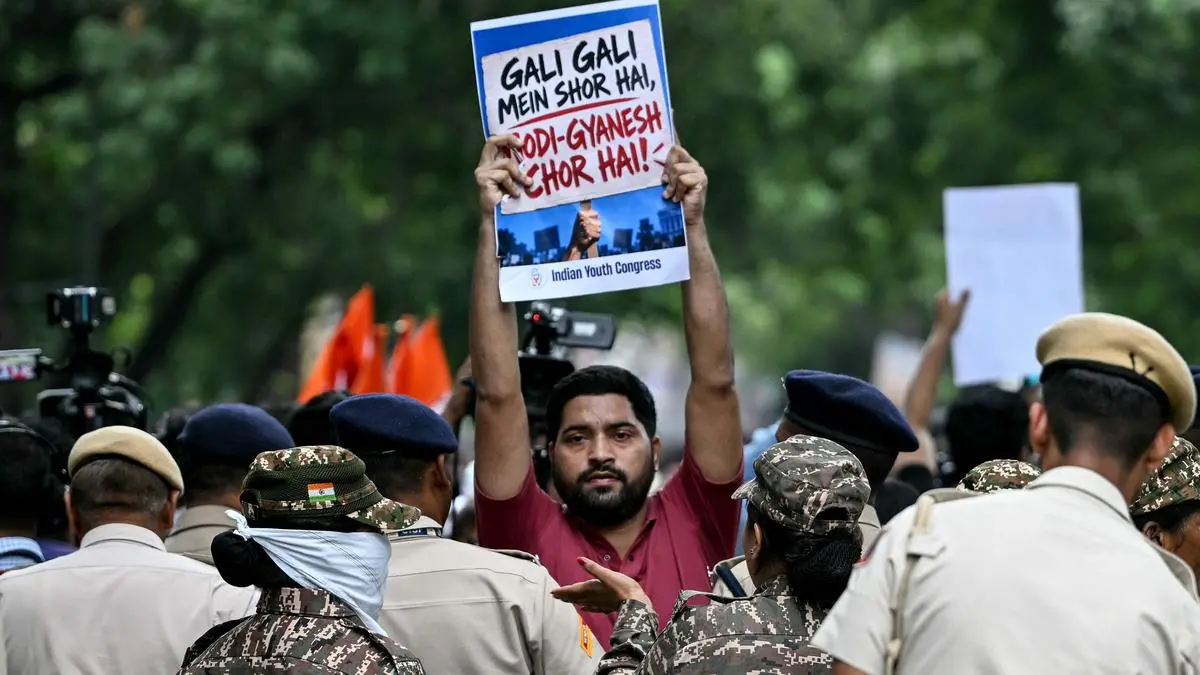
India is once again embroiled in a controversy that follows a familiar pattern: a failure of governance manifests itself; those responsible initially deny the problem and resist calls to address it; as the evidence mounts, the public comes to view the government’s denial and resistance as a betrayal of its trust; frustration turns to anger and culminates in mass protests. We saw this during the farmers’ protests, the Shaheen Bagh protests, the Jantar Mantar protests, and the protests against the Agnipath scheme for short-term military recruitment. Only with protests does the government begin to concede what should have been acknowledged at the outset.
The latest controversy concerns the Election Commission of India (ECI), a constitutional body entrusted with conducting elections and protecting their integrity. Questions about the ECI’s conduct have cast a shadow over public confidence in the electoral process. They especially invite scrutiny of recent elections: the 2024 Lok Sabha election, followed by the Assembly elections in Haryana and Maharashtra in 2024, Delhi and Bihar in 2025, and West Bengal in 2026.
The questions, however, did not begin with the Special Intensive Revision (SIR) launched in Bihar in June 2025. Before that exercise, opposition parties, led by Rahul Gandhi, had alleged irregularities in electoral rolls and polling data, which raised serious questions about the credibility of both. They alleged arbitrary deletions, questionable additions of voters, and anomalies in reported turnouts: all of which they described as “vote chori” or vote theft. The ECI rejected the allegations and maintained that changes to the rolls followed established procedures. The dispute over electoral integrity, therefore, predates SIR, even though SIR has brought it to a new scale.
The Indian Express’ recent investigation revealed a disturbing institutional dimension. It reported that Election Commissioners Sukhbir Singh Sandhu and Vivek Joshi placed at least 14 objections on record over ten months. Their concerns went to the heart of the ECI’s functioning: changes to voter registrations, deletion and restoration of names, and control of the electoral roll database. They said some decisions and instructions were issued without their knowledge or approval, even though the law calls for the ECI to seek unanimity and resolve disagreements by majority votes. The ECI acknowledged the objections but maintained that its decisions were ultimately unanimous. It is yet to explain how the reported objections were resolved.
The lack of transparency in decision-making processes within the ECI is not the only problem. The far larger problem is its nationwide SIR, an exercise in which the ECI re-examines electoral rolls and requires voters whose entries are flagged to establish their eligibility to remain on the rolls. SIR has removed more than 13 crore names from draft voter rolls across 30 States and Union Territories. Some names will be restored; others may remain excluded through no fault of the voters.
Also Read | Gyanesh Kumar is a convenient scapegoat
The consequences can extend beyond the ballot. In some places, access to welfare benefits is tied to inclusion on the electoral roll. A voter’s removal can also raise fears in them about future challenges to their citizenship. Critics therefore call SIR a backdoor route to the National Register of Citizens, a register intended to identify citizens, which was proposed alongside the Citizenship (Amendment) Act, 2019, which provides a path to citizenship for non-Muslim migrants from Afghanistan, Bangladesh, and Pakistan.
The figure of 13 crore deletions (roughly the population of Mexico) establishes the staggering reach of a process whose safeguards demand urgent and intense examination. In my view, the BJP’s political gains from SIR together with the fact that a selection committee dominated by the Prime Minister and a Union Cabinet Minister had chosen the ECI Commissioners point to a disturbing possibility of collusion between the ruling party and an institution that should be independent of it. There should be a firewall between the two. Instead, the ECI’s actions and the BJP’s public defence of the Election Commissioners make any possible firewall appear non-existent.
Activists from the All India Students’ Association and the Revolutionary Workers’ Party of India demanding the resignation of Gyanesh Kumar and calling for re-elections, at Jantar Mantar in New Delhi on September 25. | Photo Credit: Karma Bhutia/PTI
The crisis within the ECI is a manifestation of a wider crisis of legitimacy. It has shown how deeply citizens’ faith has been shaken in the country’s electoral process, its voter rolls, and, to a great extent, the outcomes of recent elections. Many are no longer confident that decisions affecting regional and national elections were made lawfully, in keeping with India’s Constitution. Calls for the Chief Election Commissioner’s resignation reflect the depth of that distrust, but a resignation in itself would not repair the damage. India needs an independent accounting of the disputed decisions, a transparent review of the voter rolls, immediate re-enrolment of people wrongly excluded, and compensation for the needless hardship they have suffered. Where an investigation establishes that wrongful exclusions affected an election’s outcome, there may be no alternative but to nullify that election and hold a fresh vote.
If this crisis were an isolated case, perhaps we could blame a few bad apples and move on. Unfortunately, under the current dispensation in New Delhi, crises arising from bad governance and public distrust have become frequent. They follow the pattern described at the beginning: when irregularities are exposed, the government first denies them, while ignoring or demonising those who exposed them as anti-national. Only when public outcry grows too loud to be dismissed does the government retreat and scramble to salvage its position. The late German political theorist Jürgen Habermas described this phenomenon as a crisis of legitimation.
Such a crisis arises in a democratic society when the government loses the trust, loyalty, and support of its citizens. At first, citizens obey its authority, often passively, in exchange for material and welfare benefits, and accept its decisions without challenge because they trust it to govern well. When the government fails to deliver those benefits and violates the trust placed in it, legitimacy erodes and a crisis emerges. Under the current dispensation, failure to deliver benefits and clear violation of citizens’ trust have become frequent, creating a crisis of legitimacy.
The student protests of July offer another example. Anger over the question paper leak and cancellation of the 2026 National Eligibility cum Entrance Test-Undergraduate medical entrance examination brought students onto the streets across India, sustained by the protest at New Delhi’s Jantar Mantar. Students had prepared for years for this exam, on which their futures depended, and its cancellation led many to take their own lives. The police used batons, tear gas, and pellet guns against the protesters to subdue them. The government promised reforms, but students continued to demand accountability, including the then Education Minister’s resignation. After weeks of protests, he resigned, while demands for compensation for bereaved families and the police crackdown remained.
Previous competitive-exam leaks had exposed the wider failure to protect students’ futures. But the protests and the response to them now made one thing clear: the government had lost the students’ trust, was willing to use force against them, and conceded only when the protests continued despite the government’s brutality.
In June this year, it also came to light that cash and valuables given as offerings by devotees had been stolen at the Ram Mandir in Ayodhya while being counted. The temple, inaugurated in 2024 on the ground where the Babri Masjid had stood for nearly five centuries, symbolised the culmination of a Hindu nationalist struggle that lasted more than a hundred years. Those entrusted with collecting and counting the temple donations were found to have been siphoning them off.
The first response of the Ram Mandir Trust was denial: the charges were called a false narrative, and those asking questions were accused of acting in bad faith. The Uttar Pradesh government, a BJP administration that had long championed the temple, also rejected the allegations before it formed a special investigation team and arrested the counting staff implicated. Evidence then piled up, and the official line turned. But by then, trust in the running of what many now regard as the most sacred Hindu temple in India had already been badly shaken.
Thousands of youth on the streets in New Delhi on July 25, celebrating the resignation of the then Education Minister Dharmendra Pradhan over exam irregularities and paper leaks. | Photo Credit: Sushil Kumar Verma
On August 31, the government announced that India’s economy grew by 7.8 per cent in the first quarter of the financial year, from April to June. It presented the figure as a spectacular result in spite of global headwinds: the supply-chain strain, the US-Israeli war on Iran, the continuing war in Ukraine, and re-globalisation.
For the BJP government, it was meant to be a moment of achievement, coming after a sharp loss of public faith over the Ram Mandir donation theft and exam paper leaks. To its surprise, former officials and prominent economists immediately challenged the claim. If growth was that rapid, they asked, why was there a jobs crunch, inflation, dearer fuel, and a cost of living crisis which most Indians felt every day and which the official growth story did not seem to reflect?
That scepticism was sharpened by the fact that, about a year ago, the IMF gave India’s national accounts data a “C” grade for methodological weaknesses; and separately, revised figures and a weaker rupee had already seen India slip in IMF rankings from the claimed fourth-largest economy to the sixth position, even while it remained among the fastest-growing economies. Regardless of the veracity of the government data, the intensity of the public debate underlined that trust in official numbers, too, had eroded.
A significant narrative of the government is of “Modi magic” in foreign policy: the claim that India’s rising weight in the world is owed, above all, to the Prime Minister’s personal diplomacy, the relationships he has cultivated, and the popularity he is said to enjoy abroad. Of late, that claim has seemed thinner. During Operation Sindoor in May 2025 (India’s strikes after the Pahalgam attack), New Delhi discovered that it was quite alone. No major country or power stood with it or backed its position. Even the US, India’s so-called comprehensive strategic partner, did not really stand with India. On the contrary, it demanded de-escalation, while Pakistan, which India has long sought to portray as outcast, drew open backing from Türkiye, Azerbaijan, and China. In the diplomatic war that followed, India’s efforts to isolate Pakistan through its all-party delegations failed. Pakistan became central to negotiations to resolve the US-Israeli war on Iran, and states in the region are increasingly seeking it as a security partner.
For more than a year, US President Donald Trump has taken public credit for the India-Pakistan ceasefire, including at the UN this month, contradicting India’s insistence that it had halted the fighting at Pakistan’s request and without third-party mediation. Meanwhile, Trump has both praised and cultivated closer relations with China and Pakistan. Both are India’s geopolitical rivals. He has also used tariffs to punish India. The government still tells the country that India remains central to a multipolar order. What is becoming harder to miss is a more bipolar pattern in which China is treated as the US’ peer competitor and India as a lesser pawn in the US’ grand strategy.
Also Read | Decoding the dissent inside ECI
Trump rarely speaks of the Indo-Pacific in the old way. A Quad leaders’ summit has not been held since 2024. Foreign ministers still meet; the heads of government do not. India’s self-congratulatory and triumphalist discourse on its own growing relevance in world politics sounds less and less credible.
The pattern is clear. The government is governing badly, as is evident from its foreign and economic policies and even from the more basic task of administering examinations on which students’ futures depend. Even when faced with overwhelming evidence of failure, it denies that anything is wrong. Rather than investigate and fix the problem, it attacks those who scrutinise it as disloyal or even anti-national. Failure, denial, and demonisation: these have become its tactics.
The frequency of such episodes has produced a crisis of legitimacy. The public is no longer fooled by a captured media or highly scripted government narratives; the realities of daily life expose the limits of the government’s claims. It cannot talk its way out of any crisis anymore. Trust, once lost, is not easily regained. The Modi government can recover some legitimacy only by acknowledging its errors, investigating failures, punishing those responsible, and making palpable changes. If it does not, India’s democracy, economy, social harmony, and political institutions will suffer.
Muqtedar Khan is a professor of international relations at the University of Delaware and a senior non-resident fellow of the Middle East Policy Council. He hosts a YouTube show on world affairs called Khanversations.
Related Stories
 India
India
Indian Ambassador Srivastava bids farewell to PM Shah
1 minute ago
 India
India
AAP donations fall 68%, BJD reports nil: What political parties received in FY26
2 hours ago
 India
India
‘From The Soil Of UP…’: Ex
2 hours ago
 India
India
Why the latest action from India's youth
2 hours ago
 India
India
India Energy Week to focus on rising energy needs, global technology solutions at fifth edition in Kolkata
2 hours ago
 India
India
INDIA bloc to meet on SIR row on Wednesday, Akhilesh Yadav to miss meet due to prior commitments; SP senio
4 hours ago
 India
India
Divya Mittal announces political plunge after quitting IAS, says ‘will do politics with people’ | India News
5 hours ago
 India
India
BJP to hold key organisational meeting of state in-charges, co-in
7 hours ago