
Iran's military has been degraded. What's left?
Iran's military has been degraded. What's left?
Estimates suggest U.S. struck 13,000 out of approximately 16,000 targets in Iran
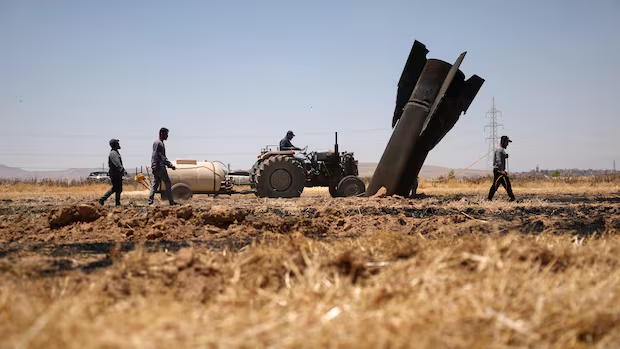
Just days before reports emerged that the U.S. and Iran were close to a peace deal, the Trump administration had launched two nights of airstrikes on the country, targeting its military surveillance capabilities, communication systems and air defence sites.
Those attacks seemed to suggest that the regime, despite weeks of coming under constant bombardment before the April ceasefire, still retains a significant cache of weapons that need to be taken out, at least in the eyes of senior U.S. military officials.
U.S. and Iran signal peace deal close as reports suggest terms appear to favour Tehran
"When U.S. Central Command told Trump we destroyed everything, what they meant was they hit all the big juicy targets that they had in their big juicy target list," said William Alberque, former director of NATO's Arms Control, Disarmament and WMD Non-Proliferation Centre.
"Did they tell him that there are thousands, if not tens of thousands of additional targets that they did not hit because at this point you're using a hammer to go after ants? No, of course not," said Alberque, who is also a senior adjunct fellow with the Pacific Forum, which is based in Honolulu.
Added Erfan Fard, a Washington-based Middle East analyst, writing in Small Wars Journal: "The more important strategic question is not what was destroyed. It is what survived."
U.S. launches new Iran strikes against 'multiple targets'
The U.S and Israel attacked Iran on Feb. 28, with strikes lasting 40 days until a temporary ceasefire was reached on April 8. U.S. and Iranian forces continued to exchange some lesser attacks following the ceasefire.
Iran still has thousands of small and fast boats, says Alberque, which can launch anti-tank weapons or fire small anti-ship missiles.
"And these are not sitting in a giant facility with a giant bullseye on the top," he said.
Instead, he says they're sitting in hundreds of shelters along the Strait of Hormuz, while missiles have been distributed to remote locations across Iran.
"So even us hitting the big missile bases means we're not hitting probably 50 per cent or more of their missiles."
The attacks before the ceasefire had "significantly degraded" Iran's ability to threaten the U.S. and its partners in the Middle East, Admiral Brad Cooper, the commander of U.S. Central Command, told lawmakers in May according to a report in the Wall Street Journal.
Before the April ceasefire, the U.S. struck an estimated 13,000 out of approximately 16,000 targets, averaging 300 to 500 targets a day, said Alex Plitsas, a former Pentagon official.
Iran may be exaggerating its missile-making capabilities, but experts say it's still a threat
Those figures were based U.S. CENTCOM briefings in terms of number of targets hit as compared to targets remaining before the war, said Plitsas, who is currently a senior fellow with the Atlantic Council, an international affairs think-tank in Washington, D.C.
Air-defence systems were degraded, elements of the regime's naval and air capabilities were damaged, senior military and security personnel were reportedly eliminated, and military facilities across multiple regions were struck, Fard wrote.
A recent BBC analysis found that more than 50 Iranian military bases, including the headquarters of the Islamic Revolutionary Guards Corps (IRGC), have been damaged by U.S.-Israeli attacks since the war began, satellite images show.
Alberque said the U.S. has hit Iran's capital ships, command and control centres, radar installations, along with sites where it's believed Iran stored and launched missiles.
"We hit the places that you would hit, if you were in a face-to-face war with Russia. We hit the big bases. We hit the big airfields," he said.
Alberque said the Iranian military has probably been degraded anywhere from 60 to 80 per cent. But the regime's ability to "fire one or two small cruise missiles at ships in the Gulf" from smaller boats still remains.
"So what percentage of those capabilities have we gotten? I have no idea," he said. "I'm guessing it's not a very high percentage."
Iran launches new retaliatory strikes at U.S. allies in Persian Gulf
Brian Carter, a fellow focusing on military affairs in the Middle East at the American Enterprise Institute, said it's difficult to quantify the degradation of Iran's military. He said he has been looking at it in relative terms, comparing the damage of this war to damage inflicted by the Israelis in 2025.
The damage inflicted on Iran is greater than in 2025, which also suggests that the pace of Iran's reconstitution will take longer. Iran is likely more degraded and degraded in different ways, specifically when it comes to weapons production apparatus, he said.
"It's very hard to give precise reconstitution timelines or precise degradation figures without understanding for each strike, what was hit, how badly was it damaged. Was it destroyed," he said.
A CNN report said that Iran restarted some of its drone production during the ceasefire that began in early April, and that Iran’s military is reconstituting much faster than initially estimated.
"The rebuilding of military capabilities, including replacing missile sites, launchers and production capacity for key weapons systems destroyed during the current conflict, means that Iran remains a significant threat to regional allies," CNN reported.
Arman Mahmoudian, a research fellow at Global and National Security Institute at the University of South Florida, said that while Iran's military infrastructure has been badly damaged, Iran has been gaining knowledge. He said the fact that Iran has been able to shoot down U.S aircraft in the second part of the war is proof.
"The Iranian military is is not as strong as it used to be. It's much weaker now. However ... it's more experienced."
Mark Gollom is a Toronto-based reporter with CBC News. He covers Canadian and U.S. politics and current affairs.
With files from The Associated Press
Related Stories
 World
World
Victor Lai Diary: Medal Secured
46 minutes ago
 World
World
Argentina star hit with one of the biggest bans in World Cup history
46 minutes ago
 World
World
Paredes banned 10 games as FIFA suspends 3 Argentina players for World Cup final scuffle
46 minutes ago
 World
World
‘We’re not remotely prepared’: Labour MPs fear party has gone soft on climate crisis
1 hour ago
 World
World
Watch: How does El Niño affect world weather?
1 hour ago
 World
World
Iran war live: Tehran president says it is time to end war ‘in position of strength’
2 hours ago
 World
World
FIFA hands Argentina's Paredes a 10
3 hours ago
 World
World
6.7 magnitude earthquake hits Peru’s southern Andes Mountains, injures 2
3 hours ago