
'It's insane' how much parents spend on berries, but when did they become an all
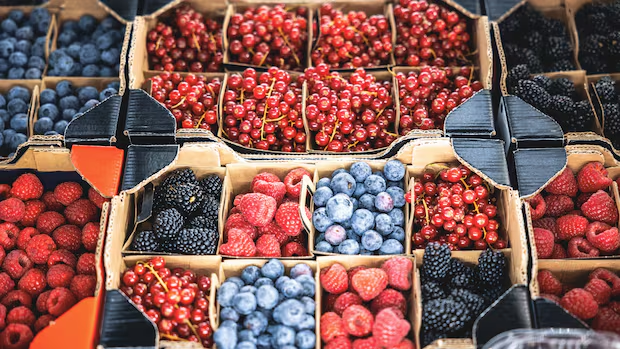
Fresh strawberries were a summer luxury. When did they become an all-season toddler snack?
Parents say they have to 'stretch the budget' to keep their kids in berries
There was a time, not so long ago, really, when apples were the preferred daily fruit, oranges were a treat, strawberries were a summer delicacy and blackberries were practically lore.
A time when the thought of packing an entire pint of fresh raspberries in your six-year-old's school lunch in the middle of February wasn't just laughable, but actually unfeasible.
"Don't have a kid without a healthy berry budget," a parent wrote on Threads in April.
"Toddler moms, how are y'all affording berries?! My son had a whole $20 worth of berries today," someone else posted in June.
"Why my kids will never have a trust fund," someone posted in an Instagram reel that showed a kitchen counter full of fresh strawberries and raspberries earlier this month.
It's a common refrain among parents over the past few years. There are memes about the berry budget, jokes about taking out a second mortgage to pay the berry tax and stories about parents saying they're going broke on berries.
Expect to pay a bit more for strawberries this year as growers grapple with rising labour and operating costs
Tomatoes cost how much now? Why inflation has come for Canada's produce section
It's funny, sure, but the berry boom also represents "so many cultural shifts it's hard to identify all of them," explained Daniel Bender, the Canada Research Chair in Food and Culture and a professor of food studies at the University of Toronto.
Over the past 20 to 30 years, a combination of new packaging technologies, the North American Free Trade Agreement, new breeds of berries designed to withstand transit times and changes in our personal tastes all contributed to the berry's shift from a seasonal treat to a year-round snack, Bender told CBC News.
But even beyond the carbon footprint and human labour-related issues, this trend comes with significant costs, he added: taste, and our overall relationship with food.
"Breeders, producers and mega-farms are focusing on mobility rather than taste and are perfectly willing to sacrifice strawberry taste for the ability to move fruit," Bender said.
"And there's a self-denying pleasure with seasonality.... What does summer mean to your kids when they can have blackberries in January?"
Canada doesn't track berry consumption per se. But fresh berry availability — the amount of food that is physically present in a country for consumption— has increased by 237 per cent since 2000, according to data from Agriculture and Agri-Food Canada.
In 2000, there were an average 3.09 kilograms of fresh berries available per person. By 2025, it was 10.42 kilograms.
While strawberries make up a third of the overall berry availability in 2025, the increase was driven by rising amounts of blueberries, cranberries and "other" berries (which includes raspberries, loganberries, mulberries, blackberries, currants, gooseberries and saskatoon berries), according to Agriculture Canada
In the same time period, the available amount of fresh oranges per person dropped six per cent, apples decreased by 23 per cent and grapefruit availability plummeted 64 per cent.
"Fresh berries continue to see strong growth in Canadian retail, driven by rising consumer demand and increased imports," the International Fresh Produce Association (IFPA) said in a statement to CBC News.
And it's not just Canada. Premium fruits, like berries, are the highest performers globally among all fruit categories, according to the IFPA's 2026 consumer trends research report.
Statistics Canada, in a statement to CBC News, confirmed that the availability trend has largely been driven by imports.
Fresh blueberries, for instance, saw an availability spike in 2021 as imports increased 38.9 per cent from 2020, the agency noted, while strawberry availability dipped from 2018 to 2019 as imports dropped 16.8 per cent year-over-year.
'Summer is going to really stretch the budget'
Melissa Spanjer has three children under the age of six. And they all love strawberries, raspberries and blueberries, she told CBC News from Ottawa, estimating she spends about $70 per month on berries alone.
"I buy them weekly. It's insane," Spanjer said.
"Because of the cost and how much my kids love them, I ration out very few for myself. And I definitely don't offer them to guests."
Spanjer, 37, said Friday that she's actually planning to take her kids berry picking that evening to stock up and hopefully save some money.
"Summer is going to really stretch the budget," she said.
Here's the scoop on Japan's alleged ice cream cartel accused of price-fixing cool treats
From sardinemaxxing to skincare, here's why tinned fish is the newest 'it' food
The price of berries has remained somewhat stable in recent inflation numbers, increasing 2.1 per cent year-over-year in May, but they're still not cheap.
The average June price in grocery stores for a 454-gram package of strawberries was $5.73, according to grocerypulse.ca data collected for Dalhousie University's Agri‑Food Analytics Lab in Halifax.
That's a 4.9 per cent retail price increase from May, said Sylvain Charlebois, the lab's director. It's mostly a seasonal adjustment as retailers transition from imported strawberries to higher-cost Canadian berries and scale back aggressive spring promotions, he said.
"If weather co-operates and the domestic harvest is strong, Canadians should expect strawberry prices to soften as we move further into the summer harvest season."
Cold wet spring in N.S. means strawberries arriving a little later
We've seen the same boom happen with other fruits over the years, such as kiwis and pineapples, noted Bender, the Canada Research Chair expert.
It also wasn't that long ago that you might get one mandarin orange in your stocking to last you all winter, he said, and now you can buy them by the crate.
Even bananas were once a rare delicacy, he said, pointing out that they were only introduced to the North American market at the 1876 World Fair. They rapidly became an everyday food, but the fact that we still have fancy dishes like Bananas Foster is a remnant of a time when they were a luxury item.
"Now they're pennies a pound, and they're a very different banana than they once were," he said, referring to them being bred specifically to survive international transportation.
"We're seeing the same thing happen in our lifetime with strawberries."
Natalie Stechyson has been a writer and editor at CBC News since 2021. She covers stories on social trends, families, gender, human interest, as well as general news. She's worked as a journalist since 2009, with stints at the Globe and Mail and Postmedia News, among others. Before joining CBC News, she was the parents editor at HuffPost Canada, where she won a silver Canadian Online Publishing Award for her work on pregnancy loss. You can reach her at natalie.stechyson@cbc.ca.
Related Stories
 Canada
Albertans head to polls in historic referendum on whether they want to stay in Canada
2 days ago
 Canada
In the news today: four soldiers killed, Alberta referendum, AI privacy fears
2 days ago
 Canada
How a grass fire at a Canadian military base killed four soldiers
2 days ago
 Canada
How will household electricity rebate reduction, temporary winter pricing change impact Ontarians?
2 days ago
 Canada
Residents told to boil tap water due to bacteria
2 days ago
 Canada
Oil
2 days ago
 Canada
Albertans vote on path to independence as Carney fights to keep Canada united
2 days ago
 Canada
Two of 4 soldiers killed in fast
2 days ago