
“K
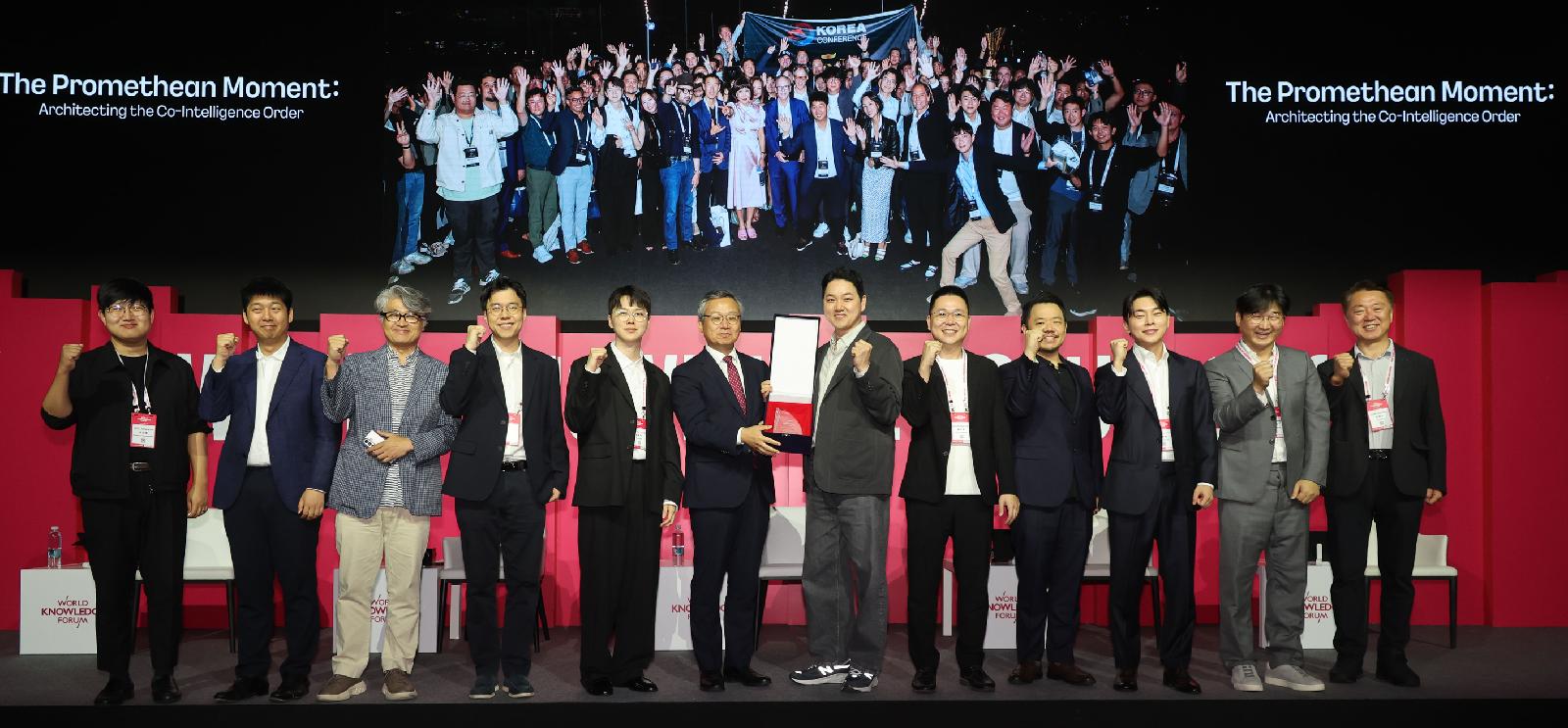
As artificial intelligence (AI) technology rapidly advances, Korean startups are making their mark on the global stage. Participants said this success stems from the synergy between Korea’s distinctive manufacturing base, where diverse industrial infrastructure is concentrated within a relatively small area, and the intellectual property (IP) created by K-culture. However, they also warned that improvements to the startup culture are needed for these achievements to become sustainable.
Representatives of startups from various fields, including sleep, music, logistics, and safety, made the remarks at the ‘Globalization of K-Startups Proven by Results’ session of the 27th World Knowledge Forum, held on the ninth at the Dynasty Hall of Hotel Shilla in Seoul.
The event was attended by Lee Jang-won, CEO of Contents Technologies; Park Cheol-su, CEO of Ourbox; Kang Min-seung, CEO of Tynapse; Choi Yun-young, CEO of SolverX; Seo Woo-seok, co-CEO of bemyfriends; and Hwang Hee-jong, CEO of A&J Science. Lee Sang-hyun, CEO of Guardian AI, and Lee Dong-heon, CEO of Asleep Inc., also attended as panelists.
Lee Jang-won, CEO of Contents Technologies, explained, “Being a Korean startup can be a premium or a discount depending on the industrial environment.” He added, “In the beauty and content industries, the entire value chain is well established, making it much easier to create new products compared with other countries.” He continued, “In particular, the content and entertainment sectors have a solid infrastructure built by K-pop over the past 30 years,” adding, “Excellent content startups continue to emerge.”
Park Cheol-su, CEO of Ourbox, emphasized the importance of industrial infrastructure, including logistics, in maximizing K-pop’s potential. He said, “As we enter an era in which even a one-person company can become a unicorn, systems and services based on the business process outsourcing (BPO) concept, which connect ideas to practical businesses, have become essential.” He stressed, “As detailed Korean content and products, such as K-beauty and K-food, enter global markets, the level of service required has risen significantly. We need global logistics capabilities that can meet those demands.”
Some participants also said they had been able to build distinctive business models by leveraging the unique culture of K-pop. Seo Woo-seok, co-CEO of bemyfriends, explained, “In the global music market, giant companies have thousands or tens of thousands of artists, but Korean companies rank among the global top five with only 50 to 100 artists.” He added, “This is possible because of Korea’s unique ‘K-pop fandom business model.’ We aim to transplant it across global IP.”
Hwang Hee-jong, CEO of A&J Science, introduced a funding strategy for research and development (R&D) biotech startups. He shared how the company attracted investment by clearly setting R&D priorities and presenting distinct milestones to maintain its drug-development pipeline. To overcome short-term funding difficulties, he recommended focusing on pipelines with strong technology-transfer potential. He also highlighted the need for joint research with global big pharmaceutical companies at the appropriate time.
Participants also said that collaboration with companies possessing strengths in various industries was creating synergies. Choi Yun-young, CEO of SolverX, explained, “We are developing ‘Physics Intelligence,’ which teaches AI the physical laws and gravity affecting the Earth to drive innovation in the manufacturing industry.” He added, “Starting with collaboration with domestic automakers and parts manufacturers, we are expanding into defense, aerospace, semiconductors, chemical plants, nuclear fusion, and quantum technologies.”
However, participants cautioned that a long-term strategy is needed for these achievements to reach a sustainable level, rather than being swept up in short-term issues or trends. They said the industry should guard against simplifying global expansion into mere sales and revenue-generating activities. Some also warned against the growing trend of using AI agents to create services too easily and abandon them just as easily.
This article has been translated by GripLabs Mingo AI.
Related Stories
 Technology
When Tech Companies Die, What Happens To The Products They Leave Behind?
1 week ago
 Technology
Two Finns supplying Russia with missile tech worth tens of millions
1 week ago
 Technology
Drones with pepper spray, four
1 week ago
 Technology
Micron Technology stock pre-market at EUR 800.50: memory storage - ad
1 week ago
 Technology
TAIEX Ends at 4
1 week ago
 Technology
ZAWYA: Technology, start-ups can double India
1 week ago
 Technology
Czech government to consider CZK 1 billion fund for startups
1 week ago
 Technology
GDIN Supports Eight Startups at CEATEC 2026 in Japan, Opens Door to Local Investor Collaboration
1 week ago