
KAIST develops ultra
KAIST develops ultra-precise inspection technology to prevent electric vehicle battery fires
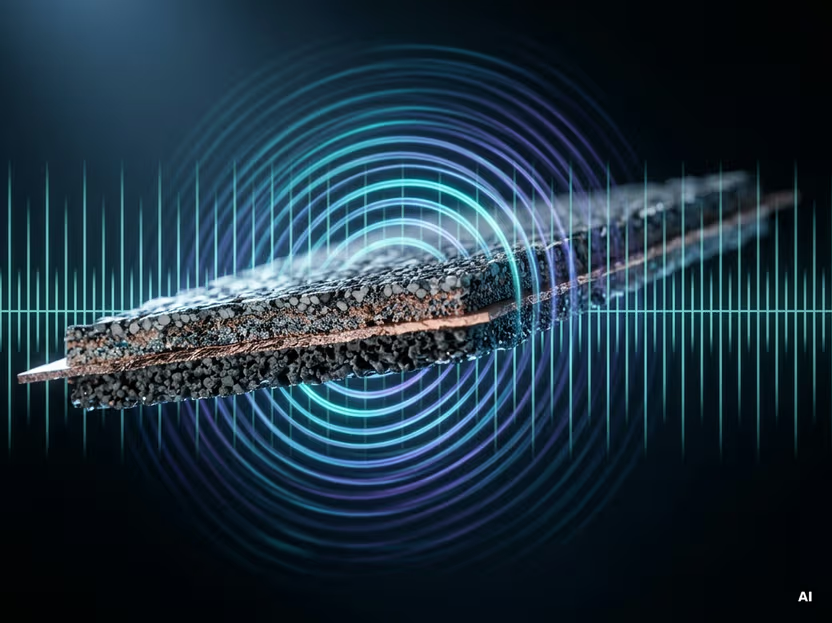
An ultra-precise inspection technology that could help prevent electric vehicle battery fires and improve battery safety has been developed. A KAIST research team has developed a method capable of detecting minute variations in battery electrode thickness that can contribute to thermal runaway with a precision equivalent to approximately one ten-thousandth the diameter of a human hair, all without disassembling or damaging the battery. The technology is expected to improve battery safety and quality by identifying invisible defects during the manufacturing process.
gure 1. Lithium-Ion Battery Electrode Thickness Measurement Using Optical-Frequency-Comb-Referenced Terahertz Fabry–Pérot Interferometry
KAIST (President Choongsik Bae) announced on 23rd of July that a research team led by Professor Young-Jin Kim from the Department of Mechanical Engineering has developed a technology that measures the thickness of lithium-ion battery electrodes in a non-contact and non-destructive manner.
The technology combines terahertz waves (electromagnetic waves in the spectral region between light and radio waves) to obtain information from inside battery electrodes with an optical frequency comb, which divides the frequency of light into evenly spaced intervals like the markings on a ruler and serves as a reference for ultra-precise measurements.
“This work represents a meaningful breakthrough...”
The electrodes in lithium-ion batteries, which are widely used in electric vehicles, are essential components through which electric current flows. Even a slight variation in electrode thickness can cause current to become concentrated in certain areas when charging and discharging, generating heat. If the heat continues to accumulate, it may lead to thermal runaway, a phenomenon in which the internal temperature of a battery rises rapidly and can result in a fire or explosion. Maintaining uniform electrode thickness is therefore critically important during battery manufacturing.
Existing inspection technologies, however, have limitations when applied to production environments. X-ray computed tomography can provide detailed images of internal structures, but its relatively long inspection time makes it difficult to use on high-speed production lines. Ultrasonic acoustic microscopy requires direct contact with a liquid medium, while laser displacement sensors can perform rapid measurements but have difficulty precisely analyzing structures inside an electrode.
The research team overcame these limitations by combining optical frequency comb and terahertz technologies. The researchers first directed terahertz waves at a battery electrode and collected signals generated as the waves were repeatedly reflected within the electrode. They then used an optical frequency comb as a reference to analyze the signals with exceptionally high precision and calculate the electrode thickness. This enabled nanometer-scale measurements of the electrode's internal structure without damaging the battery.
At the core of the technology is Fabry–Pérot interference, a regularly spaced interference pattern produced as terahertz waves repeatedly travel back and forth between the front and rear surfaces of an electrode. Much like measuring length by reading the markings on a ruler, the researchers precisely analyzed the interference pattern using the optical frequency comb as a reference to determine the electrode thickness.
As a result, the team successfully measured both the electrode thickness and its complex refractive index (a material's optical property indicating how strongly it transmits and absorbs electromagnetic waves) in a single measurement without requiring a separate calibration process.
The researchers validated the technology using battery electrodes measuring between 50 and 150 micrometers in thickness, comparable to the diameter of a human hair. With a measurement time of just 0.2 seconds, the system detected thickness differences as small as 70.1 nanometers in the anode (approximately one fourteen-hundredth the diameter of a human hair) and 465.5 nanometers in the cathode. This measurement speed is considered sufficient for use on rapidly moving battery production lines.
When the measurement time was increased to 25.6 seconds, the precision improved further. The system distinguished differences as small as 7.8 nanometers in the anode (approximately one ten-thousandth the diameter of a human hair) and 25.2 nanometers in the cathode. This represents up to a 100-fold improvement in precision compared with conventional time-domain analysis methods, enabling the detection of thickness variations that are completely invisible to the naked eye.
The technology is not limited to measuring thickness at a single point. It can generate a three-dimensional map of thickness across an entire electrode and track gradual thickness variations in real time during production. The researchers also confirmed that the system could accurately measure an electrode tilted at an angle of approximately 45 degrees, demonstrating its potential for application to fast-moving, real-world battery manufacturing lines.
The study is significant because it presents a new inspection technology capable of identifying invisible microscopic defects during production without disassembling or damaging batteries. In addition to lithium-ion batteries, the technology is expected to serve as a key quality-control tool for manufacturing next-generation all-solid-state batteries, which use solid electrolytes instead of liquid electrolytes. By detecting defects at an early stage, the technology could improve battery safety and quality while enabling more stable manufacturing processes.
"This technology is an integrated metrology platform that can simultaneously measure electrode thickness and material properties without requiring a separate calibration process," said Professor Kim. "We expect it to become a key technology for the real-time quality control of production lines for next-generation lithium-ion batteries and all-solid-state batteries."
Guseon Kang, Jaeyoon Kim, Mee-Ree Kim, et al.; "Nanometre-precision terahertz interferometry for battery electrode metrology"; Nature Communications, 2026-6-10
Other news from the department science
Elucidating the microscopic lithium ion transport in solid-state electrolytes for next-generation batteries
"This development is a significant milestone, particularly for soft X-rays..."
New review explains how catalysts working at battery surfaces or within electrolytes can accelerate sulfur conversion and guide the design of next-generation energy storage
Research that an everyday plasticizer can boost the efficiency and stretchability of light-emitting polymer films
Science Prize for Professor Birgit Esser
Edward Tate and Nicolas Winssinger share the €75,000 prize for medicinal chemistry
Study Analyzes Research Needs on the Path to a Defossilized Basic Chemicals Industry
How biocatalysis could improve LOHC technology
Research team develops methods for breaking down “forever chemicals”
Five Factors for the Success of Domestic Lithium from Geothermal Energy
Migration experience, higher education and open-mindedness foster innovative responses to crises
Chemists develop light-driven triple catalysis
Produced on a pilot scale for the first time
For the first time, chemists have succeeded in synthesizing the highly potent natural compound neosorangicin A
Researchers are using waste from citric acid production as the basis for biodegradable printed circuit boards.
Study suggests a new way to follow electronic and vibrational dynamics in real time
These products might interest you
Benefit from modern measurement technology and an experienced team
Boost your battery slurry process
Study Shows the Potential of Iron Powder for Long-Term Energy Storage, Energy Transmission, and the Use of Existing Power Plant Infrastructure in the Energy System of the Future
Penn State researchers converting PET waste into synthetic graphite that outperforms natural graphite
Germany's largest Direct Air Capture facility to be inaugurated in Berlin on July 2, 2026
Pitt startup finds a cooler, cleaner method to produce battery-quality graphite and hydrogen
Awards for oat-based drinks, a malaria vaccine, battery recycling and more
Nobian and partners launch pilot project to scale circular, low-carbon lithium refining in Europe
Fraunhofer ISE is seeking investors for a spin-off
Deep tech startup alqem is scaling its AI platform for materials research
Solstice Advanced Materials acquires Element Solutions for 14.5 billion dollars
More news from our other portals
New possibilities for biotechnology and green chemistry
A UK study analysed 71 like-for-like product pairs and counted 199 additives in plant-based items versus 100 in animal-based ones
The combination is set to deliver complete solutions for semiconductors, life sciences and materials science
Pathogens also multiply there and can spread from that location
An analysis by four organizations shows that 59 percent of the active ingredients in pesticides used in coffee cultivation are banned in the EU
The transaction involves biopharma, environmental, and food testing
Three finalists have been selected: Award Recognizes Entrepreneurial Excellence and Significant Innovation Potential in Life Sciences
Five industry associations are warning of price increases and questioning the effectiveness of the planned tax in terms of public health policy.
Researchers from the University of Jena, Helmholtz-Zentrum Berlin, and Zakodium develop AI system for chemical structure analysis
The active ingredient also shows anti-ageing effects
Nestlé manager Jolanda Schwirtz takes over as head
Agreement lays the foundation for a new era of digitally connected labs enabled by intelligent robotics to provide significant efficiencies in laboratory workflows
Antibody Shows Long-Lasting Remissions After Failure of Established Cancer Immunotherapies
The smart fridge of the future: E-nose warns of off chicken and nut allergens
Large meta-analysis finds consistent evidence across epigenetic measures worldwide
Biotech scale-up invests a mid-double-digit million amount and creates about 25 new jobs at the site
Recalls Underway: Salmonella in Flavored Pasta Affects Children Most of All
The acquisition is intended to scale up the use of AI-powered cancer diagnostics in anatomical pathology laboratories
Precise Control of Gene Expression
Hybrid wheat is expected to increase yields without requiring more land or resources
Acquisition strengthens presence in France
Study examines the emerging science suggesting a link between calorie-free sweeteners and blood sugar control
S.Pellegrino, Perrier and Acqua Panna are to grow more independently under their own roof
The origin of a sample must not influence the result: Evaluation criteria for trustworthy clinical AI
In a blind tasting test, the burger developed by AI beat a popular fast-food burger
Potential risk to humans and environment reduced
Bio-Techne to bring portfolio with industry-leading multi-omics offering, analytical technologies and integrated workflow solutions across the scientific journey
With this acquisition, GETEC is expanding into industries such as chemicals, life sciences, the food and dairy sectors, and healthcare in Southern Europe
See the theme worlds for related content
The topic world Battery Technology combines relevant knowledge in a unique way. Here you will find everything about suppliers and their products, webinars, white papers, catalogs and brochures.
Related Stories
 Technology
Durham police warn of online predator network 'The Com' manipulating children into criminal acts
1 hour ago
 Technology
Meet the 55 deep tech startups pitching investors at UNSW’s showcase
1 hour ago
 Technology
NVIDIA plans minority investments in four French startups as European tech commitment nears €9 billion
1 hour ago
 Technology
CNTTech launches English edition to spotlight Korean startups abroad
3 hours ago
 Technology
Iran's nuclear tech. potentials amount to developed nations
3 hours ago
 Technology
ZAWYA: UAE eyes deeper industrial, technology links with China
3 hours ago
 Technology
Choo Miae: "Will Not Let Up on 'Jultakdongsi' Efforts to Ensure Business Success"
4 hours ago
 Technology
Cyprus Business Now: fintech, supermarkets, gambling, shipping, startups, IMF
4 hours ago