
Lauren Fink’s research reveals what captures our attention. Can it also capture a market?
They linger on a political candidate’s face during a debate. They drift away when a school lesson loses our attention. They settle on one piece of art while passing another without a second glance.
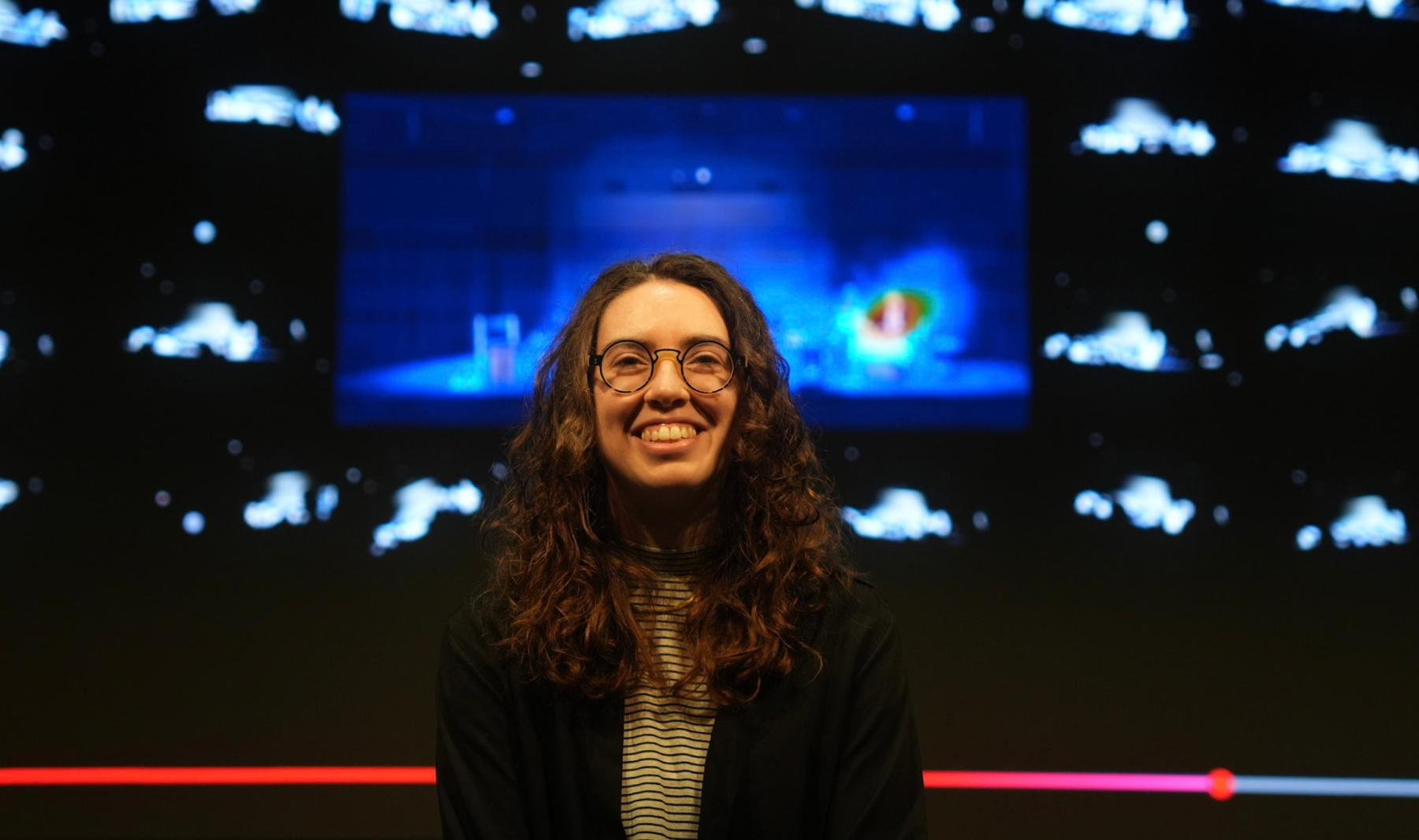
For Lauren Fink, those subconscious moments offer clues to understanding what captures our attention, and why it matters. The McMaster University assistant professor, together with PhD student Shreshth Saxena, has developed SocialEyes, a portable technology that can synchronize and analyze eye-tracking data from groups of people at once. It allows researchers to study attention as it unfolds in the real world.
That kind of insight has value outside of academia, too. Companies see possibilities in advertising, consumer research, and audience analytics.
The possibilities have left Fink — a scientist with a long list of research questions she still wants to pursue — wrestling with one she hadn’t expected: How can I be a professor and an entrepreneur?
Fink came to neuroscience through music.
Trained in music performance, she was fascinated by what happens in the mind and body when people experience music, but traditional laboratory experiments felt far removed from those experiences. She wanted to study attention where it actually happens.
At McMaster’s LIVELab concert hall, she found a place to do it and began pushing eye-tracking technology beyond the traditional one-person experiment.
SocialEyes has since been used to study everything from music and film, to hearing difficulty and politics.
During the 2025 federal election, young, undecided voters watched the English-language leaders’ debate while wearing eye-tracking glasses and watches, allowing Fink’s team to study what held the group’s attention.
Fink describes what SocialEyes captures as a kind of “social intelligence.”
While many AI and wearable technologies are designed around the individual, Fink is interested in what can be learned by looking at people together – an emerging area she describes as social wearables and social AI.
“What a crowd pays attention to actually tells you a lot about what’s important,” she says. “One person’s gaze can be difficult to interpret, but when a group of people looks in the same place, that collective pattern becomes much more meaningful.”
It turns out other people were paying attention to SocialEyes, too.
After Fink began presenting her research at conferences, companies approached her. Some had been trying to solve similar technical challenges. Others saw opportunities she hadn’t necessarily been looking for.
At McMaster, she connected with the university’s commercialization ecosystem, found mentorship among other academic-entrepreneurs, learned how to protect her technology’s intellectual property, and will soon form a company.
“You can’t be what you can’t see,” Fink says. “Speaking with people who are a bit further along is helpful. Someone says, ‘Use MILO (McMaster Industry Liaison Office) for this.’ When I started, I wouldn’t have known what MILO even is.”
This summer, she added another layer of support through the DeGroote Heersink Hub’s Masterclass: Foundations in Entrepreneurship. Over six intensive sessions, researchers, engineers and clinicians learned how to assess markets, think about scalability, navigate intellectual property, build business models and raise money.
The program is part of the university’s broader commercialization training pathway, which this fall will offer the ACE Future Innovators Bootcamp for students and faculty from all disciplines looking to take their first steps into entrepreneurship.
For Fink, it has sometimes felt like learning another language.
“Beachhead market — listen to me using terms here,” she says, laughing. “Why do we use beachhead? Why don’t you just say the first market that you want to enter?”
The vocabulary may be new. The questions behind it are becoming increasingly familiar.
Who needs SocialEyes? Who will pay for it? Where should it enter the market first? And how does Fink make the case not just for what the technology already does, but for what it could become?
Advertising, film and audience analytics offer obvious commercial possibilities. But she also wants the platform to keep answering fundamental questions about attention and social interaction — and to explore applications that could improve human health.
A sustainable company could give SocialEyes the people and resources to grow beyond what her academic lab can do alone, while allowing Fink to remain closely connected to its scientific direction — and keep asking the questions that got her here.
“With what I’ve learned this summer during Masterclass, I’ll have a clear business development plan and a sense of how this should look in the next few years,” she says. “I’ll take that vision to potential investors.”
At the Heersink ACE50 Pitch Competition in October, Fink will have five minutes to make the case for where SocialEyes could go next, with $75,000 in seed-funding available if she wins.
For a scientist accustomed to talking about what the evidence has already shown, that means asking others to believe in what might be possible.
Then again, Fink has built a career on pursuing exactly that.
“If we’re not pushing the boundaries of what’s possible,” she says, “then I’m not having fun.”
Related Stories
 Technology
Economic Community of West African States (ECOWAS) Celebrates Innovation as HubPharm Africa Wins Second Startup Awards
43 minutes ago
 Technology
Top Luxury
43 minutes ago
 Technology
Behind the technology powering a greener – and cheaper
43 minutes ago
 Technology
Neuroscience Innovator Receives Tech Titan Award
43 minutes ago
 Technology
Retail Technology News: September update
44 minutes ago
 Technology
Trump’s Super Intelligence edict supercharges .si domain registrations
44 minutes ago
 Technology
Airtel Africa Foundation Expands Tech Fellowship to Zambia
1 hour ago
 Technology
Limassol startup seeks to make quantum computing useful for businesses
2 hours ago