
Liberals continue court fight against First Nations drinking water rights, despite new bill
Liberals continue court fight against First Nations drinking water rights, despite new bill
Federal lawyers claim Shamattawa ruling 'paves the way for unlimited government liability'
The Carney government continues to fight First Nations in court to deny Canada has a legal duty to ensure they have safe drinking water on reserve, even as the Liberals advance legislation aiming to do just that.
The contradiction is prompting lawyers and opposition lawmakers to accuse the federal government of hypocrisy as the Justice Department tries to overturn a key ruling on drinking water rights won by Shamattawa First Nation through a class-action lawsuit.
Ottawa isn't disputing minor points but mounting "a wholesale, full-fledged effort to defeat the claim," said Toronto-based lawyer Michael Rosenberg, who represents the remote northern Manitoba community in the case.
"[Canada wants] the Federal Court of Appeal to say that the Federal Court was completely wrong and there is absolutely no right to safe drinking water on reserve."
Justice Paul Favel ruled last December that First Nations have an "unmistakably Indigenous" interest in safe drinking water on reserves, an interest over which Canada has assumed control, triggering a duty to act in communities' best interest.
But Canada is appealing, saying in a written argument filed May 29 that Favel's decision "went far beyond any existing legal obligation and paves the way for unlimited government liability."
Canada has legal duty to provide safe water, housing to remote First Nations, federal judge rules
Canada has no legal obligation to provide First Nations with clean water, lawyers say
In the filing, a team of five federal lawyers denies First Nations have a distinctly Indigenous interest in drinking water, asserting that First Nations’ interest in their own reserve land doesn't include water because "water is not attached to land, but flows under and around it."
Rosenberg called this position absurd but added the real problem lies in how Canada's court argument is impacting the proposed First Nations Clean Water Act, Bill C-37, which the Liberals tabled two weeks after filing their appeal argument.
A predecessor bill, which died on the order paper last year, explicitly recognized First Nations' right to safe drinking water, but the new bill replaces that recognition with weaker language, declaring it is Canada's policy to "further the progressive realization" of this right.
This wording seems designed to allow Canada to continue fighting Shamattawa, which the First Nation finds deeply disappointing and galling, Rosenberg said.
"The legal position that the government is taking is now undermining the legislation that First Nations bargained for," he said.
The bill will be up for discussion at the Assembly of First Nations' annual summer meeting in Ottawa this week.
Another lawyer who has worked extensively on First Nations water issues called the reworded section a "crass, meaningless piece of political theatre."
"If the honour of the Crown is worth anything, it has to stand for the principle that you can't talk out of both sides of your mouth on an issue," said Clayton Leonard, senior counsel with JFK Law in Victoria.
The Justice Department argues Canada supports water services in First Nations as an optional policy decision, not out of any legal duty, meaning First Nations are ultimately responsible for any problems they may face.
"This action does not challenge the government directly responsible for providing the service," Canada's argument says.
Clean water bill shows 'troubling shift' from recognizing First Nations rights, says national chief
Canada stresses 'political' nature of commitment to providing First Nations clean water
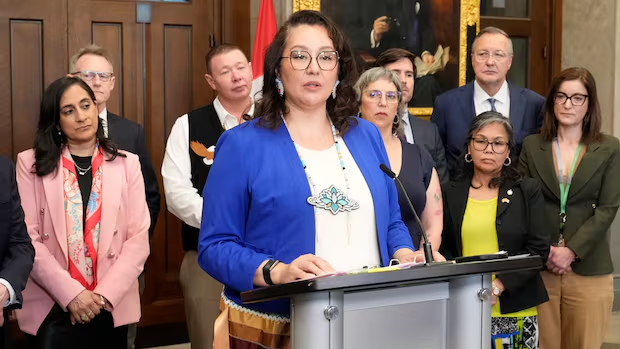
Indigenous Services Minister Mandy Gull-Masty's office deferred comment to the bureaucracy. In a statement, Indigenous Services Canada said the appeal seeks "further clarification on key issues" but declined to comment directly on the case.
"Canada continues to work with Shamattawa First Nation toward a long-term and sustainable solution to support access to clean drinking water," including by providing $26.5 million since 2019 for a water treatment plant, wrote spokesperson Anispiragas Piragasanathar.
'Walking back Indigenous rights'
The case is raising questions for the opposition Conservatives' critic on the Indigenous Services file.
"Who's really running the Indigenous Services ministry? Is it the minister herself or is it the Department of Justice and bureaucrats?" said Edmonton Northwest MP Billy Morin in an interview.
"I'd say it's the Department of Justice and bureaucrats these days. They're wanting to protect government, and that comes at the cost of protecting First Nations."
Morin said the court battle is typical for the Liberals, though he called "walking back Indigenous rights" a break from the Trudeau era.
Language change on human right in Liberals' clean water bill 'another slap in the face': Lewis
NDP MP and Indigenous affairs critic Leah Gazan called the government's position on the right to potable water unacceptable. Respecting this right isn't optional, she said.
"It's another example of what Amnesty International confirmed: a rapid rolling back of Indigenous rights by the Carney government," Gazan said.
Shamattawa and Chief Jordna Hill are suing on behalf of all First Nations people whose communities experienced a drinking water advisory from June 20, 2020 onward. The $1.1-billion case picks up from an earlier lawsuit that led to an $8-billion settlement in 2021, which requires the federal government to table water legislation.
The two lawyers said Bill C-37, despite its problems, otherwise contains much that is good and needs to pass swiftly, with amendments.
Brett Forester is a reporter with CBC Indigenous in Ottawa. He is a member of the Chippewas of Kettle and Stony Point First Nation in southern Ontario who previously worked as a journalist with the Aboriginal Peoples Television Network.
Related Stories
 Canada
Dr. Abbas Jessani named one of Canada’s Top 40 Under 40
28 minutes ago
 Canada
Canadian Armed Forces members in Toronto removed from duty after arrest on organized crime, kidnapping charges
28 minutes ago
 Canada
Security screening mostly 'unimpeachable' but 'there are gaps': Anandasangaree
1 hour ago
 Canada
Amber Alert cancelled for missing 7-year
1 hour ago
 Canada
University of Toronto launches $100M scholarship program to attract PhD talent to Canada
1 hour ago
 Canada
Posthaste: Economists warn the window for affordable housing in Canada is closing
1 hour ago
 Canada
Man accused in massive gold heist at Toronto's Pearson airport pleads not guilty as trial begins
2 hours ago
 Canada
Canadian officials react to Carney's comments on preparing for potential US invasion
2 hours ago