
Live updates: Trump meets world leaders in France with US
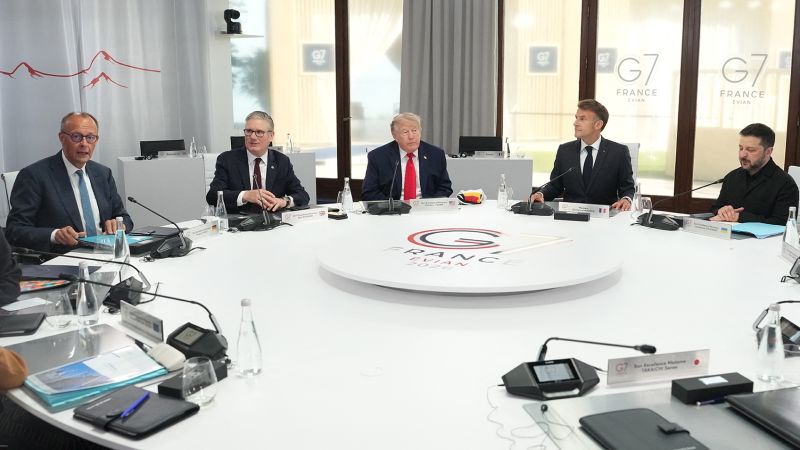
• G7 summit: World leaders have gathered at the G7 summit in Évian-les-Bains, France, where discussions about US President Donald Trump’s agreement with Iran have been “frank,” sources say. Trump is due to speak with the leaders of three Arab states as well as Ukrainian President Volodymyr Zelensky.
• US-Iran agreement: US President Donald Trump claimed the next phase of negotiations with Iran would be “easier” even though those talks are meant to resolve thorny issues around Iran’s nuclear program. Vice President JD Vance told CNN yesterday the agreement was a “general document,” leaving details to be worked out in future talks.
• Trump criticizes Israel: Trump also criticized Benjamin Netanyahu, saying the Israeli prime minister needs to be “more responsible with respect to Lebanon.” Israel and Hezbollah continued fighting yesterday, and Netanyahu has made clear he does not intend to withdraw from southern Lebanon, Gaza or Syria.
Vice President JD Vance spoke to CNN’s Jake Tapper on Monday, shedding light on the Memorandum of Understanding agreed with Iran and highlighting US expectations from the Islamic Republic.
Separately, Vance told Fox News that Iran will not receive any US taxpayer money under the agreement, while suggesting other countries could invest in Iran if sanctions are lifted and conditions are met.
“If the Iranians behave, and if there are sanctions relief, and if the Iranians are integrated into the world economy, we would invite other countries, not us, but other countries to invest in their country.”
Earlier Monday, Vance told CBS the Iranians “could have access” to a $300 billion reconstruction fund if they comply with the terms of the deal, though he said it would be funded by Gulf nations.
US President Donald Trump suggested on Tuesday that Syria might “do a better job” at dealing with Hezbollah than Israel.
Speaking to reporters at the G7, Trump said that “the man that’s running Syria now” is “very good with Hezbollah.”
Israel has spent years trying to defeat Hezbollah and stop the ability of the Iranian-sponsored militia to fire rockets on Israel from Lebanon. But so far, it has not succeeded.
Trump said he “suggested to Israel” that Syrian President Ahmed Al-Sharaa, whom he called “a person that I put there” should “take care of Hezbollah.”
“He’s not a Boy Scout, but he’s done an amazing job of pulling it together, and he is very good with Hezbollah. Does not like them,” Trump said. “I suggested to Israel to let Syria take care of Hezbollah, because to be honest with you, I think they do a better job of doing it.”
The US president said Israel has been fighting Hezbollah for “too long,” adding that “too many people are being killed.”
“You don’t have to knock down an apartment house every time you’re looking for somebody, because there are a lot of people in those apartment houses, and they’re not all Hezbollah,” Trump said.
President Donald Trump said he will meet Ukrainian President Volodymyr Zelensky later today and encouraged Russia to agree to a deal that would end its war.
“Russia should make a deal. Russia’s lost tremendous amounts of people, and so had Ukraine,” Trump said.
Trump’s focus on Iran has drawn attention away from his peace-making efforts in Ukraine. But now that an agreement has been struck with Tehran, he said he would do what he could to help resolve the Russia-Ukraine war.
Trump and fellow G7 leaders met jointly with Zelensky during a morning session at the summit in France.
US President Donald Trump has made clear his frustration with Israel’s Prime Minister Benjamin Netanyahu, telling reporters Tuesday he needed to be “more responsible with respect to Lebanon.”
Trump has clashed with Netanyahu several times in recent months, believing the Israeli leader and his government were making it more difficult for the US to strike a deal with Iran by attacking Hezbollah in Lebanon. Iran has insisted that any ceasefire deal must include Lebanon.
“Without me there would be no Israel because no other president was willing to do what I did,” Trump said in a response to a question about whether he was frustrated with Netanyahu.
“I’ve had a great relationship with Bibi, but now Bibi has to be more responsible with respect to Lebanon,” he said, referring to the Israeli prime minister by his nickname.
Netanyahu has been careful to avoid public confrontation with Trump. Speaking about the US Iran deal on Monday, he said: “There are cases in which President Trump and I do not see eye to eye. … I am responsible for Israel’s security interests, and it needs to be done wisely.”
US President Donald Trump is in France this week for the annual G7 summit, where his recently announced agreement with Iran is high on the agenda.
The details of the agreement have still not been made public, though a senior US official said yesterday that it does not require that Israel withdraw from Lebanon.
If you’re just joining us, here’s the latest:
CNN’s Elise Hammond, Adam Cancryn, Kevin Liptak, Alejandra Jaramillo, Sophia Saifi, Max Saltman, Eyad Kourdi, Tal Shalev, Ivana Kottasová and Pierre P Bairin contributed to this reporting.
President Donald Trump claimed the next phase of negotiations with Iran would be “easier” than the initial round that led to the recently announced Memorandum of Understanding.
“It goes to a second stage, which I think will be actually easier,” Trump said while meeting with the emir of Qatar on the sidelines of the G7 summit in France.
Officials have said the next phase would involve technical discussions on Iran’s nuclear program, as well as financial relief for Tehran and details on reopening the Strait of Hormuz.
Trump also insisted the US would not be “investing any money in Iran,” seeking to tamp down on fears among some of his allies that Tehran would receive American funds.
Officials have said instead that a $300 billion reconstruction fund would be funded by Gulf nations.
As they gather for the G7 summit in France, the leaders of the world’s most powerful countries are hoping to get more clarity on US President Donald Trump’s deal with Iran.
The basic contours of the agreement are known: the US will end its blockade of Iranian ports, Iran will reopen the Strait of Hormuz, and the two sides will begin 60 days of nuclear negotiations.
Trump said the full text of the agreement would be released “pretty soon” but likely after a formal signing ceremony on Friday, but more details could emerge from his meetings on Tuesday.
Here is what we know — and don’t know:
The US said the strait would reopen after the agreement is signed on Friday, with Trump declaring that passage would be “permanently toll free.”
But Iran said on Monday that Tehran will collect “fees” for maritime services offered alongside Oman, state-affiliated Tasnim news agency reported. It said these charges would not amount to “tolls”.
Safety will be key. CNN has previously reported that Iran has mined in the strait and international maritime and shipping organizations stressed that there is a difference between being allowed to pass and being able to do so safely.
Pakistan, which brokered the agreement, said both sides have “declared the immediate and permanent termination of military operations on all fronts, including in Lebanon.”
However, the agreement does not include a requirement that Israel withdraw from Lebanon, a senior US official said on Monday. Meanwhile, fighting continued overnight as both Israel and Hezbollah conducted strikes.
The US said Iran made assurances that it would never develop a nuclear weapon. But there are no concrete commitments around Iran’s nuclear program or its uranium stockpiles.
Iran said the 60-day nuclear negotiations will begin only after the US releases billions of dollars of frozen funds. But a US official said no money would be released without clear commitments by Iran.
US Vice President JD Vance said later on Monday that Iranians “could have access” to a Gulf nations-funded $300 billion reconstruction fund if they comply with the terms of the deal.
Oil prices fell to their lowest level since early March and the Dow clinched a record high Monday after the agreement was announced — however, a broader economic recovery will likely take months.
Discussions about President Donald Trump’s agreement with Iran among G7 leaders at dinner Monday night were “frank” and in-depth, according to people familiar with the conversation.
The group meal lasted for nearly two hours around a table perched above Lake Geneva’s south shoreline, and also veered toward other topics like Ukraine, the people said.
Emerging afterward, European officials said they still had questions about the Iran accord. Trump signed it virtually on Sunday but the text has not been revealed publicly. They are mainly concerned with how quickly the Strait of Hormuz can be reopened to commercial traffic, something US officials have offered differing answers on over the course of the last day.
Heading into the summit, US officials said they expected European nations to contribute to efforts to remove mines from the Strait of Hormuz now that hostilities have ended.
French President Emmanuel Macron, the summit’s host, said during a meeting with Trump that his country was “ready to take our fair share of the burden” to support the deal.
But Trump downplayed the need for European assistance, claiming the deal itself would allow the waterway to open freely.
“I don’t think we’re going to need much help, but I don’t think it’s a bad idea to have a ship or two up here from a few countries,” he said.
US President Donald Trump has joined G7 leaders in France today, with the US-Iran agreement set to dominate discussions.
Here are the latest pictures ahead of talks in Évian-les-Bains.
French President Emmanuel Macron held a quick bilateral meeting with Ukraine’s President Volodymyr Zelensky ahead of this morning’s main gathering of the Group of Seven in Évian-les-Bains, the Élysée Palace said.
As the host of the G7 meeting, Macron invited Zelensky to attend the sidelines of the gathering, hoping his presence could help shore up the group’s support for Ukraine.
A key part of the mission is getting US President Donald Trump on board.
A possible meeting between Zelensky and Trump was the first thing Macron spoke about as he greeted the Ukrainian leader inside the lush grounds of the Hôtel Royal where the summit is taking place.
“So first, do you have a bilateral thing organised … with President Trump?” Macron was heard asking Zelensky before offering to “arrange this.”
Trump’s official schedule does not include bilateral talks with Zelensky, but an impromptu meetings can, and often do, happen during summits like this one.
One of the most consequential past meetings between Trump and Zelensky was unscheduled and took place on the sidelines of Pope Francis’ funeral in April last year. That meeting was their first since the disastrous Oval Office encounter and it marked something of a turning point in their rocky relationship.
As world leaders gather at the G7 summit on Tuesday, the Iran war is expected to dominate discussions.
US President Donald Trump had wanted to enter the summit of leading industrialized nations in a position of strength and with an agreement in hand, sources say. And after months of conflict and negotiations that drew immense skepticism from his fellow G7 leaders, he’ll now get that — albeit with significant, lingering questions about the specifics of the agreement and the extent to which each side will abide by it.
The G7 leaders have been forced to confront higher energy prices as a result of the Strait of Hormuz’s prolonged closure. Over the last several months, Trump lashed out at nearly all of them for their reluctance to help patrol the key waterway, making for an awkward backdrop to this week’s gathering.
Ahead of the summit, officials from four of the G7 countries said that how to move ahead in the Middle East — even with an agreement in place — would undoubtedly provide fodder for intense discussions behind the closed doors of the Belle Époque Hôtel Royal in Évian.
On Tuesday, the leaders of three Arab states — Egypt, Qatar and the United Arab Emirates — will also join for talks, invited by French President Emmanuel Macron to help home in on the thorny questions affecting their region. Trump will meet them individually as well.
Donald Trump is joining other leaders at the first day of the G7 summit on Tuesday, but the United States president has never been a particular fan of attending these meetings.
In his first term, he consistently questioned advisers whether his presence was necessary, and wondered what could be accomplished without the presence of countries like Russia and China.
He abruptly cut short his time at two summits in Canada — one during his first term in the northern woods of Quebec and one last year in Alberta. Attending his first G7 in 2017 on the rocky coast of Sicily, he seemed to feel fellow leaders were ganging up on him by trying to convince him to remain in the Paris climate accord (some aides believed the pressure pushed him to withdraw from the agreement more quickly than he might have otherwise).
The last time French President Emmanuel Macron hosted the summit, in 2019, a dinner beneath the Biarritz lighthouse grew heated when Trump demanded Russia be readmitted into the alliance after being ejected following Moscow’s annexation of Crimea in 2014. Over their plates of Basque tuna, Trump’s fellow leaders offered little support for the idea.
Five years and a full-scale Russian invasion of Ukraine later, Trump opened last year’s G7 by issuing the same demand.
Some residents of southern Lebanon who were displaced by months of war between Israel and Iran-backed Hezbollah began returning to their homes Monday, expressing joy and cautious optimism the conflict there will cease pending the US and Iran signing an agreement to end hostilities Friday.
“It’s the best feeling … We’re returning to our town, to our land,” a man traveling to the city of Tyre told Reuters.
Another man from Tyre told Reuters that returning home was “an indescribable feeling … even if returning to rubble, it doesn’t matter.”
The residents are attempting to return to their homes even though Israel has said it won’t be withdrawing troops from the south and authorities in southern Lebanon warned against people rushing back.
The deal between US and Iran announced by Pakistan’s Prime Minister, a key negotiator, included calls for a ceasefire in Lebanon but Israel’s Defense Minister, Israel Katz, has stated that Israeli troops will not be withdrawing from security zones in southern Lebanon, Gaza and Syria.
Some people attending Iran’s first World Cup 2026 match against New Zealand Monday night were seen carrying or wearing anti-Iranian regime symbols, according to reports ––passing through security without any issues, despite warnings from Tehran and the world soccer’s governing body FIFA.
A flag, bearing the symbol of a lion and sun, has been used for centuries before the 1979 revolution. Iran had threatened to stop matches if flags or other anti-government symbols were brought into World Cup stadiums, according to Reuters.
FIFA has also banned such flags at the World Cup, citing stadium regulations. A last-minute hearing in Los Angeles on Monday upheld the ban, The Athletic reported.
“This team is not the team of the people of Iran,” Farhad Jafargad, one of the few attendees wearing a white t-shirt with the lion and sun design, told Reuters.
Other soccer fans who draped themselves with the official Iranian flag told the news outlet they were heckled by protesters, but that they wanted to focus on their team and forget about politics.
“We’re very proud of our country,” 57-year-old Mehdi Jafari, who wore an Iran soccer shirt, told Reuters.
“We’re here to support Iran. I think we should all let go of the politics and just go in and cheer on the Team Melli.”
French President Emmanuel Macron asked Ukrainian President Volodymyr Zelensky to attend the G7 summit this week, in an effort to cajole the group to agree on support for Kyiv and the need for negotiations to end Russia’s war, now in its fifth year.
US President Donald Trump spent much of his first year back in office trying unsuccessfully to broker an agreement between Zelensky and Russian President Vladimir Putin. But he rarely discusses that conflict anymore as Iran consumes his attention, and European officials are eager to ascertain whether Trump is willing to apply new pressure on Putin.
On Monday, Zelensky toured Kyiv’s historic Kyiv Pechersk Lavra, just hours after it suffered a major attack from Russia.
Condemning the attack on one of Ukraine’s most iconic historical sites, Zelensky said he will push hard for more air defenses when he meets with European leaders and Trump at the summit.
Trump has repeatedly insulted most of his G7 counterparts over the last several months, reopening old grudges and igniting new feuds with leaders he once seemed to respect.
Now, the US president and the other European leaders will all be under one roof at the French spa resort Évian-les-Bains.
Here’s a look at where things stand:
Read what Trump has posted on social media about the leaders
President Trump arrived for the G7 summit in Évian-les-Bains, France, on Monday as questions remain over the memorandum of understanding between the US and Iran.
CNN’s Alayna Treene reports from Geneva, Switzerland, on what we know:
Vice President JD Vance said Monday that Iran will not receive any US taxpayer money under the terms of an agreement aimed at ending the war, while suggesting other countries could invest in Iran if sanctions are lifted and conditions are met.
Vance added that while US funds would not be involved, economic opportunities could emerge if Iran is reintegrated into the global economy.
“What we have said,” the vice president continued, “is there’s a lot of economic benefit in the United States for leaving a lot of sanctions and welcoming them back into the world economy.” Vance also said the US would support foreign investment in Iran under certain conditions when asked about a $300 billion reconstruction fund.
Earlier Monday, Vance said the Iranians “could have access” to a $300 billion reconstruction fund if they comply with the terms of the deal, though he said it would be funded by Gulf nations.
Israel and Iran-backed Hezbollah continued fighting on Monday, even though the United States and Iran have reached an agreement aimed toward ending the war. A formal signing ceremony is scheduled for Friday.
US President Donald Trump and Vice President JD Vance both virtually signed the memorandum of understanding with Tehran, a senior US administration official said. Parliament Speaker Mohammad Bagher Ghalibaf signed the document for the Iranian side, the official said.
A lot of questions remain about the memorandum and how it will play out. The text has not been released, but it does not require Israel’s withdrawal from Lebanon, according a senior US administration official.
If you’re just dropping in, here’s the latest:
CNN’s David Goldman explains what happened Monday in the oil markets:
CNN’s Max Saltman, Eyad Kourdi, Alejandra Jaramillo, John Towfighi, Tal Shalev, Mohammed Tawfeeq, Jennifer Hansler, Betsy Klein and Kit Maher contributed reporting to this post.
Iran came from behind twice to draw 2-2 against New Zealand in their opening World Cup match in Los Angeles.
This is the first time in World Cup history that a host nation is at war with one of the participants, though the United States and Iran have reached an agreement aimed at ending hostilities.
New Zealand grabbed the lead early in the 7th minute when Elijah Just scored with a volley. Iran’s Ramin Rezaeian clinched the equalizer in the 32rd minute.
Just restored the All Whites’ lead in the second half, but Iran struck back quickly with Mohammad Mohebbi heading the ball in for another equalizer.
Related Stories
 World
World
Manchester United weigh up stunning move for Real Betis and ex-Tottenham forward Troy Parrott
1 week ago
 World
World
Israeli police arrest 10 following weekend attacks by settlers on journalist and diplomats
1 week ago
 World
World
Trump says suspension of Russia sanctions is to keep peace negotiations going
1 week ago
 World
World
Ukrainian drones strike St. Petersburg oil facilities | NHK WORLD
1 week ago
 World
World
Victoria Falls stadium in Zimbabwe nears completion for CWC27
1 week ago
 World
World
‘The world will be amazed:’ Iran’s commanders prepare for further war
1 week ago
 World
World
Festival opens with musket salute in Sakai, Osaka
1 week ago
 World
World
Trump's new pitch for Republican candidates — they're really good
1 week ago