
Mayor needs more spending powers, ministers told
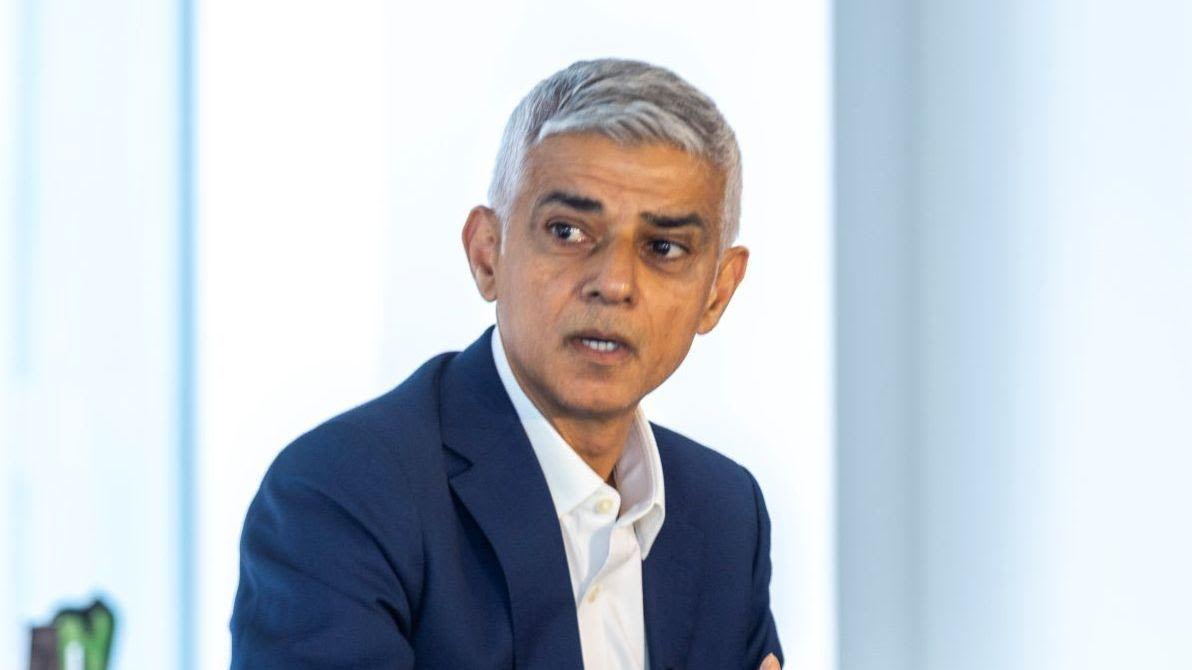
The mayor of London must be allowed to raise and retain money locally to fund major transport infrastructure projects like the Bakerloo Line extension, ministers have been told.
Under current rules, Sir Sadiq Khan has to lobby central government for funding for any new schemes that cannot be financed by the Greater London Authority (GLA).
Local government expert Prof Tony Travers said he believed many large infrastructure and housing schemes could progress in London if some financing powers were handed to City Hall.
A government spokesperson said it was to overhaul the way the regional mayors are funded by replacing grants with a share of local income tax in 2028.
Among the tools available to local mayors is Tax Increment Financing (TIF) - which involves borrowing against expected income from taxes.
This was used to fund the GLA's £1bn contribution to the costs of the Northern line extension to Battersea Power Station and Nine Elms earlier this decade.
But this method requires obtaining permission from the housing secretary to set up a designated area in which tax income can be used.
Speaking at an all-party parliamentary session on devolution, Travers called on the new prime minister to give these powers to mayors.
He told MPs and peers regional mayors currently had "virtually zero" incentive to raise money in their own areas as it largely gets funnelled to central government.
"Whether it's the Bakerloo Line extension, the West London Orbital, the extension of the DLR across the river from Beckton into Thamesmead - these are things that could easily go ahead if London had the kind of powers that were used to build the Northern Line extension," Travers told the LDRS.
"Instead, we are stuck in a slow central decision-making process waiting for Treasury approval."
The mayor's contribution to the Northern line extension to Battersea was raised locally by borrowing against expected tax income [PA Media]
He warned the mayor's housing goal - of building 558,000 homes between 2028 and 2037 - would only be met if these powers are granted, as many developments are dependent on transport schemes progressing.
Travers said he believed Prime Minister Andy Burnham was committed to regional devolution.
"He'll have to do it for London, because London generates such a large part of the UK's economic output, and a bigger share of taxation."
The Ministry of Housing, Communities and Local Government said that the mayor of London "can already raise money through the mayoral community infrastructure levy which has helped fund projects like the Elizabeth Line and we're extending this power to other regional mayors across the country".
A GLA spokesperson said TIF was "one of several tools" to support major infrastructure investment.
They added that the mayor and TfL "continue to explore innovative approaches to unlock vital investment and support sustainable economic growth" across the capital.
Listen to the best of BBC Radio London on Sounds and follow BBC London on Facebook, X and Instagram. Send your story ideas to hello.bbclondon@bbc.co.uk
Income tax devolution must 'work for London', says mayor
London councils call for more devolutionary powers
More housing and devolution for London, Khan lobbies
Related Stories
 Finance
Oil prices create 'huge worry' as winter looms
2 hours ago
 Finance
Parti Québécois leader comes under fire for $130M sovereignty referendum plan
1 day ago
 Finance
Carney’s cabinet meets in Banff as Trump escalates trade war
2 days ago
 Finance
Carney's cabinet huddles in Banff as trade war intensifies
2 days ago
 Finance
Ukraine war briefing: Arctic attack extends Kyiv’s strike reach into Russian gas heartland
3 days ago
 Finance
Arrest Cheema, says Opposition; ‘stop vulture politics’, counters AAP
3 days ago
 Finance
‘I fear the price could be high’: Inside the German state where the far
3 days ago
 Finance
EU unveils ‘buy European’ public procurement rules to counter China
3 days ago