
Metro Vancouver gets warrant to seize Parkland refinery documents following 2024 chemical leak | CBC News
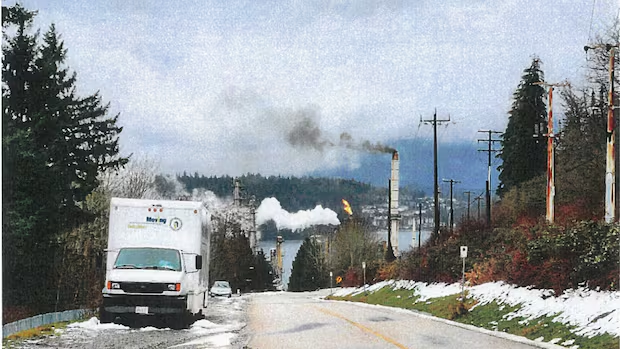
Black gas: Inside the investigation of a B.C. oil refinery chemical leak
Metro Vancouver pursuing up to $1.2 million in fines against refinery owned by U.S. company
Metro Vancouver has been granted a search warrant to seize dozens of documents inside Burnaby's Parkland Refinery that it believes will prove the facility polluted the region during a malfunction in January 2024 — and that staff didn't immediately warn the district about it.
Parkland could face fines up to $1.2 million for the chemical leakage on Jan. 21, 2024, which left an odorous haze across the region and prompted hundreds of calls to emergency lines.
Residents complained of headaches, coughs, dizziness and even vomiting, according to a request for a search warrant filed by district environment enforcement officer Jason Mushtuk.
The binders of documents being requested include emissions monitoring data, logbooks, shift schedules, maintenance records, and a list of compounds workers onsite were exposed to during the leak.
In the court application, the officer says the documents would help prove the company committed multiple air quality offences.
They would also be necessary to "establish and prove that Parkland could have taken reasonable measures to prevent the discharge of unauthorized air contaminant."
Court documents reveal the company believes releasing the documents could harm its "competitive position" in the market.
A judge granted the order on May 8.
A Metro Vancouver spokesperson said they won't comment on the ongoing investigation.
Parkland said it's cooperating and wouldn't comment further.
Citing Parkland's own internal investigation of the leak, Metro Vancouver said the incident traces back to a cold snap that prompted an emergency shutdown of the fluid catalytic cracking (FCC) unit used to make gasoline on Jan. 12, 2024.
On Jan. 20, Parkland started to turn the unit back on, but torch oil had leaked through a valve into the machine's riser and reactor. The oil is believed to have combusted.
The Parkland internal investigation says at about 3:50 p.m. PT, "FCC stack opacity spiked for ten minutes, remaining elevated for an hour." Stack opacity refers to how much light is blocked by emissions from an industrial smokestack.
Parkland outlines factors behind Burnaby, B.C., refinery emission
At 6:30 p.m., the emissions darkened again, and continued overnight.
There was a 10 p.m. meeting where the issue was discussed and, according to Parkland, "with no resolution in sight, the FCC unit was scheduled for shutdown at 6:00 a.m. the next day."
Just before 7:30 a.m., workers heard a "loud pop" and saw the stack plume "change from white-grey to green-black."
Burnt plastic odours and black smoke were observed in the surrounding area, including by Metro Vancouver officers. The district received its first public complaint at 7:55 a.m.
Parkland's environment manager Vicki Bowman reported the incident to the district at 8:30 a.m. Public advisories were issued hours later.
In total, the district says it received 171 public complaints and the City of Vancouver received 144 complaints. The complaints included people or their children in physical discomfort, including headaches, breathing issues, nausea, and even vomiting.
According to court records, Metro Vancouver believes polycyclic aromatic hydrocarbons (PAH), benzene, aldehydes, alkanes and alkenes were likely discharged during the leak. PAHs and benzene are classified carcinogens in Canada.
The DP World Canada terminal at the Port of Vancouver had to shut down "due to impacts of the emission plume," which cost the company more than $600,000 in losses, according to documents.
Mushtuk requested information from longshoreman who were working that day, asking how they were affected by the air quality, suggesting their testimony could be used in legal proceedings.
According to the court filing, Metro Vancouver officers initially requested access to binders of documents to learn more about what happened and corrective actions taken.
Mushtuk says Parkland provided access to redacted copies of the files, but only under supervision within Parkland's offices — prompting the request for a search warrant.
Sunday stank in Metro Vancouver. Here's how weather played a role
In an exhibit included in the filing, Parkland's environmental safety director Jacki Hess expressed concerns that releasing of the documents directly to Metro Vancouver means they could eventually be made public in future Freedom of Information requests.
Hess wrote that "the disclosure of that information would significantly harm Parkland's competitive position and interfere with [its] negotiating position."
She also claimed the documents contain confidential commercial, scientific and technical information.
According to the search warrant request, Mushtuk says the documents would support his belief that Parkland committed multiple air quality offences, including minute-by-minute data required to prove Parkland exceeded emissions limits.
Excessive emissions discharge carries a fine of up to $1 million, according to Metro Vancouver bylaws.
The document also cites Parkland's internal investigation as evidence that the malfunctioning equipment that led to the pollution was discovered on Jan. 20 and should have been reported to the district immediately, but wasn't — another bylaw infraction that carries a fine up to $200,000.
Mushtuk says the information would also "show the scope of corrective actions addressing deficiencies identified in the Incident Investigation Report" that contributed to the chemical leak.
Burnaby residents demand transparency over refinery fumes
Metro Vancouver wouldn't say if it will pursue fines through adjudication. It typically pursues companies through the courts when "public interest in the maintenance of environmental values requires prosecution."
Since 1998, the regional district has levied fines totaling $1.45 million through prosecution. None of the fines have exceeded $300,000.
Sunoco, the company that owns the refinery, reported a profit of more than $3 billion in its last quarter. It is headquartered in Texas.
Jon Hernandez is an award-winning multimedia journalist from Vancouver, British Columbia. His reporting has explored mass international migration in Chile, controversial logging practices in British Columbia, and the global HIV/AIDS epidemic.
Related Stories
 Canada
Israeli bulldozers smash Palestinian olive trees ahead of annual harvest
47 minutes ago
 Canada
Trump claims Canada’s ‘Liberal takeover’ will ‘end very badly’
47 minutes ago
 Canada
As Alberta separatism referendum looms, flags become symbol of voting intention
48 minutes ago
 Canada
New federal funds support pandemic preparedness research
48 minutes ago
 Canada
Anand to see if Netanyahu is crossing Canadian airspace with arrest warrant in effect
1 hour ago
 Canada
Trump says Canada welcomed millions ‘unchecked.’ The facts tell a different story
1 hour ago
 Canada
UK survivor of Canadian poison seller says he exploited her despair
1 hour ago
 Canada
Winnipeg plasma collection centre's licence suspended: Health Canada
1 hour ago