
Modi madness highlights diaspora role as 'human bridge'
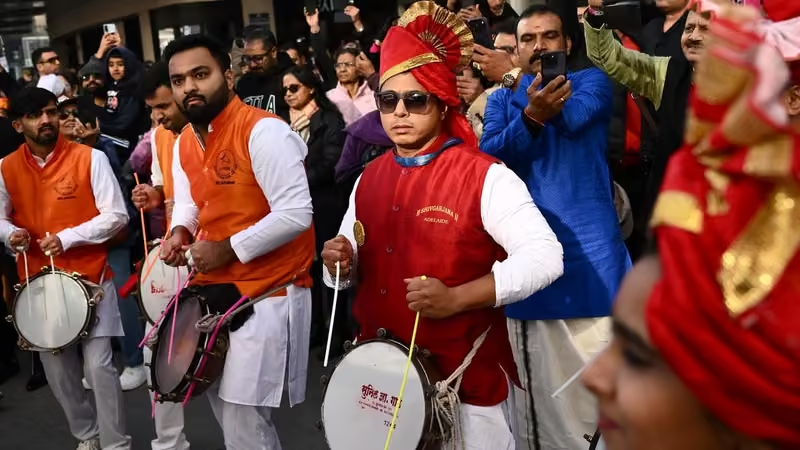
Indian Prime Minister Narendra Modi's visit has left many in awe of the popularity he commands among Indian-Australians and what the relationship with "modern India" means for Australia.
The at times controversial political figure has proven himself capable of steering the world's fastest-growing economy to greater heights during his more than a decade in office.
And his historic third visit to Australia has shown a willingness for his mates Down Under to be a part of that development through defence and trade, under which both countries stand to benefit.
The fact some 30,000 of the roughly one million Australians who could trace their roots to India turned out to see the country's head of state was an example of the opportunity Australia had before it, former federal senator turned head of the India Australia Institute Lisa Singh said.
"It shows Australia recognises the value of our Indian diaspora to the relationship," Ms Singh told AAP.
"The notion of that diaspora being a 'human bridge' between the two countries."
While so many from the subcontinent have made Australia home, they maintained a deep cultural connection to India and wanted to be part of the country's development, Ms Singh said.
"They want to connect with the advancement of India - the modern India," she said.
Mr Modi himself invited Australian businesses to invest in India's rapidly expanding economy during a chief executives' forum in Melbourne.
Vikas Kumar from the University of Sydney Business School said India, as a developing economy, was more than just "China 2.0".
"India is large, it is chaotic," he told AAP.
Professor Kumar said India should be seen not just as a country, but as a collection of diverse states, with the diaspora uniquely positioned to help establish state-level connections.
"I would think that they are relatively more qualified and connected, obviously, but also quite eager to make that contribution," he said.
Ms Singh said the two countries complemented each other in ways beyond a highly publicised uranium trade deal, such as education and sport, where Australia could step in to play a part.
Half of India's population is younger than 25 and in desperate need of upskilling, with a deal for two Australian universities to open new campuses in India among those landed during the visit.
"If Australia can support India through our high-level expertise in higher education - then that is a really good thing," Ms Singh said.
Mr Modi concluded his visit on Friday with a visit to the Melbourne Cricket Ground, with Ms Singh noting the countries have shared interests in sports beyond cricket - including India's bid to host the Olympics in 2036.
"We're so complementary, and I think a lot of that ... played out in this visit, through defence, through uranium, through sports, through education," she said.
Related Stories
 India
India
Starlink, Ambani’s venture should get equal treatment, let consumers decide: Shashi Tharoor
3 days ago
 India
India
Lawrence Bishnoi’s rise: Student politics, first murder and a sprawling crime network | India News
3 days ago
 India
India
India’s finance minister says market liquidity makes it easier for investors to exit
3 days ago
 India
India
India news: CJP alleges 'deliberate' delay in leaders' release
3 days ago
 India
India
Indian Diaspora Holds Pro-Modi Counter
3 days ago
 India
India
Clashes Erupt in London as Diaspora Divided Over India's Election Chief and Electoral Roll Controversy
3 days ago
 India
India
London: Indian diaspora rallies in support of PM Modi, criticises CJP protesters
3 days ago
 India
India
Cabinet Approves Go
3 days ago