
Moving artificial intelligence from research to real
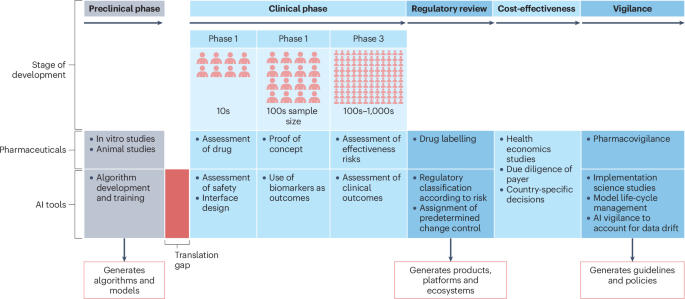
Artificial intelligence (AI) applications in neurology have reached an inflection point. Despite US Food and Drug Administration approval of numerous algorithms in neuroimaging, neurophysiology, genetics and chatbots, their real-world impact remains limited. This disconnect between research promise and clinical reality represents a gap in understanding how to translate AI algorithms into clinical benefit for patients globally. In this Perspective, we examine the challenges that prevent clinical AI use in neurology moving beyond pilot studies towards meaningful clinical impact. We consider the steps required in the process of translation, including research, validation of AI models, regulatory approval pathways and clinical implementation. We discuss implementation of AI models as stand-alone products versus embedded platforms, and the requirements for sustainable deployment. Beyond traditional clinical decision support tools, we examine paraclinical applications of AI, including chatbots and ambient voice documentation. We recommend expanding capacity for prospective validation and scaling by implementing and validating technologies across multiple sites and countries, which requires infrastructure from long-term partnerships. Neurology must shift from asking whether AI can work to understanding how to use it safely at scale.
This is a preview of subscription content, access via your institution
Prices may be subject to local taxes which are calculated during checkout
Tracxn. Native AI in Healthcare – Companies. tracxn.com https://tracxn.com/d/sectors/native-ai-in-healthcare/__Tl5eFsTO1TeAyMWAv1mZ2ckAIl4ywCTh_vx2THnj_dY/companies (2026).
Nguyen, T. D. et al. Adoption of artificial intelligence in the health care sector. JAMA Health Forum 6, e255029 (2025).
Article PubMed PubMed Central Google Scholar
Wu, K. et al. Characterizing the clinical adoption of medical AI devices through U.S. insurance claims. NEJM AI 1, AIoa2300030 (2024).
Poon, E. G., Lemak, C. H., Rojas, J. C., Guptill, J. & Classen, D. Adoption of artificial intelligence in healthcare: survey of health system priorities, successes, and challenges. J. Am. Med. Inform. Assoc. 32, 1093–1100 (2025).
Tveit, J. et al. Automated interpretation of clinical electroencephalograms using artificial intelligence. JAMA Neurol. 80, 805–812 (2023).
Mansilla, D. et al. Generalizability of electroencephalographic interpretation using artificial intelligence: an external validation study. Epilepsia 65, 3028–3037 (2024).
US Food & Drug Administration. Marketing submission recommendations for a predetermined change control plan for artificial intelligence-enabled device software functions: guidance for industry and Food and Drug Administration staff. FDA https://www.fda.gov/regulatory-information/search-fda-guidance-documents/marketing-submission-recommendations-predetermined-change-control-plan-artificial-intelligence (2025).
European Union. Regulation (EU) 2017/745 of the European Parliament and of the Council of 5 April 2017 on medical devices, amending Directive 2001/83/EC, Regulation (EC) No 178/2002 and Regulation (EC) No 1223/2009 and repealing Council Directives 90/385/EEC and 93/42/EEC (text with EEA relevance). EUR https://eur-lex.europa.eu/eli/reg/2017/745/oj/eng (2017).
Kull, M. & Annunziata, A. A landmark partnership between Cleveland Clinic and IBM Research. IBM https://research.ibm.com/blog/cleveland-clinic-ibm-discovery-accelerator (2021).
Anastasijevic, D. Mayo Clinic selects Google as strategic partner for health care innovation, cloud computing. mayoclinic.org https://newsnetwork.mayoclinic.org/discussion/mayo-clinic-selects-google-as-strategic-partner-for-health-care-innovation-cloud-computing/ (2019).
European Union. Regulation (EU) 2024/1689 of the European Parliament and of the Council of 13 June 2024 laying down harmonised rules on artificial intelligence and amending Regulations (EC) No 300/2008, (EU) No 167/2013, (EU) No 168/2013, (EU) 2018/858, (EU) 2018/1139 and (EU) 2019/2144 and Directives 2014/90/EU, (EU) 2016/797 and (EU) 2020/1828 (Artificial Intelligence Act) (text with EEA relevance). EUR https://eur-lex.europa.eu/eli/reg/2024/1689/oj/eng (2024).
Medicines and Healthcare products Regulatory Agency. Health Institution Exemption for general medical devices. gov.uk https://www.gov.uk/government/publications/health-institution-exemption-for-general-medical-devices (2025).
Zhou, J. et al. Large language models in biomedicine and healthcare. npj Artif. Intell. https://doi.org/10.1038/s44387-025-00047-1 (2025).
NHS England. Guidance on the use of AI-enabled ambient scribing products in health and care settings. NHS https://www.england.nhs.uk/long-read/guidance-on-the-use-of-ai-enabled-ambient-scribing-products-in-health-and-care-settings/ (2026).
US Food and Drug Administration. Good machine learning practice for medical device development: guiding principles. FDA https://www.fda.gov/medical-devices/software-medical-device-samd/good-machine-learning-practice-medical-device-development-guiding-principles (2025).
US Food and Drug Administration. Artificial intelligence-enabled device software functions: lifecycle management and marketing submission recommendations — draft guidance for industry and Food and Drug Administration staff. FDA https://www.fda.gov/regulatory-information/search-fda-guidance-documents/artificial-intelligence-enabled-device-software-functions-lifecycle-management-and-marketing (2024).
National Institute for Health and Care Excellence. NICE health technology evaluations: the manual. NICE https://www.nice.org.uk/process/pmg36/chapter/introduction-to-health-technology-evaluation (2026).
American Medical Association. CPT (Current Procedural Terminology). AMA https://www.ama-assn.org/practice-management/cpt (2025).
Fornell, D. Radiology dominates FDA-cleared AI, but reimbursement lags far behind. radiologybusiness.com https://radiologybusiness.com/topics/artificial-intelligence/radiology-dominates-fda-cleared-ai-reimbursement-lags-far-behind (2025).
Basu M. Dozens of AI disease-prediction models were trained on dubious data. Nature https://doi.org/10.1038/d41586-026-00697-4 (2026).
Ewen, J. B. et al. The GREENBEAN checklist for reporting studies evaluating the effectiveness of EEG-based biomarkers. Clin. Neurophysiol. 176, 2110777 (2025).
Moons, K. G. M. et al. PROBAST+AI: an updated quality, risk of bias, and applicability assessment tool for prediction models using regression or artificial intelligence methods. BMJ 388, e082505 (2025).
Dan, J. et al. SzCORE: Seizure Community Open-Source Research Evaluation framework for the validation of electroencephalography-based automated seizure detection algorithms. Epilepsia 66, 14–24 (2025).
Billot, B. et al. SynthSeg: segmentation of brain MRI scans of any contrast and resolution without retraining. Med. Image Anal. 86, 102789 (2023).
Goebl, P. et al. Enabling new insights from old scans by repurposing clinical MRI archives for multiple sclerosis research. Nat. Commun. 16, 3149 (2025).
Article CAS PubMed PubMed Central Google Scholar
Kraljevic, Z. et al. Foresight-a generative pretrained transformer for modelling of patient timelines using electronic health records: a retrospective modelling study. Lancet Digit. Health 6, e281–e290 (2024).
Jiang, L. Y. et al. Health system-scale language models are all-purpose prediction engines. Nature 619, 357–362 (2023).
Sheikh, S. & Jehi, L. Predictive models of epilepsy outcomes. Curr. Opin. Neurol. 37, 115–120 (2024).
Obermeyer, Z., Powers, B., Vogeli, C. & Mullainathan, S. Dissecting racial bias in an algorithm used to manage the health of populations. Science 366, 447–453 (2019).
Article CAS PubMed Google Scholar
Observational Health Data Sciences and Informatics. Standardized data: the OMOP common data model. OHDSI https://www.ohdsi.org/data-standardization/ (2026).
Shenzhang, S., Möller-Grell, N., Jiang, Z. J., Dobson, R. & Chandrabalan, V. V. OMCP: Model Context Protocol servers for the OMOP common data model. HDR https://ukhealthdata.org/wp-content/uploads/2025/09/OMCP.pdf (2025).
Health Level Seven International. HL7 messaging standard version 2.9: an application protocol for electronic data exchange in healthcare environments. HL7 https://www.hl7.org/implement/standards/product_brief.cfm?product_id=516 (2019).
Health Level Seven International. HL7 FHIR Release 5 (R5), v5.0.0. HL7 https://hl7.org/fhir/R5/ (2023).
Möller-Grell, N., Shenzhang, S., Jiang, Z. J., Chandrabalan, V. V. & Dobson, R. Agentic conversation on OMOP CDM: the OMCP-A2A foundation library. OHDSI https://www.ohdsi.org/2025showcase-310/ (2025).
Tidy, J. AI coding platform’s flaws allow BBC reporter to be hacked. BBC News https://www.bbc.co.uk/news/articles/cy4wnw04e8wo (2026).
Greenberg, A. Thousands of vibe-coded apps expose corporate and personal data on the open web. WIRED https://www.wired.com/story/thousands-of-vibe-coded-apps-expose-corporate-and-personal-data-on-the-open-web/ (2026).
Steiger M. Patientendaten stehen nach «Vibe Coding» mit KI offen im Internet [Patient data exposed on the internet after “vibe coding” with AI]. SL https://steigerlegal.ch/2026/03/31/vibe-coding-patientendaten/ (2026).
Holdgraf, C. et al. iEEG-BIDS, extending the brain imaging data structure specification to human intracranial electrophysiology. Sci. Data 6, 102 (2019).
Kaur H. et al. E-188 The influence of artificial intelligence tools on enhancing patient follow-up compliance for unruptured intracranial aneurysms: insights from Viz Aneurysm® software. J. Neurointerv. Surg. https://doi.org/10.1136/jnis-2024-SNIS.293 (2024).
Zhang, X. et al. Effect of a clinical decision support system on stroke care quality and outcomes in patients with acute ischaemic stroke (GOLDEN BRIDGE II): cluster randomised clinical trial. BMJ 392, e085810.
Kings College Hospital, London, UK
James T. Teo & Mark P. Richardson
Institute of Psychiatry, Psychology & Neuroscience, Division of Neuroscience, King’s College London, London, UK
Neurological Institute, Cleveland Clinic London, London, UK
Queen Square Multiple Sclerosis Centre, Department of Neuroinflammation, Faculty of Brain Sciences, University College London, London, UK
Epilepsy Centre at Neurological Institute, Cleveland Clinic Research, Cleveland Clinic, Cleveland, OH, USA
Department of Computational Life Sciences, Cleveland Clinic Research, Cleveland Clinic, Cleveland, OH, USA
Department of Clinical Neurophysiology, Danish Epilepsy Centre, Dianalund, Denmark
Department of Clinical Neurophysiology, Copenhagen University Hospital Rigshospitalet, Copenhagen, Denmark
Department of Clinical Medicine, University of Copenhagen, Copenhagen, Denmark
Search author on:PubMed Google Scholar
The authors contributed equally to all aspects of the article.
Correspondence to James T. Teo.
J.T.T. has received research grant funding from the Engineering and Physical Sciences Research Council, Innovate UK, the National Institute for Health and Care Research (NIHR) and the Office of Life Sciences. He is in working groups of multiple UK public sector advisory boards (Department of Health and Social Care AI Advisory, Health Research Authority, Medicines and Healthcare Regulatory Authority and National Health Service (NHS) 10-Year Plan). He is a co-founder of and owns equity in CogStack (AI startup). He is employed by NHS public institutions as well as Cleveland Clinic London. The views in this Perspective represent his own. A.E. has received research grants from Autolus, Biogen, Innovate UK, IXICO, the Medical Research Council, Merck, the NIHR and Roche. He has served as an advisory board member for Bristol Myers Squib and Merck Serono. He is the founder of and an equity stakeholder in Queen Square Analytics. He serves on the editorial board of Neurology (American Academy of Neurology). He has received speaker honoraria from Merck, MS at the Limits and Roche for educational sessions. M.P.R. has received research grants from Angelini Pharma, Autifony Therapeutics, the Epilepsy Foundation, the Epilepsy Research Institute, the European Commission, GW Pharmaceuticals, the Medical Research Council, the NIHR and Xenon Pharma. He has served as an ad hoc adviser and has been a member of advisory boards for Lundbeck, Piramidal, UCB and UNEEG Medical. He is a co-founder of and owns equity in NeuralPulse and has licensed intellectual property to Neuronostics. He is a board member and trustee of the Epilepsy Research Institute. L.J. has received research grants from the National Institutes of Health, where she served on the Clinical Research Informatics Strategic Planning Initiative Working Group. She is the Executive Lead of the Cleveland Clinic–IBM partnership and is a board member of Microsoft’s Artificial Intelligence Industry Innovation Coalition. She serves on the National Institute of Neurological Disorders and Stroke Benchmarks for Epilepsy Research Taskforce and on the advisory committee to the Office of Science for the US Department of Energy focusing on national AI and quantum strategies to accelerate discovery. S.B. has received research grants from Danish Agency for Higher Education and Science: International Network Programme, the European Union (Eurostars Programme/EUREKA and HORIZON Europe Framework Programme), Filadelfia Research Fund, Independent Research Fund Denmark and Innovation Fund Denmark. He has received speaker honoraria from Eisai and UCB Pharma.
Nature Reviews Neurology thanks H. Fröhlich, C. Granziera, I. Nasrallah and the other, anonymous, reviewer(s) for their contribution to the peer review of this work.
Publisher’s note Springer Nature remains neutral with regard to jurisdictional claims in published maps and institutional affiliations.
AIRAMed (2026): https://arzt.airamed.de/en/airascore-structure
Cortechs AI (2026): https://www.cortechs.ai/neuroquant/
European Union Innovative Health Initiative: https://www.ihi.europa.eu/
GE HealthCare: https://www.gehealthcare.co.uk/
Icometrix (2026): https://www.icometrix.com/multiple-sclerosis
Natus Neuroworks: https://natus.com/neuro/autoscore-ai/
Newton’s Tree: https://www.newtonstree.ai/
OpenEHR Foundation: https://openehr.org/
Rapid AI (2026) IschemaView: https://www.rapidai.com/neurovascular/ischaemic-stroke
Springer Nature or its licensor (e.g. a society or other partner) holds exclusive rights to this article under a publishing agreement with the author(s) or other rightsholder(s); author self-archiving of the accepted manuscript version of this article is solely governed by the terms of such publishing agreement and applicable law.
Teo, J.T., Eshaghi, A., Richardson, M.P. et al. Moving artificial intelligence from research to real-world clinical use in neurology. Nat Rev Neurol (2026). https://doi.org/10.1038/s41582-026-01225-8
Version of record: 29 June 2026
DOI: https://doi.org/10.1038/s41582-026-01225-8
Related Stories
 AI News
Bill Gross bets AI can help mass
4 days ago
 AI News
Nigeria records 93% rise in AI micro
4 days ago
 AI News
The Italian gelato maker using AI to invent new flavours
4 days ago
 AI News
Closing the Gap Between Agentic CX Pilots and Production
4 days ago
 AI News
New Brunswick data centre debate highlights cross
4 days ago
 AI News
How to Structure an AI Agent Referral Fee Agreement Between Startups
4 days ago
 AI News
No, AI didn’t delete a Swedish reality TV series
4 days ago
 AI News
There is no AI in Armageddon. Artificial intelligence is a tool, not an apocalypse
4 days ago