
Netanyahu is flying freely over Canada as his international arrest warrant remains in place
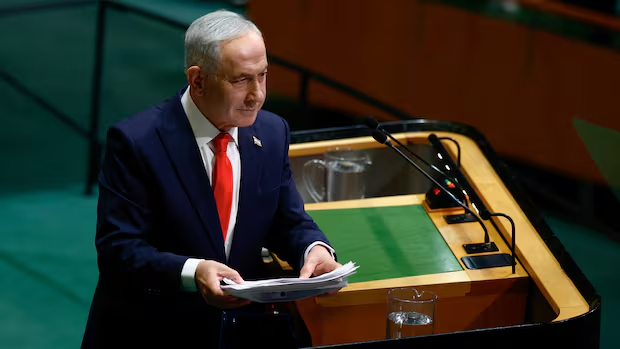
Netanyahu is flying freely over Canada as his international arrest warrant remains in place
Permitting Israeli leader to enter airspace goes counter to Rome Statute, says international law expert
A review of two years of flights by Israeli Prime Minister Benjamin Netanyahu shows that the Israeli leader is once again routinely taking a more direct path — through Canadian airspace — when travelling to the United States despite the international arrest warrant that Canada has committed to enforce.
Canada has been criticized for undermining its public message of support for international law by permitting Netanyahu to fly over the country. Over that time, the federal government's explanation of its rationale for doing so has shifted.
European countries appear to be split on the issue of whether an obligation to enforce the warrant extends to sovereign airspace.
The government of France, which has also allowed Netanyahu to fly through its airspace, has said it will enforce International Criminal Court (ICC) arrest warrants against Israeli officials — but has also argued that it has no obligation to do so in the air.
French Foreign Ministry spokesperson Pascal Confavreux said after Netanyahu's most recent flight that "the Rome Statute does not impose any obligations regarding overflights of its territory by a state plane which has a passenger who is targeted by an arrest warrant," referring to the treaty that founded the ICC.
France is an exception in clearly stating its interpretation of its Rome Statute obligations. Italy and Greece have also allowed Netanyahu to overfly national territory, but both have declined to explain their legal reasoning.
A statement from the Prime Minister's Office over the summer was less direct, saying that Canada's "law enforcement objectives" are not typically linked to who it permits to fly through Canadian airspace.
Whether or not airspace is covered by the Rome Statute is debated by international law experts.
The facts about Netanyahu in Canadian airspace
Ardi Imseis is co-director of the international law program at Queen's University and a member of the Group of Eminent International and Regional Experts, a commission of inquiry mandated by the UN Human Rights Council to investigate violations of humanitarian law in the Yemeni war.
"Canada is a state party to the Rome Statute of the International Criminal Court, which requires it to arrest and surrender any person who is subject to an arrest warrant issued by the court," Imseis told CBC News.
"Canada has therefore breached its obligations as a state party to the Rome Statute by allowing Netanyahu to enter Canadian airspace en route to the United States."
Flight data suggests that Netanyahu's concerns about the risks of international travel peaked in late 2025, with his flight to New York that year burning a considerable amount of extra fuel to avoid the European mainland, staying mostly over Mediterranean waters before entering the Atlantic Ocean through the Strait of Gibraltar.
Some countries, such as Slovenia and Turkey, have publicly stated that their airspaces are closed to the Israeli leader. In other cases, such as Spain, no ban has been announced but Netanyahu's jet has made clear detours to avoid airspace. Netanyahu's plane has also continued to deviate from the fastest Great Circle route to avoid either Irish or British airspace (both lie on the same heading).
In November 2024, the ICC issued an arrest warrant against Netanyahu for alleged war crimes including "starvation as a method of warfare" and "intentionally directing an attack against the civilian population." The Israeli government rejects the charges.
The government of Canada has been reluctant to say whether it granted permission for the flights.
However, on the last two occasions it has given answers.
Netanyahu's most recent overflight — on Sept. 24 for the United Nations General Assembly — was also the one that ranged furthest into the Canadian mainland since the warrant was issued, crossing Labrador and a large part of Quebec.
As the UN gathered in Manhattan, Canadian Foreign Affairs Minister Anita Anand told reporters she didn’t know whether Netanyahu would cross Canada.
"I actually have asked my department to provide me with information relating to this particular flyover, which I did not have before coming to the United Nations," Anand told reporters outside UN headquarters a day before Netanyahu landed.
The Israeli leader would have had to seek permission for that flight from Anand's department at least two days before Anand’s remarks, under Canadian protocol rules.
Netanyahu again flies through Canadian airspace en route to Washington
Myah Tomasi of Global Affairs Canada later said that the decision was out of respect for the traditions of the United Nations.
"Any authorization to pass through Canadian airspace should not be interpreted as an endorsement of the policies or actions of any particular government," she said.
"In this case, the overflight request was in connection to the United Nations General Assembly, a critical forum for the diplomatic engagement."
Despite this position from the Carney government, Netanyahu's plane, known as the Wing of Zion, clearly avoided Canadian airspace when he travelled to the UN General Assembly last year.
On July 27, when the United Nations was not on his agenda, Netanyahu's Boeing 767-300 also crossed Newfoundland and Nova Scotia on his way to an Oval Office meeting with U.S. President Donald Trump.
The Israeli Embassy told CBC News that it had sought a green light from the Carney government for Netanyahu's jet to cross Canada. The embassy did not respond to questions about the most recent flight.
Israel says it asked Canada for permission for Netanyahu to use Canadian airspace
It was following that July flight, and the Israeli statement, that Prime Minister's Office spokesperson Audrey Champoux told CBC News "Canada does not currently link its overflight policy to law enforcement objectives except where an imminent security risk is present."
Separately, a Global Affairs Canada spokesperson told CBC News that "Canada's position remains that, as a state party to the Rome Statute of the International Criminal Court, it must comply with its obligations under the statute and under international law."
Netanyahu's first flight of the Carney era was in July 2025, and carried the Israeli leader to Washington to meet Trump and members of Congress. On that occasion the Wing of Zion skirted just outside Canadian airspace off Newfoundland before entering U.S. airspace near Atlantic City, N.J.
The flight prior to that, in February 2025, was Netanyahu's first visit to the U.S. after the issuance of his arrest warrant, and occurred while Justin Trudeau was still prime minister. Trudeau had committed to enforce the ICC warrant, without specifying whether that determination also applied to Canada's airspace. Carney later made a similar commitment.
In any event, that flight avoided Canadian airspace, entering the U.S. at the mouth of Delaware Bay.
Support for the court questioned
Some international law experts have said that by failing to uphold the ICC's authority more strongly, Canada is aiding those in the Trump, Putin, and Netanyahu governments who seek to destroy it. (Neither the U.S. nor Israel are parties to the Rome Statute, and Russia withdrew a decade ago.)
"On the one hand Canada says it believes in the international rule of law and holds itself out as a strident supporter of the ICC," Imseis said.
"On the other hand, Canada's refusal to discharge its clear and unambiguous obligations to execute the arrest and surrender of Netanyahu demonstrates a commitment to lawlessness."
"Simply put," he added, "Ottawa has allowed a wanted fugitive from international justice to repeatedly use its territory to escape criminal accountability."
Errol Mendes, a former senior adviser to the Privy Council who teaches law at the University of Ottawa, said he was not as concerned by the overflights, but what he sees as a wider pattern of abandonment of the International Criminal Court.
"That court is now in dire danger from the Trump attempt to destroy it, not only by sanctioning individual judges, including Canadian Kim Prost, but also financially strangling the court through freezing all financial transactions going through the U.S.," he told CBC News.
Mendes says that as a founding member of the court, Canada has a strong obligation to come to its defence, "including with blocking actions against the Trump financial and other sanctions."
"If they don't," said Mendes, "the court may well come to a halt which would be devastating for the international rule of law and the global commitment to combat impunity for the most serious international crimes."
Evan Dyer has been a journalist with CBC for 25 years, after an early career as a freelancer in Argentina. He works in the Parliamentary Bureau and can be reached at evan.dyer@cbc.ca.
Related Stories
 World
World
‘Golden passport’ plan aims to attract wealthy foreigners
4 minutes ago
 World
World
'Xiaomi Vision Gran Turismo' Footage Revealed at 'Gran Turismo World Series' Rd.3 - Singapore
5 minutes ago
 World
World
Manchester Half Marathon: Dad with MS attempts world record
1 hour ago
 World
World
Co
1 hour ago
 World
World
Flydubai co
1 hour ago
 World
World
G7 nations agree to release oil stockpiles | NHK WORLD
2 hours ago
 World
World
Christa Pike on ventilator after surviving Tennessee execution attempt, lawyer says
3 hours ago
 World
World
Video. Latest news bulletin | October 3rd, 2026
3 hours ago