
New art at Nanaimo’s McGregor Park to commemorate Japanese Canadians
New art at Nanaimo’s McGregor Park to commemorate Japanese Canadians
Published 5:30 am Wednesday, July 15, 2026
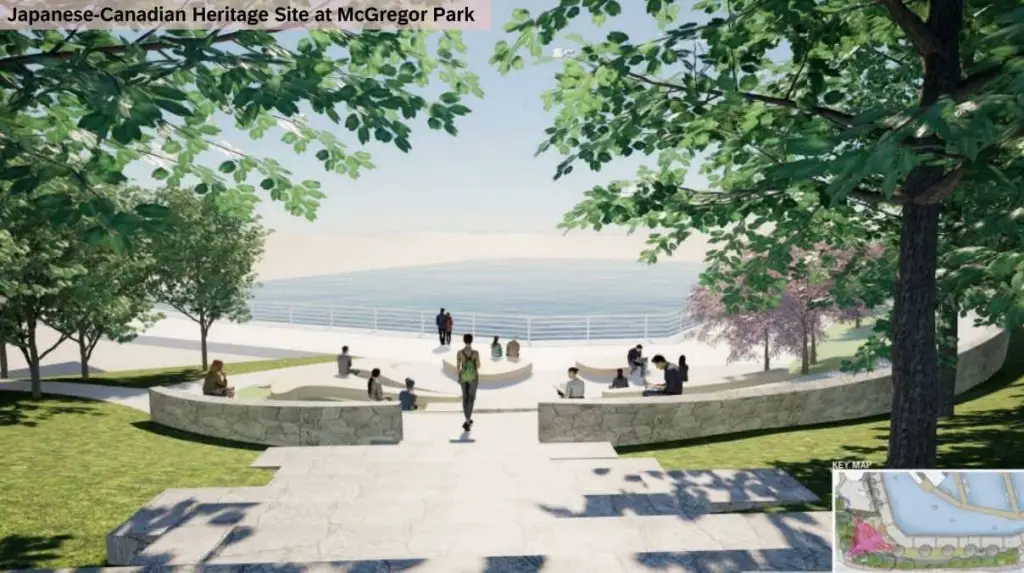
The Japanese Canadian Legacies Society and the City of Nanaimo are funding a new art installation in McGregor Park that will celebrate Japanese-Canadian heritage in the city. (City of Nanaimo graphic)
The area along the waterfront known as McGregor Park is getting a makeover.
The park, which is a part of the Nanaimo Harbour Front Walkway and located directly across the harbour from the Port Theatre, will become home to a permanent landscape art installation celebrating Japanese-Canadian heritage in Nanaimo through design and public art integrated into the natural landscape.
With funding from the Japanese Canadian Legacies Society and the City of Nanaimo, the project is intended to create a lasting space for reflection, gathering, storytelling, and cultural expression while recognizing the important contributions of Japanese Canadians to Nanaimo.
As well, a new Nikkei Outdoor Performance Space, also funded by a JCLS Legacy Infrastructure grant, will be developed at Beban Park to create a dedicated venue for cultural performances, storytelling, music, educational programming, and community gatherings.
The history of Japanese Canadians in Nanaimo, and along the west coasts of both the U.S. and Canada, is tainted by the Second World War.
In the early 20th century, Japanese Canadians built Nanaimo into the “Herring Capital of the World,” operating 43 herring salteries and boatyards around Departure Bay, Hammond Bay, and Newcastle Island
More than 40 Japanese-Canadian families lived and thrived in Nanaimo until the War Measures Act was introduced in 1941, after the Japanese attack on the American naval base in Pearl Harbor.
Japanese-Canadian homes and businesses in Nanaimo and the West Coast were seized by the government and the families forced out due to fears they might be collaborating with the Japanese government.
The families were imprisoned in internment camps in the interior of B.C. and their homes, boats, lands and belongings were auctioned off.
Even after the seven years of internment ended, families weren’t allowed to return to Nanaimo and the West Coast.
In 1988, Prime Minister Brian Mulroney delivered Canada’s first apology for the treatment of Japanese Canadians during the war.
According to the City of Nanaimo’s projects page, rather than serving as a traditional monument, the project in McGregor Park will transform the green space into a place of reflection and learning, encouraging visitors to engage with the history and legacy of Japanese Canadians in Nanaimo.
“The design will blend artistic expression with the surrounding environment, creating a space that invites exploration while enhancing the park’s existing character,” the city said.
“The Harbourfront Walkway will remain open throughout construction, which is expected to be complete in December. Adjacent roads and bike lanes may be temporarily impacted.”
As for the new performance space in Beban Park, the city’s website stated it is envisioned as a flexible outdoor venue that supports both Japanese-Canadian cultural programming and broader community events throughout the year.
“It will provide an opportunity for residents and visitors to experience performances, festivals, ceremonies, and educational activities in a welcoming park setting,” the city said.
That project is also expected to completed in December.
Related Stories
 AI News
Nextech3D.ai launches enterprise pilot for AI workforce platform KraftyLab Intelligence
9 minutes ago
 AI News
World shares are mixed and oil prices climb as Iran threatens to block Middle East energy exports
52 minutes ago
 AI News
One dead and three missing after boat sinks near Alcatraz
52 minutes ago
 AI News
U.S. launches new daylight attacks on Iran, upping pressure alongside naval blockade
52 minutes ago
 AI News
Calls for ICE reform grow after agents kill 2 men in their cars in 1 week
52 minutes ago
 AI News
Iran threatens to block more trade routes as US launches fresh strikes
52 minutes ago
 AI News
Iran and India Share a Civilisational Bond Beyond Politics, Says Supreme Leader's Representative
54 minutes ago
 AI News
Wildfire smoke blankets Ontario: Air Quality Health Alert
54 minutes ago