
New memorial marks one of Canada's deadliest — but less known
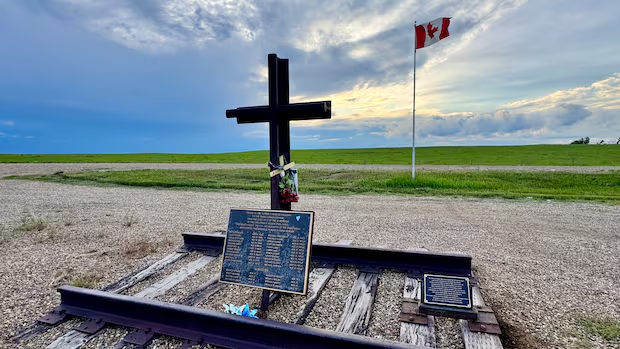
New memorial marks one of Canada's deadliest — but less known — highway accidents
A fiery crash killed 22 men on a CPR rail crew bus near Webb, Sask., in 1980
Violet Denty was just nine years old when she awoke to the sound of her father crying at the kitchen table in their modest home in Rushoon, a small fishing village tucked into Newfoundland and Labrador's Burin Peninsula.
She knew something was terribly wrong.
"My father is a Silent Generation man. He did not cry. He did not show emotion if he didn't have to. But that morning, he was crying," she recalls.
"I asked what was wrong and Mom said, 'Calvin and James have died.'"
Like many young men affected by Newfoundland and Labrador's fisheries crisis and mine closures, her older brothers Calvin, 26, and James, 25, had headed west to work on the rail line to earn money for their families.
"Saskatchewan to me was like the other side of the moon," she said. "All I knew was that my brothers were on the track and they weren't coming home."
These days, when most people think of a horrific bus crash in Saskatchewan, their minds turn to the Humboldt Broncos bus crash in 2018 that killed 16 members of a junior hockey team and injured 13 others.
However, the bus crash that claimed 22 young men — including Calvin and James Lake — and left eight others injured on May 28, 1980, stands as the deadliest highway disaster in Saskatchewan history and the third worst in Canada.
This week, friends and family will gather at the spot near Webb, a small village 34 kilometres west of Swift Current, to dedicate a new plaque that will offer more details about the crash.
Brent Cammer, 72, a rancher who rushed to the scene with the Webb fire truck that day, helped install the plaque. He says people often stop at the existing roadside memorial and ask, "What happened?"
A group of 93 men, known as the Canadian Pacific Railway "Prairie Steel Gang," had put in a grueling shift fixing the tracks near Webb. They quit around 2:30 p.m. and boarded three leased school buses for the short trip back to their bunk cars.
A westbound car crossed into the path of the bus, loaded with 30 passengers. The bus driver, Michael Beach, shouted a warning and swerved toward the shoulder, but the car slammed into the front and side of the bus, sending it rolling.
Seconds later, a tanker truck carrying hot asphalt oil struck the wreckage, tearing the bus roof away. The scene erupted into fire and chaos. Hard hats and boots littered the highway.
Other CPR workers who were in the third bus, travelling just minutes behind, braved the flames and explosions to try to lift the bus and rescue anyone left alive. Hot oil pooled in the ditch, and black smoke billowed a hundred metres into the sky.
CBC's The National reports on the steel gang bus crash
A hockey rink in Swift Current was turned into a temporary morgue. The coroner had to rely on clothing, tattoos, wedding rings and dental records to try to identify the badly burned victims.
Of the 22 dead, 12 were from Newfoundland and Labrador, nine from Manitoba, and one from Ontario.
One survivor, Gerald Synard, later told CBC News how difficult it was to see the families of those who died.
"I wonder if they're thinking why you survived, and their loved ones didn't survive. It tears you up inside," Synard said.
Tommy Slaney's sisters didn't think he was anywhere near the accident.
The 25-year-old from St. Lawrence, Newfoundland and Labrador, called his parents every week and in his last phone call had said he'd be fixing tracks in Alberta.
Yvonne Edwards and Janet Brewer remember their distraught mother watching the national news that night and worrying about all the other mothers who had lost their sons.
Police cars and a priest arrived at their house the next morning.
Richard "Tommy" Slaney had been on the bus, they said. He was presumed dead, but hadn't been identified yet.
"We were just kept in the dark, just waiting," Edwards said. "A terrible waiting game."
This CBC report shows workers and coffins arriving in St. John’s
Brewer kept thinking it couldn't be true. Her brother was larger than life. He loved cars, music and books.
"He knew everyone and everyone knew him," she said.
It turned out their brother had borrowed a t-shirt from a friend and was mistaken for the other young man. Tommy Slaney was buried in the other man's hometown.
The misidentification of victims was echoed 38 years later after the Humboldt Broncos bus crash, when coroners struggled to distinguish teen hockey players, in part because they all had bleached their hair blond for playoffs. One family discovered their son was alive three days later, while another family learned the boy they'd comforted in the hospital was not theirs.
The Slaney family was left with a lot of questions about what actually happened and who — if anyone — was to blame. Communication from CPR quickly faded off, Edwards said, and the victims' families were too devastated, and too spread out, to organize themselves.
"There was no social media at the time," she added.
Calls for seatbelts and harsher DUI penalties
No one was ever charged. No lawsuits were ever filed.
But a coroner's inquest began almost immediately.
According to newspaper archives, medical evidence from three pathologists showed all but one of the men died instantly or quickly from the impact of the accident, and they did not burn to death as feared by many.
The provincial director of highway traffic safety testified that he was "reasonably sure" fatalities would have been prevented if passengers had been restrained in their seats.
The coroner's jury recommended that all school-type buses be equipped with seat belts or other restraining devices.
It wasn't until 2018, after the deadly Humboldt Broncos crash, that Transport Canada decided all newly built medium and large buses would require seatbelts as of 2020. Seatbelts are not mandatory on school buses.
The coroner's jury also heard the driver of the car might have been legally impaired.
The two men from Ontario in the car had been drinking at the Legion hall in Swift Current before the crash. A CBC report from the coroner's inquest said the driver initially refused to do a blood test. He eventually consented five hours later at the hospital.
RCMP analysis suggested the driver's blood-alcohol level would have been between .06 and .11 at the time of the crash. The legal limit was .08.
The CPR foreman driving the bus had a blood-alcohol level of .04.
The jury recommended drivers should be required to submit to a blood-alcohol test immediately after a motor vehicle accident, and that stiffer penalties for impaired driving should be considered.
Another recommendation was twinning the Trans-Canada Highway west of Swift Current to the Saskatchewan-Alberta border. It took another 18 years to start four-lane construction, and it was completed in 2008.
As you drive along the Trans-Canada highway near Webb, a Canadian flag catches your eye.
It's a memorial to the crash, with a section of rail track, a welded steel cross, and a plaque naming the 30 men on the bus.
Residents from Webb built the monument soon after the accident and have maintained it ever since. A similar memorial was erected 5,600 kilometres away in Rushoon, Newfoundland and Labrador, in 2010 to give families on the east coast a place to gather every year on the anniversary.
But there's something poignant about the spot where it happened.
Living just a mile from the memorial, Brent Cammer often meets travellers curious about the tragedy.
"There was always people asking about what happened here, how come all of these guys died?" he said.
The rancher is determined to "do right by those boys," and says a new plaque will help tell the story.
It's heartwarming for Janet Beach, who craves any kind of connection to her brother Michael.
"The friends I have now, they never knew Michael," she said. "The memorial is really very, very special for me."
A reunion and plaque dedication is planned for June 16.
Though she can't attend, Violet Denty is grateful her brothers and their friends continue to be remembered.
“Let's never forget them,” she said.
Tommy Slaney's sister, Yvonne Edwards, hopes to visit the spot one day soon.
“I just want to see where it happened — where he spent his last moments.”
People are invited to attend the plaque dedication at 4:30 p.m. Tuesday, June 16, at the crash spot, followed by a supper and roundtable conversation with a documentary crew from 47 Filmworks Inc. at the Webb community hall.
Bonnie Allen is a senior news reporter for CBC News based in Saskatchewan. She has covered stories from across Canada and around the world, reporting from various African countries for five years. She holds a master's degree in international human rights law from the University of Oxford. You can reach her at bonnie.allen@cbc.ca
Related Stories
 Canada
Documentary asks encampment residents how they ended up there
18 minutes ago
 Canada
Trolling or part of a larger plan?: Why Elon Musk waded into the separatism debate
18 minutes ago
 Canada
Lions clinch playoff spot with win over Redblacks
1 hour ago
 Canada
Life
1 hour ago
 Canada
Plans progress but 550 flats demolition 'not imminent'
1 hour ago
 Canada
Here's what to know about flu, COVID
1 hour ago
 Canada
Trump says Norway has ‘indelible stain’ for not awarding him Nobel Peace Prize
3 hours ago
 Canada
Elks score fourth-quarter TDs to down Ticats 27
3 hours ago