
New York is pausing new hyperscale data centres. Could the same happen in Canada?
New York is pausing new hyperscale data centres. Could the same happen in Canada?
Canada is in its 'hot data centre summer'
New York became the first U.S. state to pause the development of hyperscale data centres this week, citing concerns around energy use and the environment.
"It's my responsibility to take action and lead," said Democratic Gov. Kathy Hochul. Through her executive order, New York won't issue new permits for new large data centres for one year.
The move puts the state in the middle of a growing debate over how to regulate the massive data centres powering artificial intelligence. That debate has reached Canada, too, as companies look to expand their buildouts here, and some communities question the strain on local power grids and water supplies.
Hamilton, Ont., was on the verge of imposing a similar moratorium, though city council voted it down Wednesday.
"This … seems to be our hot data centre summer," said Anne Pasek, a Trent University associate professor who studies data centres and believes many are being greenlit without adequate public consultation.
Here's a look at why they are drawing scrutiny and whether similar pauses could happen elsewhere in Canada.
Data centres are where companies keep computing infrastructure such as servers and storage drives. They often look like large, windowless warehouses.
Many criticisms focus on hyperscale data centres, the largest kind. Definitions vary, but they typically have more than 5,000 servers and 10,000 square feet of floor space, though many are much larger.
These facilities are not only used for AI. They are the physical infrastructure supporting cloud computing, meaning you interact with one every time you post on Instagram or stream a show. About 20 per cent of data centre energy use is currently estimated to go toward AI, though that is expected to grow.
AI has become massively popular very quickly and requires substantial computing power. Companies have poured hundreds of billions of dollars into infrastructure as they bet on the technology's potential — and their ability to dominate the resulting market.
That rapid growth has intensified concerns about the industry's environmental impact.
Data centres hungry for power putting 'extraordinary pressure' on Hydro Ottawa
Fort Erie, Ont., property an 'unparalleled opportunity' for data centre, developer says
Data centres accounted for about 1.5 per cent of global energy consumption in 2024, according to the International Energy Agency. That is expected to more than double by 2030.
They are also known for using large amounts of water. Thousands of servers operate around the clock, drawing electricity and generating heat. Servers are often chilled through evaporative cooling, in which warm water absorbs heat and evaporates.
This method is energy efficient, but it requires freshwater because minerals in untreated water can corrode machinery. Many centres use potable water, raising concerns that they could take resources away from nearby communities. Other cooling methods promise to use less water, though some experts say those claims can be misleading.
In total water use, other large industries still consume far more. Global data centres used 4.5 trillion litres of water in 2025, with AI workloads accounting for about 20 per cent — roughly 900 billion litres — according to the United Nations University think-thank.
By comparison, irrigation in the United States alone used nearly 100 trillion litres of water in 2023, most of it freshwater.
But as the AI industry expands and the technology becomes more complex, it will require a growing share of resources.
Data centres tend to be built in clusters, meaning communities near them feel the impacts — including noise and air pollution — deeply. Two-thirds of Canadians surveyed by Angus Reid said they would oppose a large AI data centre being built near their home.
"We're not just kind of thinking about, like, one industrial plant versus another," said Pasek. "We're thinking about adding a small city onto our grids."
That is also a concern for Shaolei Ren, a professor at the University of California, Riverside, who researches energy-efficient and sustainable computing.
"Even though the data centre doesn't use that much water directly overall compared to some other industries, the demand is really localized," he said.
Data centres can strain local power grids, he said, especially during peak seasons.
"The key challenge for energy is really the peak power usage in the summer."
Earlier this month, the U.S. Department of Energy asked mid-Atlantic data centres to use backup power instead of electricity from the public grid as East Coast cities dealt with a major heat wave.
Meta building its first Canadian data centre northeast of Edmonton
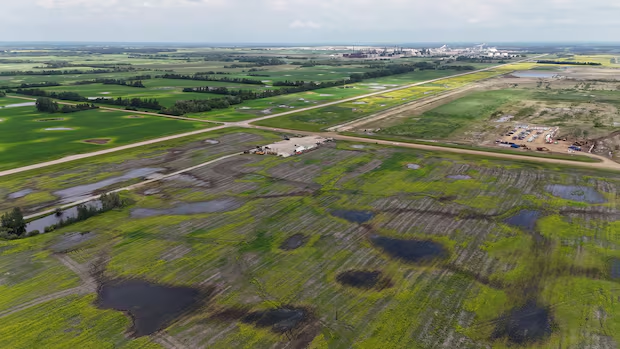
Although the U.S. leads the world in data centre buildout, Canada has become attractive because of its relatively cheap electricity. Meta recently announced plans to build a massive centre near Edmonton, its first in the country.
Canada currently has five hyperscale data centres, but many more are planned or under construction, according to research from York University. The paper, currently under peer review, defined hyperscale as 50 megawatts or more of power.
CBC News asked every province and territory whether they would implement moratoriums of their own. None explicitly said they would. New Brunswick, Nova Scotia, Ontario and P.E.I. did not respond.
In Alberta, which accounts for 90 per cent of planned data centre capacity, the government said it welcomes "responsible AI data centre investment."
"We've seen that some jurisdictions rushed to attract data centres without doing their homework on what these projects would mean for their electrical grid and water supply," Technology Minister Nate Glubish said in a statement.
To prepare, he said the province modernized its electricity legislation, created a new tax framework and maintained strong water regulations. Still, a National Observer investigation found three-quarters of planned data centres in Alberta are in high water-stress areas, meaning there is not enough freshwater to meet demand.
Manitoba said it recently rejected a proposed large-scale data centre in Île-des-Chênes because it would not create enough jobs to be economically worthwhile. Premier Wab Kinew has previously said the facilities don't appear to be "in the best interests of Manitobans."
Quebec said it is open to data centres because they contribute to digital sovereignty. It acknowledged concerns around heat generation, saying it values developers with circular economy models, and is also looking at managing future electricity demand.
Developer withdraws plans to build northern Ontario AI data centre over public opposition
Saskatchewan said it evaluates each project on its individual merits.
The Northwest Territories said its cold climate could benefit some data centres, but energy costs are high. "Any future proposals would need to be carefully evaluated," Finance Minister Caroline Wawzonek said in a statement.
Yukon said there has not been a demonstrated business case for a centre in the territory.
Hanna Lee is a copy editor at CBC News. You can contact her at hanna.lee@cbc.ca.
With files from Reuters and CBC's Nora Young
Related Stories
 Canada
Environment Canada warns of incoming heavy rain for Sooke, Metchosin
32 minutes ago
 Canada
Ford government to begin ripping out, reconfiguring Toronto bike lanes following court of appeal ruling
32 minutes ago
 Canada
Consumer goods makers see spike in Canadian demand
32 minutes ago
 Canada
Byelection wins a ‘clear message’ of support for trade stance, Carney says
33 minutes ago
 Canada
Police arrest 34 after a fatal shooting in a rural Dutch village
1 hour ago
 Canada
U.S. and Iran Continue to Trade Missile Strikes
1 hour ago
 Canada
Bank of Canada expected to hold interest rates steady, but renewed trade war muddies economic outlook
1 hour ago
 Canada
Canada ready to further distance itself from U.S. on military procurement
1 hour ago