
New York Times moves to quash Trump administration subpoenas over Air Force One reporting
New York Times moves to quash Trump administration subpoenas over Air Force One reporting
Newspaper's legal motion tees up major fight over press freedom in U.S.
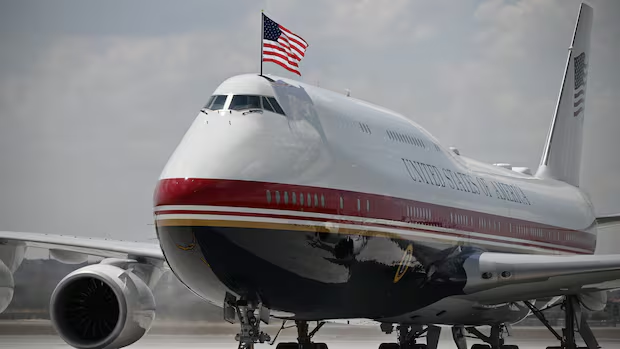
The New York Times on Wednesday filed a motion to quash subpoenas that the U.S. Justice Department served on journalists who reported on security concerns involving the new Air Force One.
The move tees up a significant court fight over press freedom in the United States and the government's ability to force reporters to identify sources.
"As we set out in our motion, these subpoenas are brought in bad faith to punish The Times for its coverage. They violate the constitutional rights of The Times and its journalists," David McCraw, the newspaper's senior vice-president and deputy general counsel, said in a statement.
"We are going to court to defend our journalists' rights to report freely on the administration and to provide the public with stories that matter."
The filing was made under seal in the Southern District of New York, where the journalists were summoned in subpoenas delivered last Friday to testify before a federal grand jury.
The subpoenas, some of which were delivered to reporters at their homes, marked a dramatic escalation of a crackdown by U.S. President Donald Trump's administration on media leaks that free press advocates swiftly condemned as a government effort to intimidate news organizations.
It followed an FBI search earlier this year of a Washington Post reporter's home and the seizure of her electronic devices.
'Aggressive' subpoenas on New York Times journalists part of a larger pattern, says advocate
The subpoenas sought to force the reporters to testify before a federal grand jury in Manhattan this week after they reported on security concerns involving the new Air Force One.
The new jet in question, a gift from Qatar that Trump's administration spent $400 million US (around $561.6 million Cdn) to retrofit and upgrade, recently entered service.
But the Republican president used an older model Air Force One jet to leave a NATO summit in Turkey last week.
The Times, citing anonymous sources, reported that the switch had come at the urging of the Secret Service and that the newer plane lacked some of the advanced security features of the older aircraft, including antimissile capabilities. On social media, Trump denied security concerns.
The U.S. Justice Department has justified the subpoenas by saying that "to be clear, reporters are not the targets, those leaking classified information are."
"We value and appreciate the important role that the press plays in this country," the department said after the Times reported it had received the subpoenas.
"But DOJ also plays an important role to make sure that the people entrusted with our nation's secrets do what they're supposed to do with that information, which means not sharing classified information."
Asked about the issue at his Senate confirmation hearing Wednesday, acting Attorney General Todd Blanche said: "The Department of Justice requires that I authorize it, which I did. And those reporters — we're not targeting reporters. They're material witnesses."
When Senator Peter Welch pointed out to Blanche that the department wants to ask the journalists who their sources were, Blanche replied, "No, the question we want to ask them is who provided them with classified national security information, which everybody in this body should want to protect."
What are Justice Dept's policies on leaks?
The Justice Department over the years has developed, and revised, internal policies governing how it will respond to news media leaks.
Though the department across presidential administrations has periodically seized the phone records of individual journalists in hopes of identifying sources for national security stories, it is extremely rare for the government to attempt to compel a reporter to reveal their sources before a grand jury.
In April 2025, then-Attorney General Pam Bondi rescinded a policy from President Joe Biden's Democratic administration that protected journalists from having their phone records secretly seized during leak investigations — a practice long decried by news organizations and press freedom groups.
The moves again gave prosecutors the authority to use subpoenas, court orders and search warrants to hunt for government officials who make "unauthorized disclosures" to journalists.
Trump administration subpoenas New York Times journalists after Air Force One reporting
A memo Bondi issued said members of the press are "presumptively entitled to advance notice of such investigative activities," and subpoenas are to be "narrowly drawn."
Warrants must also include "protocols designed to limit the scope of intrusion into potentially protected materials or newsgathering activities," the memo stated.
In January, FBI agents searched the home of Washington Post reporter Hannah Natanson, who has been covering Trump's transformation of the federal government, as part of a leak investigation into a Pentagon contractor accused of taking home classified information.
Related Stories
 AI News
2 of 8 men charged in thwarted attack on UFC cage
32 minutes ago
 AI News
Search underway off Indonesia for 24 people missing after boat sinks, at least 1 dead
32 minutes ago
 AI News
11 children killed and 19 injured in an overnight orphanage fire in Algeria
32 minutes ago
 AI News
A Big Letter To The World
33 minutes ago
 AI News
Trump expected to focus on election conspiracies in national address
33 minutes ago
 AI News
Keep Durga Pujas out of politics, says Samik
34 minutes ago
 AI News
Why this historic Quebec cheese brand is being sold to a French company
34 minutes ago
 AI News
CBC/Radio
34 minutes ago