
News
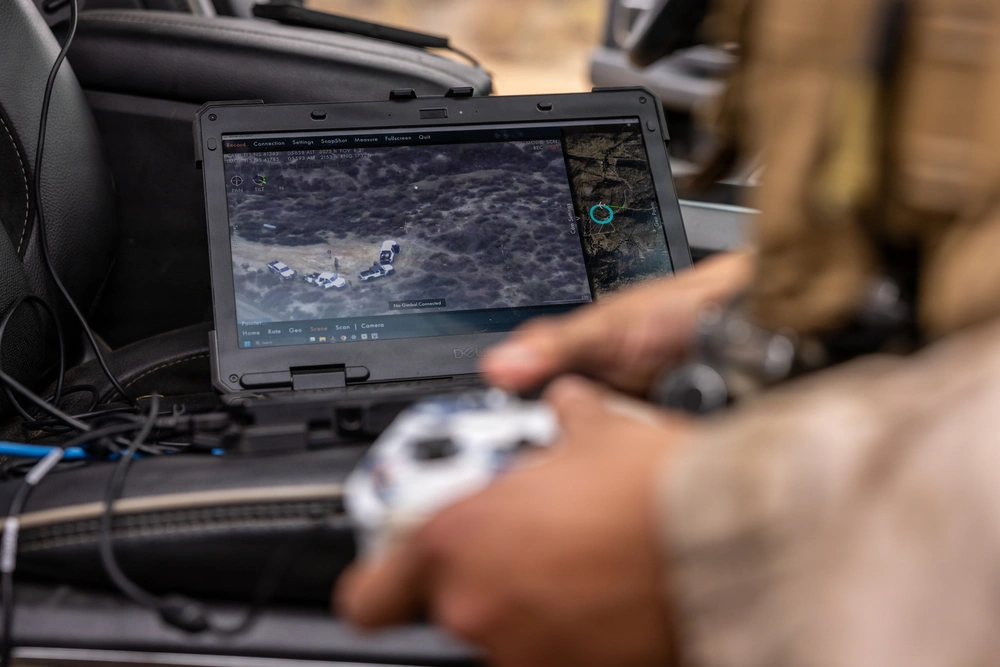
SAN DIEGO, Calif. — U.S. Marines assigned to Joint Task Force-Southern Border, in support of Operation Ardent Vanguard, are testing emerging command-and-control (C2) capabilities designed to improve communications and situational awareness for mounted and dismounted patrols operating in remote environments along the southern border.
The effort brought together Marines from 1st Battalion, 7th Marine Regiment, 1st Marine Division, and Combat Logistics Regiment 17 (CLR-17), 1st Marine Logistics Group (1st MLG), to address communications gaps encountered during operations. Together, they developed an innovative solution to overcome dead zones, restore connectivity in challenging terrain, and enhance small unmanned aerial systems (sUAS) already critical to patrol operations. This capability extends Marines’ visibility in mountainous terrain, allowing them to observe areas beyond ground-level line of sight while sharing a live video feed with dispersed ground troops.
Maintaining communications in mountainous terrain is a persistent challenge. Steep mountains and deep valleys can obstruct line-of-sight communications and severely degrade radio performance.
“The initial issue to overcome was radio communications in dead zones,” said Master Sgt. Steven Baez, a communications chief with CLR-17, 1st MLG. “These gaps in connectivity can limit the ability of patrols and units to maintain reliable communications and access critical information while operating in the field.”
To overcome the initial issue, the Marines started at the root problem: 5G dead zones. Maj. Michael Calnan, the regimental communications officer with CLR-17, 1st MLG, described how the team solved this problem.
“The most scalable solution was to push existing services into those dead zones, giving service members the tools they need to be effective,” said Calnan. “This solution was especially efficient because these systems are widely available as both government and commercial off-the-shelf solutions. This allowed the unit to experiment with emerging technology and develop individual solutions for each location based on requirements and needs.”
From Aug. 3–7, 2026, the Marines went out to several known dead zones within the San Diego Sector to test their concept.
“The goal of the demonstration was to integrate three separate capabilities into a single, more robust command-and-control solution,” said Baez. “By combining resilient tactical communications, live sUAS video feeds, and AI-enabled situational awareness, the objective was to enhance the ability of personnel to monitor and secure the border.”
The test leveraged Mobile Ad hoc Network (MANET) radios to build an adaptable meshed network that enabled all connected radios to communicate with one another where traditional signals fail.
“As nodes are added to a meshed network, it gets faster and more effective. This capability lets every connected radio talk to all others, regardless of terrain or other communication obstacles,” said Calnan.
With a MANET established, sUAS operators launched the Stalker VXE30 and Skydio X10 in areas where they were previously unable to fly. Once a reliable network was established and drones were flying above, the Marines pushed the live drone feed to Android Tactical Assault Kit (ATAK) devices. This integration solved a major tactical hurdle by bridging the gap between sUAS assets and ground-level tactical networks within the identified dead zones.
“The key technical breakthrough was establishing a complete command-and-control chain connecting the Starshield terminal, laptop, Compass service, and sUAS, and then transmitting the information to the tactical users on the ground,” said Baez.
With the Marines now able to view live feeds from sUAS assets on a portable ATAK device, another step of innovation presented itself: an artificial intelligence overlay that assists Marines by enhancing their current detection and monitoring capabilities. The overlay provides faster target recognition to identify individuals, vehicles, and other items, which can be configured to the needs of the patrol.
Following the successful demonstration, communications Marines are now focused on expanding the capability to a wider portion of the border mission. The next phase is aimed at reducing communication dead zones and increasing patrol access to live UAS feeds, real-time information, and AI-assisted identification capabilities to improve situational awareness.
For the individual Marine on patrol, this proof-of-concept translates to simplicity and speed of unique military capabilities brought to the southern border mission. Rather than managing multiple disconnected systems, a Marine can enhance situational awareness by viewing live aerial videos, receiving AI-aided alerts, and maintaining constant contact with headquarters. This streamlining significantly boosts operational speed and decision-making at the lowest level, while keeping higher headquarters involved.
U.S. Northern Command works side-by-side with the Department of Homeland Security and U.S. Customs and Border Protection within narrowly defined authorities to provide unique military capabilities to protect the territorial integrity of the southern border.
Related Stories
 Technology
Louisiana Tech University President Jim Henderson retiring
28 minutes ago
 Technology
New Subsea Equipment Provider AQO Joins The Market
1 hour ago
 Technology
Micron Technology Stock Wavers Ahead Of Fiscal Q4 Earnings Report
1 hour ago
 Technology
Trump to usher in ‘golden age’ of American tech with DC bash showcasing powerful new tool
2 hours ago
 Technology
News
2 hours ago
 Technology
Biologists identify a cellular pathway that allows colorectal cancer to metastasize
6 hours ago
 Technology
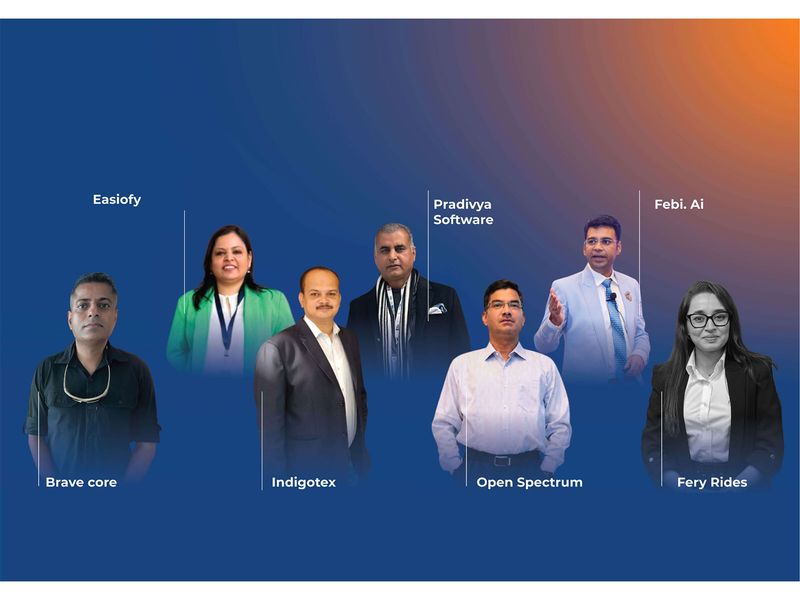
From the factory floor to the farm: Six startups showing what acceleration can unlock in India
8 hours ago
 Technology
Chinese auto companies race ahead on EV technology, achieving 5
8 hours ago