
Northern Albertans raise concerns about Wonder Valley AI data centre at packed community hall
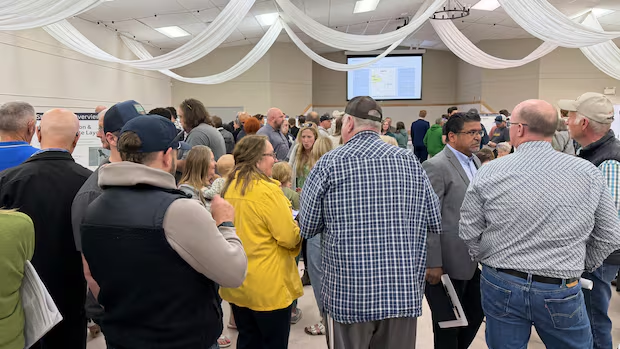
Northern Albertans raise concerns about Wonder Valley AI data centre at packed community hall
Hundreds turned up at open house to hear from O’Leary Digital
An open house hosted by the company behind the proposed Wonder Valley artificial intelligence (AI) data centre campus in northern Alberta left some attendees wondering if the firm behind the $70-billion project is even interested in their concerns.
Casey Klein and her young son spent more than an hour at the event held at the Grovedale Community Hall on Thursday night, located about 20 kilometres south of Grande Prairie, Alta. The open house featured six information booths staffed by representatives from O’Leary Digital, the company led by Canadian businessman and celebrity investor Kevin O’Leary.
Klein said the event left her with more questions than answers.
“For a project this large, on the [information] boards, there was a lot of soft language,” she said, adding that she had been hoping for more concrete figures.
Gloria Jaycox, another attendee and longtime Grande Prairie resident, was similarly disappointed in the format of the event, saying she would have preferred a traditional town hall format with speakers and opportunities for questions to be answered in front of a full audience.
“I thought they did the event for their benefit, not the community,” Jaycox told CBC News.
O’Leary Digital is proposing to build a nine gigawatt, large-scale data centre industrial park that would take up more than 64 square kilometres in the Municipal District of Greenview, 42 kilometres south of Grande Prairie.
Grande Prairie is located about 390 kilometres northwest of Edmonton.
CBC News spoke to over a dozen attendees at the open house. The majority of those said they were opposed to the project, but several said they were neutral and wanted to learn more.
One attendee told CBC News they supported the project, highlighting job opportunities.
People who attended the event raised a number of concerns about the Wonder Valley proposal, relating to issues like how much heat it will produce, how much water it will use and how much noise it will make.
O’Leary Digital CEO Paul Palandjian said most of the concerns he heard were focused on the environmental effects the site could have and how unregulated AI could be “a force for bad” in the world.
“I think it will be a force for good, but there has to be regulation and guardrails that protect citizens,” he said about the technology.
Palandjian also spoke about the long-term educational and medical opportunities that he believes AI can offer.
Those kinds of benefits can only be realized with the power generation and computing infrastructure such as what is being proposed at Wonder Valley, he said.
Palandjian said the campus won’t draw electricity from the existing grid, meaning there "will be zero impact to ratepayers’ utility costs.” He also said he expects the project to “run very quiet,” with noise at levels around 55 decibels near the Wonder Valley perimeter.
Wonder Valley will not have to undergo a provincial environmental impact assessment but permitting and approvals are still needed for the project to go through.
Klein told CBC News that she felt how little Indigenous consultation has been done has been “disheartening” and said she fears that some of the potential environmental ramifications won’t be realized until after the project has started.
“I still feel residents need completed studies,” she said. “I want the full environmental impact assessment.”
In April, Alberta’s Ministry of Environment and Protected Areas said the Wonder Valley project was reviewed by an independent approvals officer who deemed it exempt from the assessment due to its proposed use of standard power and water systems.
Sturgeon Lake Cree Nation (SLCN), which is located roughly 130 kilometres away from the proposed Wonder Valley site, is now calling on the federal government to complete an impact assessment, in lieu of the province’s exemption.
“This is a massive project with significant emissions, water use and, most alarming, creates a heat island in an area already ravaged by wildfire, drought and climate change,” Chief Sheldon Sunshine said in a statement on Thursday.
Last summer, the Municipal District of Greenview declared an agricultural disaster due to drought conditions.
Palandjian said he recognizes concerns from Indigenous groups around the environment, and that his company wants to work to find options to reduce how much water Wonder Valley would use. If it is built, the facility is projected to use up to six million cubic metres of water annually.
Palandjian described a “floating barge system” that would eliminate the need for permanent infrastructure and said the company is also looking at turbo-cell technology and other options to reduce water usage.
Proposed data centre park exempt from provincial environmental impact assessment
He also told CBC News about heat dispersion and capture technologies to reduce the amount of heat produced by the campus, “so the heat doesn’t change anything in the nearby area.”
“That’s the first I’ve heard of those potential technologies he’s talking about. I haven’t seen any of it in all of the research that we have done,” Sunshine told CBC’s Daybreak Alberta with Paul Karchut on Friday, in an interview that was set to air on Saturday.
A preliminary technical assessment by Utah-based physicist Robert Davies, and which was commissioned by SLCN, raises concerns that the proposed project could become “one of the largest single-site heat sources on the planet”.
Sunshine said the SLCN is analyzing the information it has to try and better understand potential impacts from the proposed project, but it has been difficult as SLCN has only been given Level 1 consultation on the proposal from the province.
Forestry worker Brett Bradshaw, attended Thursday’s open house and said he opposes the project. He told CBC News he isn’t convinced events like the one on Thursday will make a difference.
“I feel that we don’t have a say,” Bradshaw said. “I feel that they’re going to be putting these data centres in whether we say no or not.”
Palandjian said Thursday’s event will be the “first of what I expect and hope will be many open houses to be able to communicate the facts about the project; hopefully which will allay a lot of the concerns and misinformation.”
Eagle Andersen is a reporter for CBC News in Grande Prairie. He previously worked as an associate producer for CBC News in Kamloops, B.C. You can reach him at eagle.andersen@cbc.ca.
Related Stories
 AI News
Thomson Reuters launches first proprietary LLM to take on legal AI startups
6 minutes ago
 AI News
Intel at AI Infra Summit 2026
7 minutes ago
 AI News
Connect Amazon Bedrock AgentCore to cross
7 minutes ago
 AI News
Bill Gates believes the world is unprepared for AI
7 minutes ago
 AI News
Promising Artificial Intelligence Stocks To Keep An Eye On
1 hour ago
 AI News
Quite Contrary: AI Should Be Used For The Unglamorous Jobs, Not Just Building Fancy Startups, According To Samer Bejjani Of Shootday
2 hours ago
 AI News
US Can Lose Its Lead in AI Technology Race to China
2 hours ago
 AI News
SG's 1982 Ventures joins $400m round in US AI startup Higgsfield
3 hours ago