
Oil prices swing Alberta’s $9.4B deficit to $2B surplus, but finance minister urges caution
Oil prices swing Alberta’s $9.4B deficit to $2B surplus, but finance minister urges caution
'We cannot mistake a temporary windfall for a permanent trend': Jason Nixon
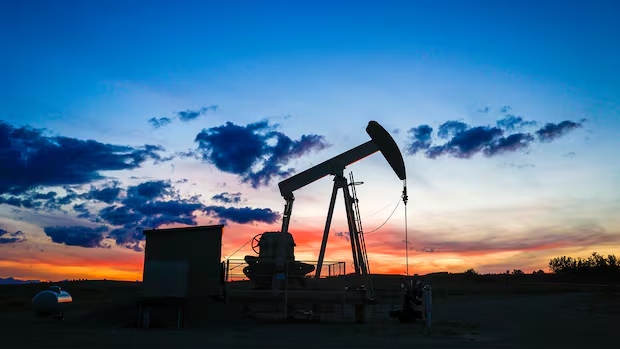
Alberta's finance minister vowed to remain cautious while his government enjoys a massive budgetary turnaround due to high oil prices — an expected $2-billion surplus this year instead of the $9.4-billion deficit the province forecast a few months ago, just before war began with Iran.
Jason Nixon said he will not treat this dramatic upswing as a "blank cheque" to fund program spending, mindful that unexpected fossil-fuel geopolitics or the escalating U.S.-Canada trade war could create more damaging volatility.
"We know things can change and we cannot mistake a temporary windfall for a permanent trend," the minister told reporters Thursday.
Instead, Alberta will continue to budget conservatively and focus any potential new spending on relief for businesses affected by U.S. tariffs or Canadian counter-tariffs, or another round of "energy rebates" for Albertans, Nixon said as he updated his province's fiscal picture for the first time since Alberta tabled its budget in February.
Alberta premier doubles down on diplomacy with Americans to stave off U.S. tariffs
Back then, the province based its deficit-mired budget on a benchmark oil price it pegged at $60.50 US per barrel for the 2026-2027 fiscal year.
But that financial blueprint came out a mere two days before the U.S. and Israel began their attack on Iran, which led to a prolonged squeeze on oil tankers' access to the key Strait of Hormuz shipping route.
In the nearly five months since, oil prices have actually averaged about $88 US per barrel, the province estimates, which will substantially boost the province's energy royalties and tax revenues.
Alberta's revised surplus forecast assumes an ease in conflict and global oil supply squeeze, and for oil prices to decline substantially and average $73.50 US for the April-to-March fiscal year.
If that doesn't happen, and oil prices remain at or near current levels, Alberta could add several billion dollars more to its annual surplus.
But Nixon expressed a reluctance to take any such optimism to the bank, as a political veteran familiar with the extreme ups and downs of Alberta's budgetary volatility, heavily reliant as it is on oil prices.
"How can you not be in a good mood to stand up here and announce a $2-billion surplus and an over $11-billion swing in the fortunes of our province?" he said.
But he quickly added: "I know how quick it changes."
Rising oil prices lift not only the province's royalties from oil and gas extraction, but also its personal and corporate tax revenues. For every $1 US fluctuation in the per-barrel rate, the province's budgetary bottom line rises and falls by $680 million, according to Alberta Finance.
What this might mean for Albertans
The same geopolitical factor that's a boon to the provincial government has also sent gasoline and diesel prices skyward, worsening affordability woes for residents.
Alberta has declined to offer a break this year on its 13-cent-a-litre fuel tax, as the federal government has done and the province itself did in 2022 during a price shock.
Instead, the Danielle Smith government has offered the $100-per-adult Alberta Energy Rebate, "to get that money into Albertans' pockets" more directly, Nixon said.
However, far less of that rebate money than expected has reached those pockets. Only 1.2 million Albertans have applied for that direct payment out of 3.4 million eligible, which Nixon acknowledges is largely due to an onerous online application process.
The minister told reporters that for any future rebate programs, Alberta Finance will work with Canada Revenue Agency for better systems integration to smooth out the current application bumps.
The war-fuelled rise in oil prices also erased a previously $4.1-billion forecast deficit for the 2025-2026 fiscal year that ended in March, Nixon announced. His department is still finalizing the government's annual report and expects to have year-end figures available later this year.
Despite the newly forecast $2-billion surplus for 2026-2027, Nixon added that Alberta wouldn't actually have any money to direct into extra debt repayment or the long-term Heritage Savings Trust Fund, because of some complicated financial obligations and accounting rules.
The province reported that the government's taxpayer-supported debt sits at $94.8 billion. That figure is down $14.1 billon from February's budget, largely because of the oil price turnaround.
Alberta's oil estimates 'very conservative'
Alberta's revised forecast, which assumes oil prices will decline substantially this fiscal year, is "very conservative," said Servus Credit Union chief economist Charles St. Arnaud.
But he said it's difficult for the province to translate its budgetary turnaround into new spending, given how sensitive Alberta's budget is to volatility in oil prices.
“That mismatch is very hard, because if we start committing to new spending in the good years, when you have lower prices, that’s when you hit and have a deficit," said St. Arnaud.
"That’s a reason why they want to be relatively conservative in their estimates."
St. Arnaud added the province may not want to create expectations for a high surplus in its budget, to avoid the expectation of increased spending that could accompany it.
He also cautioned that Alberta's budgetary turnaround is possible due to it being less affected by tariffs as other provinces, which could change as Canada's trade war with the U.S. continues.
'We will still feel it here': Tariffs might hit Alberta economy, jobs more indirectly, say experts
NDP calls for more support to counter cost of living
Alberta's surplus arriving as a result of increased oil prices is a sign that cost of living is still a problem around the province, NDP Leader Naheed Nenshi said. Affordability concerns are exacerbated by cuts to disability and seniors benefits, he added.
To support Albertans with affordability concerns, Nenshi called on the province to offer a break on the fuel tax, and use its sudden windfall to increase Heritage Fund savings and spend more on needed infrastructure like schools, hospitals, clinics or roads.
“There is an opportunity to use a windfall like this to catch up on capital projects, on one-time spending, as well as return money to people’s pockets, and save a little bit, because we may need it for a rainier day,” said Nenshi.
The Opposition leader also criticized how reliant the provincial economy is on royalty revenues, and said the UCP government needs a better plan to support Albertans facing an affordability crisis and to better diversify the economy.
“We should never be on a roller-coaster like this,” said Nenshi.
"When we get windfalls, we should know what to do with them, and we should be able to balance our budget without relying on Trump starting a war in Iran."
Jason Markusoff is a CBC producer and writer. He analyzes what's happening — and what isn't happening, but probably should be — in Calgary, in Alberta and sometimes farther afield. He's covered Alberta for more than two decades, previously reporting for Maclean's magazine, Calgary Herald and Edmonton Journal. He appears regularly on Power and Politics, West of Centre and various other CBC current affairs shows. Reach him at jason.markusoff@cbc.ca
Related Stories
 Canada
Federal Court staff work weekends, on vacation to keep up with cases: chief justice
44 minutes ago
 Canada
Toronto, Montreal, Ottawa residents among 32 Canadians missing at Nepal
44 minutes ago
 Canada
Man who killed woman pregnant with his child in 2007 granted escorted absences from prison
44 minutes ago
 Canada
Riley Laychuk's weekend forecast: slightly unsettled
1 hour ago
 Canada
Alberta pulp mill under pressure from Trump’s tariffs gets $20M in federal support
1 hour ago
 Canada
NP View: Fortress North America isn't what Canada needs
1 hour ago
 Canada
Number of Canadians missing in Nepal
2 hours ago
 Canada
Kazakhstan’s new ruling party projected to win Sunday elections
2 hours ago