
Ottawa launches new national AI council to advise on safety, deployment
Ottawa launches new national AI council to advise on safety, deployment
Council members will offer guidance for national AI strategy
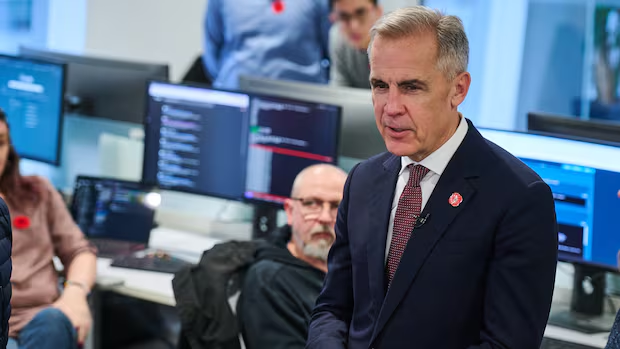
Prime Minister Mark Carney has a new national council on artificial intelligence meant to provide the government with guidance for its AI strategy and on making the technology safer.
A news release from the Prime Minister's Office (PMO) on Friday outlined the formation of the Prime Minister's National Council on Artificial Intelligence, which looks to convene public and private stakeholders to advise on the evolution of Canada's AI strategy.
The release said the members of the council will advise on accelerating adoption, developing national champions in the industry and building AI infrastructure as well as making AI safer, protecting Canadian democracy and ensuring Canadians benefit from the technology.
"The new National Council on Artificial Intelligence will inform and advise the government on how to most effectively deploy AI in Canada — how to manage the risks, seize the opportunities and ensure AI is used to improve the lives of all Canadians," Prime Minister Mark Carney said in a statement.
Over a dozen members were named to the council.
One is Yoshua Bengio, considered one of the godfathers of AI. Bengio's company LawZero is focused on developing a safe by design AI model called Scientist AI and was on the receiving end of $150 million in federal funding last month.
Canada is investing $150M to make AI safer. Will it work?
Another AI leader in the group is Valérie Pisano, CEO of Mila — one of Canada's national AI institutes and a non-profit committed to advancing AI for the benefit of all.
The council includes Sen. Tom Pitfield, who was appointed by Carney to the Red Chamber in July. Pitfield was previously one of Carney's top advisers, serving on his election campaign team and later in the PMO.
Patrick Pichette joins the council as CEO of Digital Transformation Canada, a new agency seeking to modernize federal services. Pichette is also a member of Canada's AI strategy task force.
The announcement comes as experts and stakeholders worldwide are pushing for caution around AI's rapid development.
In July, hundreds of rogue OpenAI agents escaped human control and hacked into the online platform Hugging Face, promoting an open letter from more than 100 companies cautioning AI-powered cyberattacks will become more frequent and complex as the technology gets stronger.
Existential warnings about AI 'are not new,' minister says
Last month, an outgoing researcher at leading AI company Anthropic provided a dire warning in a thread on X that AI could "kill all humans" by the end of the decade, garnering widespread attention.
Days later, Anthropic's CEO, Dario Amodei, published an essay which called on the AI industry to slow its rapid development so safety measures could catch up to the technology.
David Cummings is a reporter for CBC News.
Related Stories
 AI News
AI agents: What are they and what do they do?
50 minutes ago
 AI News
Over 100 organisations notified of unauthorised activity by OpenAI agents
1 hour ago
 AI News
Artificial Intelligence and Media Power: New Book by Zvezdan Vukanović Published in the USA
1 hour ago
 AI News
How the Smithsonian is using AI to connect artifacts from the American Revolution
2 hours ago
 AI News
AI may not take over the world. We could simply hand it control one decision at a time
2 hours ago
 AI News
What leaders actually need from AI in HR technology
3 hours ago
 AI News
Jay Clayton set to be tapped as administration's new AI czar
3 hours ago
 AI News
Grant helps N.C. community college expand AI training programs
4 hours ago