
Ottawa moves to restrict social media for kids under 16
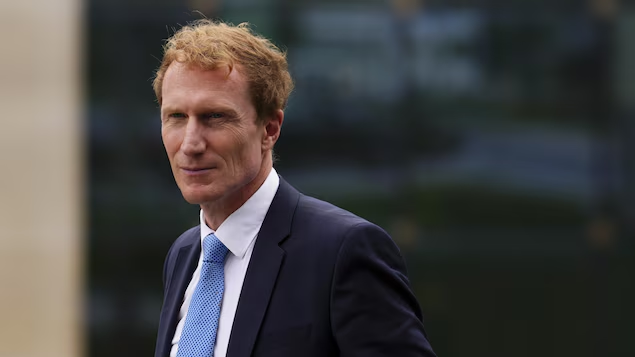
Watch Power & Politics as Canadian Identity and Culture Minister Marc Miller holds a news conference about the government's Safe Social Media Act. The new bill is expected to restrict young Canadians' access to social media platforms and regulate AI chatbots.
Photo: La Presse canadienne / Sean Kilpatrick
Catharine Tunney (new window) · CBC News
The federal government is moving to restrict young Canadians' access to social media unless those companies can show they've made their platforms safe.
Culture Minister Marc Miller introduced his long-awaited online harms bill in the House of Commons on Wednesday, which also puts in some controls around artificial intelligence chatbots.
The bill, named the Safe Social Media Act, sets out three core duties for regulated services: the duty to protect children, the duty to act responsibly and the duty to make certain content inaccessible.
The Liberal bill would force social media services — defined as traditional social media platforms, live-streaming services and adult content services focused on user-shared content — to restrict accounts for children under 16 years old.
However, services could seek an exemption if they implement what officials briefing reporters called adequate safeguards to protect children. The exemption wouldn't apply to adult content services.
The exemption will be based on criteria to be determined later through regulations, said officials.
Chatbots will have to flag violent ideation
The bill, which has to be passed by Parliament before becoming law, also sets out criteria for AI chatbots, public-facing services that can mimic human relationships, including the obligation to reduce the risk of harmful content being generated by their services.
AI chatbots will need measures to respond when a user expresses ideas of suicide or self harm or an intention to commit an act that could cause death or serious bodily harm to an individual, said officials.
The bill also proposes to set up a Digital Safety Commission which would be responsible for enforcing the act, developing regulations and guidance, assessing compliance and managing complaints.
The federal government has been signalling some kind of ban for children and young teens for months. Ottawa, like governments around the world, is under pressure from parents and advocates to address social media's addictive features and limit access to predatory and sometimes dangerous content. Psychologists have been warning that design features like infinite scroll are impacting teens' self-esteem and mental health.
The Canadian government has also faced calls to regulate AI chatbots following the Tumbler Ridge, B.C., mass shooting earlier this year. In the wake of the tragedy, it emerged that OpenAI did not share internal warnings with law enforcement about messages sent to its chatbot, the immensely popular ChatGPT, by the shooter.
A previous attempt to pass an online harms bill was marked by controversy and died when former prime minister Justin Trudeau prorogued Parliament in early 2025.
That bill included Criminal Code and Canadian Human Rights Act amendments that Conservative Leader Pierre Poilievre said would chill free speech.
Conservatives have said they want to review the new bill before commenting.
Related Stories
 Canada
Why is Air Canada still offering passengers American booze?
42 minutes ago
 Canada
Alberta NDP urges Smith to cancel separation vote amid Canada
42 minutes ago
 Canada
Fact-checking the White House statement of facts about Canada
42 minutes ago
 Canada
A Chinese humanoid robot sets a new 100
1 hour ago
 Canada
Grocers revive signage to indicate tariff
1 hour ago
 Canada
Trump's trade war: Fact
1 hour ago
 Canada
Would U.S. tariffs actually change after Trump, or is this the new normal?
1 hour ago
 Canada
More charges for former Manitoba MP Inky Mark after 445 guns, explosives found in home: RCMP
1 hour ago