
Pitch perfect: Developing natural grass for the World Cup
This year's World Cup has been smashing viewership records. Hosting the tournament has prompted Americans to tune in and turn out for soccer like never before. The telecast for this afternoon's final match, between Spain and Argentina, is expected to set another record.
But for one man in Tennessee, this whole tournament has been about as exciting as watching grass grow … which, for him, is high praise.
"The number one thing is the pitches, right? We need to have a good surface, a good canvas for the players to play on," said Dr. John Sorochan, a distinguished professor in Turfgrass Science at the University of Tennessee, Knoxville. He's a world-renowned leader in the field of fields.
"You look at the last men's World Cup, 1.8 billion people watched the final; that's 20 percent of the world watched that," he said. "And they enjoyed it. And they didn't even think of the field, sadly. But there's so much that went into it, right?"
For the past five years, the University of Tennessee, in collaboration with Michigan State University, has been working on the FIFA Pitch Research Project. [Pitch is the more globally-used term for field.]
This year's World Cup, with 104 matches, held in 16 stadiums across three countries, is the largest in history. And all of those matches, per FIFA's mandate, must be played on high-quality natural grass.
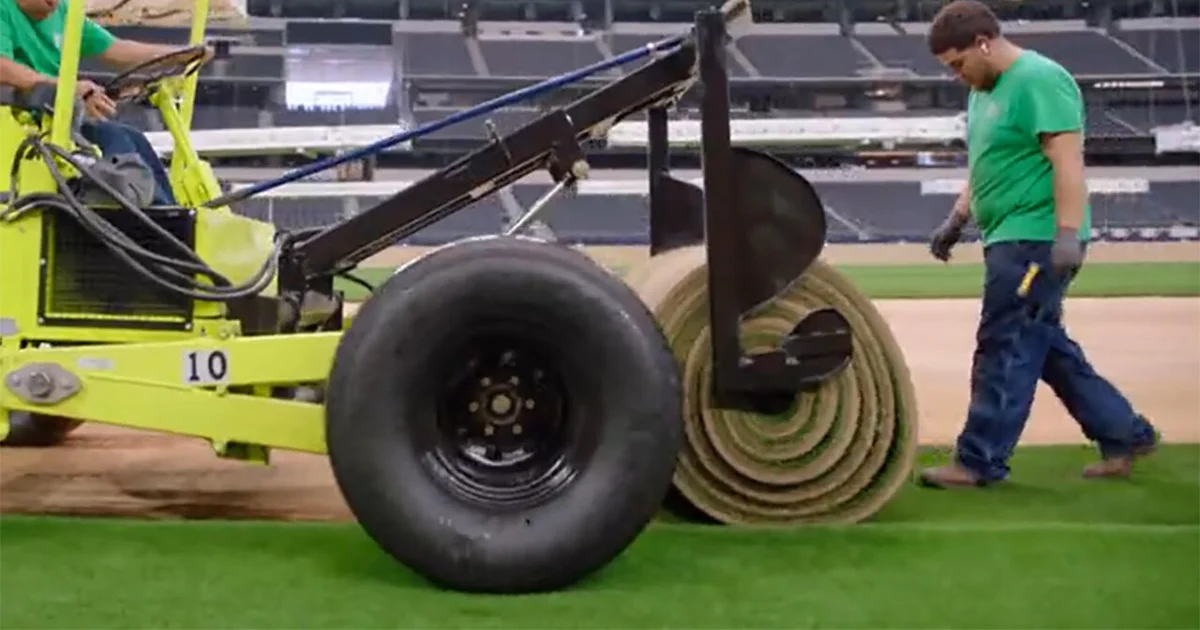
Since the stadiums are all at different elevations in different climates, they can't all use the exact same species of grass. Rolls of scientifically-engineered sod have been trucked in from farms across the country, oftentimes laying real grass on top of existing artificial grass fields. The grass installed at MetLife Stadium in New Jersey (where today's final is being played) was grown in North Carolina.
Five of the stadiums have domes. So, FIFA funded and constructed an indoor growing facility on the Tennessee campus to test, among other things, how grass responds to grow lights, which are switched on for 12-14 hours in domed stadiums so there is enough light to grow the grass.
Sorochan says the grow lights wouldn't be needed if only one match were being played. "But we need [grass] to be alive inside for, you know, 10 to 12 weeks," he said.
Sorochan has spent years testing the resiliency of grass. He's co-developed a robot that can stomp a cleat with the amount of force exerted by the average male professional soccer player. "We just go row by row by row, and we get a heat map of the variability or the consistency of that surface – hopefully, for World Cup pitches, the more consistent the better," he said.
He and his team have also examined how a soccer ball rolls and bounces. "Some of the research we've done is, like, how do you manage this natural grass so when the ball lands, it's going to skip and it's not going to bounce too high and it's going to be at the knees or lower so the player can get the ball and do their move," he said.
They've tested on different types of grass – and there are many different types of grass, from a traditional Meyer Zoysia, to a more drought-tolerant TifTuf Bermuda, which is used on golf courses and athletic fields.
Brad Jean, the owner of Crossroads Sod Farm in Tennessee, is not far from the grass gurus at the university. "When we have problems, we have diseases or we have issues, you know, we can call them and you know, they come out and they help us," he said.
Sod farming is a big business, with most of Jean's customers being residential users and golf courses. "It's probably a $2.1, $2.2 billion sector," he said.
Not surprisingly, he's not the biggest fan of artificial turf. "If it's 90 degrees, AstroTurf is going to be really, really hot, and the grass is going to be really cool," he said. "You're playing on plastic, that plastic gets in your clothes, it gets in everything. It goes home with you."
Studies have also linked higher rates of injuries with artificial playing surfaces (although less so with newer, more forgiving generations of artificial turf).
But John Sorochan believes it's more than that. There's just something special about grass. "It's the play of the game, and the beauty of the game," he said. "On the grass, the play of the game, the flow of the game, is more natural. Pun intended."
And where does that grass go after the World Cup? Well, for $450, FIFA will sell you a slice of souvenir sod from this afternoon's match – just in case you want to keep some on your home turf. Pun also intended.
Story produced by David Rothman. Editor: Lauren Barnello.
Related Stories
 World
World
Manchester United weigh up stunning move for Real Betis and ex-Tottenham forward Troy Parrott
1 week ago
 World
World
Israeli police arrest 10 following weekend attacks by settlers on journalist and diplomats
1 week ago
 World
World
Trump says suspension of Russia sanctions is to keep peace negotiations going
1 week ago
 World
World
Ukrainian drones strike St. Petersburg oil facilities | NHK WORLD
1 week ago
 World
World
Victoria Falls stadium in Zimbabwe nears completion for CWC27
1 week ago
 World
World
‘The world will be amazed:’ Iran’s commanders prepare for further war
1 week ago
 World
World
Festival opens with musket salute in Sakai, Osaka
1 week ago
 World
World
Trump's new pitch for Republican candidates — they're really good
1 week ago