
Rahul Gandhi Ushers a New Style of Youth-Centric Politics in India - The Diplomat
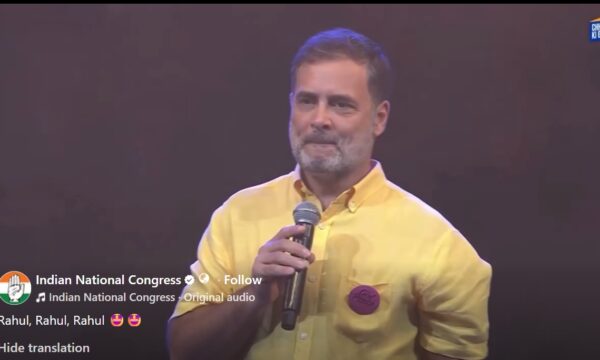
When Congress leader and Leader of the Opposition Rahul Gandhi addressed women students at the Chhatron ki Goonj (Voice of Students) event in Pune last week, he urged them to “Smash the Patriarchy,” a message that resonated not just with his audience at the Pune event but with youth across the country.
“India’s biggest strength, its asset,” Gandhi said, “is its 70 crore (700 million) women.”
“Be loud, be proud. Fight for your space,” he told his young audience.
Unsurprisingly, his speech raised the hackles of India’s ruling Bharatiya Janata Party (BJP). BJP leader and Union Minister for Parliamentary Affairs Kiren Rijiju questioned why Gandhi was “always target[ing] only Hindu? What about minority women…”
Gandhi had not mentioned Hindus in his speech. However, the BJP, a Hindu nationalist party, chose to misquote the Congress leader in a bid to shift the discourse to a Hindu-Muslim communal one, a standard ploy of the BJP and other Hindutva organizations.
Since the protests at New Delhi’s Jantar Mantar in June-July this year, India’s Gen Z has shown utter disdain for the BJP and its leaders and the kind of politics they engage in. Indeed, several protestors used expletives to mock BJP leaders.
In a desperate attempt to win back their support, Prime Minister Narendra Modi addressed Gen Z youth for the first time on the night of July 24 through an awkward hand-held Instagram reel, where he said he was “pained” and it was a “cultural shock” seeing “our young daughters” mouthing expletives against him and other BJP leaders. Modi’s speech was condescending. He spoke down to the protesters, viewing them through a patriarchal lens and addressing them as his daughters and sisters. He described them as “misguided” and said he had “forgiven” them.
Modi’s speech infuriated Gen Z in general and women in particular, who have continued to target the BJP and its patriarchal mindset.
The BJP and its ideological mentor, the Rashtriya Swayamsewak Sangh (RSS), are intensely patriarchal organizations led by geriatric men steeped in conservatism and misogyny. They are seriously out of touch with India’s educated youth.
Gandhi’s speech at Pune on August 22 was undoubtedly aimed at presenting himself as a foil to Modi’s patriarchal image. He drew the attention of youth to the BJP’s patriarchal and gender discriminatory mindset. While Modi called out women for using expletives at the Jantar Mantar protests, he was not similarly “pained” by the abusive language of male protesters, Gandhi pointed out.
Gandhi appears to be seeking to change the political discourse in India, shifting it away from the BJP’s communal discourse to one that strikes a chord with youth in general and women in particular. He is leveraging youth power in a big way by speaking about youth aspirations and problems.
Following the widespread outrage among students over the leakage of question papers of the NEET entrance exam, Gandhi began the Chhatron ki Goonj campaign in various cities, where he spoke about the exam paper leak extortion racket, unemployment, educational degrees without jobs, and the private coaching mafia. The events drew large crowds.
Then in June-July, the Cockroach Janata Party (CJP) started protests at Jantar Mantar, which drew thousands of students to the protest site. The Modi government’s use of force against the protesters on July 20 galvanized the students. The Jantar Mantar protests were successful in forcing Education Minister Dharmendra Pradhan to resign, a key demand of the protests. This was the first time in 12 years since Modi and the BJP came to power that mass protests were able to force the resignation of a sitting minister.
Following the police brutality on July 20, which saw police use pellet guns on protesters, Gandhi led a dharna (a sit-in protest) in front of the prime minister’s residence. It led to a confrontation that left Gandhi with a bloody nose; the visuals went viral on social media. For both the CJP students and the Leftist student unions that participated in the Jantar Mantar protests, this was a rare occasion of a leading politician not only raising their issues in parliament but also taking the fight to the streets. Not surprisingly, prominent youth leaders like Neha Bora were happy to address the media, alongside Gandhi.
Gandhi aligned himself with Gen Z in Parliament; the Congress-led opposition parties did not allow Parliament to function during the recent monsoon session and demanded the resignation of Home Minister Amit Shah for sanctioning police brutality on the students. Gandhi actively took up the case of a pellet gun victim at Jantar Mantar, 19-year-old Sahil Lochab, a student protester, who was so severely injured by the pellets fired by police that he lost his vision in one eye. With the Delhi Police refusing to lodge a complaint in this case for over a month, Gandhi, last week, spent over seven hours at the local police station and refused to leave until the complaint was lodged.
With India’s mainstream media functioning more or less as mouthpieces of the Modi government, the student protesters have relied on social media and YouTube channels of independent journalists to convey the picture on the ground. They boycotted mainstream TV news channels that were trying to defame their protests. Through live videos, catchy slogans, memes, and Instagram reels using humor and satire, Gen Z garnered public attention and support. They fearlessly lampooned Modi’s strong man image, cultivated since 2014, with a meme of a baby monkey, which is still viral on social media.
In his outreach, Gandhi appears authentic, young, and tech-friendly. He is leveraging social media by posting short videos of his daily life and sharing his thoughts through Instagram reels and YouTube videos that have made him more relatable to a young audience. Unlike Modi, who has never held a press conference in the 12 years he has been India’s prime minister, and addresses audiences only with the help of a teleprompter, Gandhi seems an approachable leader. Not only has he held press conferences and spoken to the media candidly, but he has also opened up to youth via Ask Me Anything sessions. He has shown willingness to engage with youth as equals and does not preach to them.
Unlike Modi’s Insta reel debut on the night of July 24, which backfired spectacularly with Gen Z, Gandhi’s relatable outreach is striking a chord with youngsters
Fifty-five-year-old Gandhi does not pretend to be young; he asks youngsters to teach him Gen Z lingo. He asks them about their aspirations and how he can better understand their problems. He is not insecure about his masculinity and wears pink and yellow colored shirts, usually seen as feminine colors.
In its 12th year in power and despite enjoying a majority in parliament, the BJP is rattled. It is out of sync with youth, who comprise 30 percent of India’s electorate.
The BJP’s IT Cell, which was infamous for trolling and doxxing dissenters and critics on social media, is in trouble as it failed to anticipate and grasp the Gen Z mood during the student protests. Amit Malviya, who headed the BJP’s IT cell, was recently shunted out.
Despite these setbacks, Modi’s inability to course-correct is evident. In his Independence Day speech on August 15, he ranted against “Dimagi Naxal” (intellectual or thinking leftist rebels), which served as a dog whistle to right-wing goons and BJP-affiliated students to attack leftist academics at Jadavpur University in West Bengal.
Modi also issued diktats to Cabinet ministers to make Instagram reels and posts, without addressing the content of what youth are angry about. The CJP shot back, urging the government to pay attention to their “School Theek Karo”(Repair the Schools) campaign across the country and take remedial action. “They’ll spend money on anything and everything, just not on schools,” the CJP’s Abhijeet Dipke posted on X.
Interestingly, Gandhi’s image has evolved from being mocked pejoratively as “Pappu” (inexperienced or incompetent) to becoming the most sought-after leader of India’s youth. He has emerged as the perfect foil to Modi’s jaded and arrogant image. In fact, leaders of other opposition parties, including Akhilesh Yadav of the Samajwadi Party, have started adapting to the new style of politics that Gandhi has ushered in.
Related Stories
 India
India
Kangana Ranaut opens up on politics, career and being ‘Hugely Desirable’: 'Had an identity for 20 years a
37 minutes ago
 India
India
Will legacy brands handover online operations to start
2 hours ago
 India
India
Why India’s Gen Z Protests Matter to Young People Everywhere
3 hours ago
 India
India
130+ Indians, 37 NRIs out of reach as Nepal floods toll mounts, Bihar, UP on alert: What is happening? | India News
7 hours ago
 India
India
Why India is sharing missile secrets with its private sector
7 hours ago
 India
India
Ukraine’s drone attacks have left Russia desperately scrambling for oil imports
9 hours ago
 India
India
Piyush Goyal proposes India
11 hours ago
 India
India
MIT India’s IRS 2026 Advances 25
13 hours ago