
Repentigny calls for stop to rail traffic after TSB investigation reveals 'several deficiencies'
Repentigny calls for stop to rail traffic after TSB investigation reveals 'several deficiencies'
Ongoing investigation will likely yield lessons, says TSB
The mayor of Repentigny, Que., is calling on the federal transport minister to suspend rail traffic through the city until CN Rail implements corrective measures to the railway track.
This comes after the Transportation Safety Board of Canada (TSB) released an update Thursday morning to its investigation into the July 5 train derailment in the city, northeast of Montreal.
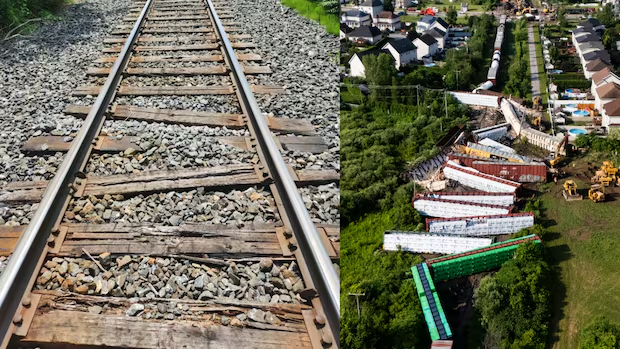
The TSB found the track had "several deficiencies" when a train carrying 172 wagons derailed in the middle of a residential neighbourhood.
"What we learned this morning is concerning, so this changes the situation," said Nicolas Dufour, Repentigny's mayor.
In a statement, the TSB shared a letter it sent to Transport Canada on July 10, outlining its preliminary observations in the early days of the investigation.
"Specifically, between Mile 118 and Mile 121, rail anchors were missing or had displaced in a few locations. Furthermore, several ties were skewed and were no longer perpendicular to the rails," wrote the TSB's director of investigations, Vincenzo De Angelis.
"Given these risks, Transport Canada may wish to consider verifying the integrity of the track on the CN Joliette Subdivision to ensure that it is safe and meets operational requirements."
That is because some of the deficiencies were observed on areas of the track outside of where the train derailed and beyond the section repaired by CN following the incident, according to senior TSB investigator Luc Régis.
Régis said that trains are generally a safe form of transportation but if the identified problems go unchecked, they could contribute to another derailment.
He noted, however, that the deficiencies existed prior to the derailment without any incidents until July 5.
TSB investigation reveals ‘several deficiencies’ caused Repentigny train derailment
CN Rail resumed its train operations on July 8, with trains rolling at significantly lower speeds compared to the usual 80 km/h limit.
The company released its own findings on Thursday, saying the evidence suggests the derailment was likely caused by a thermal misalignment of the rail, which occurs when extreme temperatures cause the rail to shift.
"CN believes that this was caused by the misapplication of the Company’s engineering standards related to rail distressing during the work that was conducted on the level crossing in the spring of 2026," the statement reads.
"At this stage, CN does not believe speed, train handling and mechanical issues were causes of the derailment."
After derailment, Repentigny, Que., asks Ottawa to reduce freight train speeds in urban areas
Days after derailment, trains are back on tracks in Repentigny, Que. — and residents are uneasy
Dufour said the TSB's statement on Thursday changes how the city and its residents are feeling.
"We’d assumed that if Transport Canada had given the go-ahead for the resumption, it was because the relevant authorities were evidently satisfied with the measures currently in place," he told Radio-Canada.
"We are officially requesting that operations be suspended until these repairs are completed."
CN required to reduce speed, says Transport Canada
In an email on Thursday, Transport Canada spokesperson Hicham Ayoun said the operating speed of trains in the affected area has been reduced to 10 miles per hour — or about 16 kilometres per hour — until certain conditions are met.
"This restriction will remain in effect until Transport Canada has completed its post-repair inspections, CN has completed its internal review of the causes and implications of the occurrence, and Transport Canada is satisfied that all applicable safety requirements have been met," Ayoun said.
He also confirmed that Transport Canada conducted a track inspection in the affected area on July 10 and is following up with CN to "ensure that all applicable safety standards are being met."
Transport Canada is also assessing the integrity of the track on the CN Joliette Subdivision, as recommended by the TSB.
Pierre Barrieau, a public transportation consultant and university lecturer, said significantly reducing the speed limit is a good way to ensure better safety.
"It will greatly diminish the chances of a derailment and also, if there is a derailment, trains will stay much more within the tracks," he said.
In Thursday's statement, the TSB said its investigation is ongoing. It was given a classification reserved for incidents where "it is quite likely that new safety lessons will be identified and that transportation safety will be advanced by reducing risks to persons, property, or the environment."
Annabelle Olivier is a digital journalist at CBC Montreal. She previously worked at Global News as an online producer. You can reach her at anne.isabelle.olivier@cbc.ca.
With files from Gloria Henriquez
Related Stories
 Canada
Albertans head to polls in historic referendum on whether they want to stay in Canada
5 days ago
 Canada
In the news today: four soldiers killed, Alberta referendum, AI privacy fears
5 days ago
 Canada
How a grass fire at a Canadian military base killed four soldiers
5 days ago
 Canada
How will household electricity rebate reduction, temporary winter pricing change impact Ontarians?
5 days ago
 Canada
Residents told to boil tap water due to bacteria
5 days ago
 Canada
Oil
5 days ago
 Canada
Albertans vote on path to independence as Carney fights to keep Canada united
5 days ago
 Canada
Two of 4 soldiers killed in fast
5 days ago