
Seeing spots: Saskatchewan experiencing 'ladybug boom'
Seeing spots: Saskatchewan experiencing 'ladybug boom'
Entomologist says that province is home to about 75 different species of ladybugs
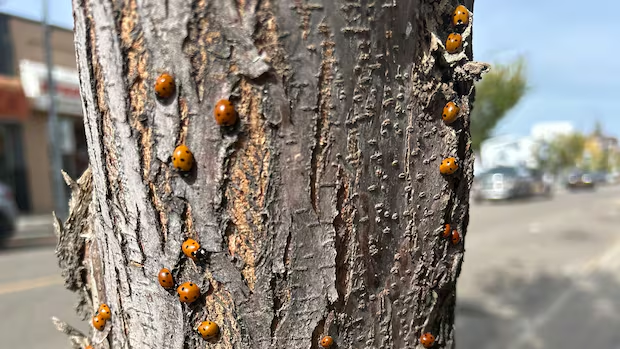
Ladybugs are out in full force across Saskatchewan this month ahead of hibernation, according to experts.
"Bugs go in big cycles of booms and busts, and I think we just happen to be in a bit of a ladybug boom right now," Georgiana Antochi-Crihan told Saskatoon Morning host Candice Lipski.
Antochi-Crihan is the City of Saskatoon's entomologist. She said that the key to understanding the ladybug swell is to think small.
"A lot of that tends to have to do with the amount of food that is available for them," she said.
Ladybugs feast on a diet of aphids, scale insects, mealybugs and other agricultural pests.
Ashley Thompson hasn't noticed a massive ladybug boom this year in Regina, but said the city has seen aphids galore.
"There was a large aphid population this year, and of course that does help promote the survivability of ladybugs," said Thompson, the manager of parks technical services for the City of Regina.
A similar abundance of aphids caught Vesna Fa's eye this past summer in North Battleford.
"I spend lots of time in the garden and I think that we have lots of aphids and different kinds of enemy bugs, and I think that's what attracts ladybugs," she said.
Fa is the executive director of Midwest Food Resources, a food security non-profit that operates in North Battleford, Lloydminster, Meadow Lake and Turtleford.
"Ladybugs are friends. So keep them, don't spray them. Do nothing to them," Fa said.
To swat or not? These scientists suggest we rethink our fear toward insects
Ladybugs are critical critters in the garden, but warmer winters could wipe them out
Candace Savage agreed that the province's ladybug population should be celebrated for their role in the environment. She is the chair of Wild About Saskatoon, a volunteer organization that promotes biodiversity.
Among the approximately 75 species of ladybugs that Antochi-Crihan said live in the province, there are both native and introduced species. The most common ladybug, the seven-spotted lady beetle, is an introduced species that can be identified by the namesake seven spots on its shell.
"It's so very important to be providing native plants, and encouraging these wonderful and fun introduced species. But more importantly, providing habitat for all the variety of creatures that naturally occur here," Savage said.
Thompson attributes the amount of ladybugs out and about this month in Regina to their looming hibernation.
"We will typically notice more of the population just because it is warm and they're starting to gather for the winter, and they're kind of finding these warm places up against the side of buildings and they kind of congregate together," Thompson said.
Antochi-Crihan said ladybugs have a secret weapon for surviving winter in freezing prairie temperatures.
"A lot of that has to do with the internal compounds that they make. So, some of them make some antifreezing compounds and they start to ramp up this production as we get into the fall," Antochi-Crihan said.
Ladybugs are likely to appear in large numbers again as they exit hibernation next spring.
With files from Saskatoon Morning
Related Stories
 Lifestyle
Sobeys' parent Empire agrees to end property controls. Here's how it's a win for consumers
1 day ago
 Lifestyle
Food inspections hampered by staff shortages
3 days ago
 Lifestyle
Mother bear that wandered into B.C. store killed by conservation officers
3 days ago
 Lifestyle
Man shot by ICE agent in Texas treated for paralysis in left side, lawyer says
3 days ago
 Lifestyle
Canada leaving billions on the table by not processing more crops at home, new agri
3 days ago
 Lifestyle
Hundreds flee homes in Far North Cameroon after armed group raid kills 15
3 days ago
 Lifestyle
Haiti: Over 250,000 children trapped in the grip of hunger
4 days ago
 Lifestyle
Restaurant 'feels helpless' over dine and dashers
4 days ago