
Smart glasses expose a gap in Canadian privacy laws
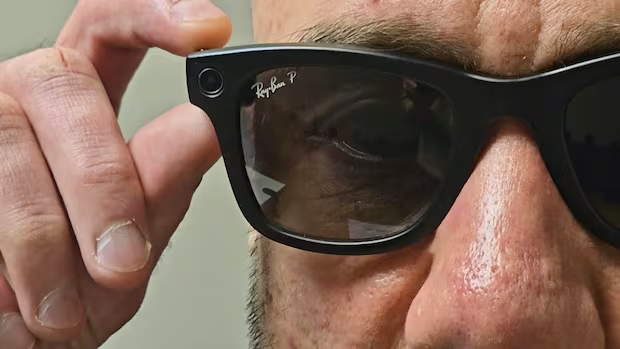
Smart glasses expose a gap in Canadian privacy laws
Smart glasses allow people to film more discreetly than with a phone
Questions about privacy have been raised around the use of smart glasses and their ability to film people without their knowledge.
David Fraser, a privacy lawyer with McInnes Cooper in Halifax, explained the legalities surrounding this technology in an interview with CBC’s Information Morning.
This interview has been edited for length and clarity.
These are glasses that have cameras, sensory displays and augmented reality built in. Like a smartphone on your face, basically. Correct?
That's essentially what it is. The technology has gotten so much better and much smaller that they really can be embedded in glasses that look like normal glasses.
It would be easy enough to film someone without their consent. But do you need someone's permission to film them in Canada?
We have privacy laws that regulate businesses, but an individual wearing smart glasses walking in a public area or walking into a street or a shopping mall, they're not subject to those particular laws. And we do have laws about voyeurism, but those are generally for places like change rooms or bedrooms or bathrooms and things like that.
For a normal person, just for whatever personal reasons, wearing these glasses in a public place or shopping mall or store, there's generally no law that would prevent them from doing that, at least in Canada.
What about if you're gathering these images on private property?
Anybody who controls private property can set conditions on entry. So, these stores ... they could put up a sign saying no photography on our property. As soon as you activate your smart glasses on their property, you would become trespassing. Now that's a civil matter, not a criminal one, but the person can be ejected.
Do we need laws to regulate this sort of thing?
It needs to be done very carefully. Canada's voyeurism offence was added to the Criminal Code relatively recently because video cameras became small enough to be hidden covertly. That became a problem, and there have since been hundreds of convictions under that provision for genuinely harmful conduct.
Sometimes new technology and particular kinds of covert technology can present problems that we as a society need to think about, but think about very carefully in terms of if we're going to come up with the law. We need to do it very, very carefully and figure out exactly where the lines need to be drawn.
Fate of 200-year-old N.S. lighthouse hangs in the balance as work begins on replacement
Power restored for thousands affected by widespread outages in Halifax area amid heat wave
16 pilot whales dead in mass stranding on Sable Island
Snap, tap and send: Programmer develops free tool for HRM residents to fast-track civic issues
Shubenacadie residents 'pleased' to see cenotaph back in its original location
With files from Information Morning
Related Stories
 Technology
Georgia Tech captain Kyle Efford announces medical retirement from football: 'Nothing left in the tank' | OutKick
30 minutes ago
 Technology
Agreement signed on second Polish nuclear power plant
1 hour ago
 Technology
RPI Team Builds Resource
1 hour ago
 Technology
Cut screen time in classrooms to avoid long
1 hour ago
 Technology
Can Vibe Coded Apps Replace Adobe and Microsoft? These AI Apps Hope So
1 hour ago
 Technology
Two Climate
3 hours ago
 Technology
Westchester Tech Accelerator selectes eight more businesses
3 hours ago
 Technology
Missed Bytes Technology Group? Here’s What Holders Saw
3 hours ago