
Soren Monroe
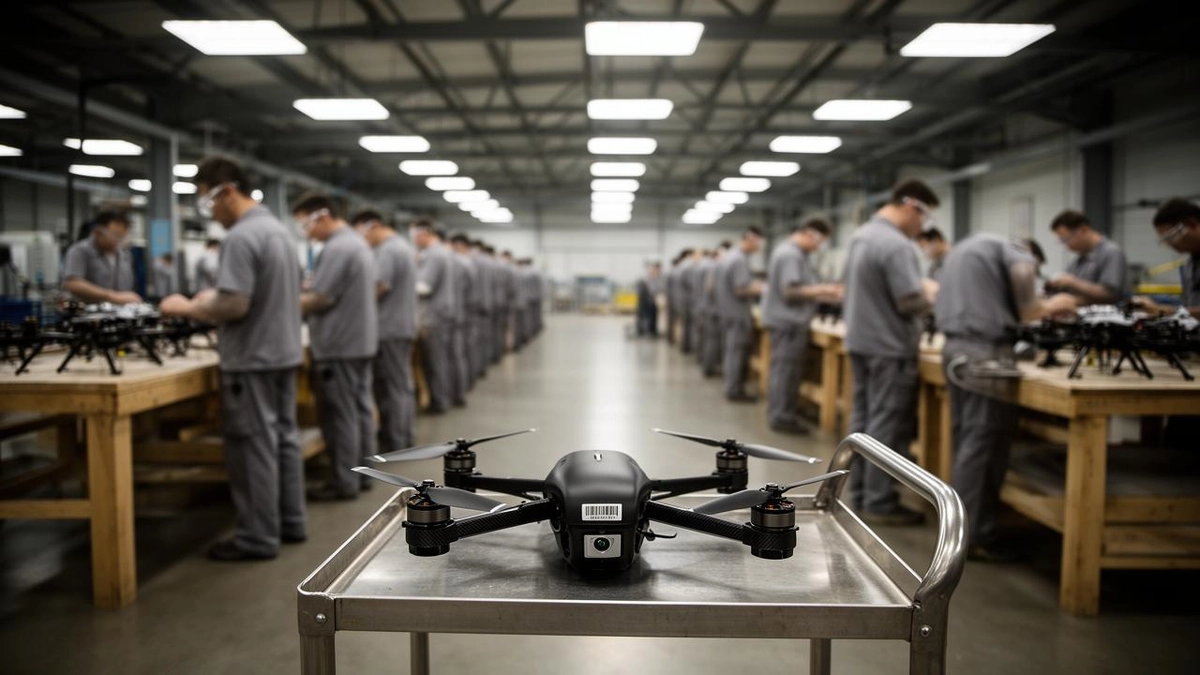
The levers for closing the remaining 100 km/h gap are conventional but concrete: bigger motors, bigger battery, and continued aerodynamic refinement. The new airframe gained speed primarily from the latter — “a lot of the last one, still a lot of places we can improve” — which suggests the company sees aerodynamic optimization as a meaningful, incremental lever rather than a solved problem.
The materials discussion draws a direct, unsolicited contrast with a competitor the host had previously visited. At another defense startup’s R&D facility, cast metal drone bodies were presented as a feature — heavier, but usable as heat sinks. Neros takes a fundamentally different approach. Airframes are mostly carbon plates, chosen for the simple reason that “carbon is really light and really strong.” A flat aluminum bottom plate doubles as the heat sink, contacting the motherboard and radios through thermal interface material when the drone is closed out.
Monroe-Anderson frames the choice in cost terms: flat carbon plates and aluminum sheets are 2D-cut parts — cheap to manufacture at scale. Cast metal bodies require casting or CNC machining, adding cost per unit. “Carbon is really light and really strong, but it doesn’t have some of the advantages of what they were doing with those metal bodies — you get to use it as a heat sink.” The aluminum plate is a compromise that captures the thermal benefit while keeping the part simple and cheap to produce.
A detail that would surprise anyone familiar with aerospace manufacturing: Neros does not have a wind tunnel. For a company building interceptors designed to fly at 300 to 400 km/h, this might seem like an omission. Monroe-Anderson’s explanation is grounded in the physics of quadcopters versus fixed-wing aircraft.
“For our types of drones, these quadcopters are much less affected by wind than a fixed-wing drone,” he says. “We do a ton of testing in very windy conditions, but we’ve never needed to specifically put something in a wind tunnel.” Real-world testing substitutes for controlled-environment testing, and the company does “a ton of it” — the ten-person flight-test team deploys daily as two crews in two separate desert locations, two hours from the factory, deliberately trying to break prototypes.
Fixed-wing drones are a possible future, however. “A lot of the same stuff that’s been figured out in FPV — we can make lower-cost systems that are really effective. That applies in fixed-wing, too. And that is what Neuros wants to build, so at some point.”
Perhaps the most operationally distinctive choice inside Millennium 1 is the company’s testing regime. Every single drone Neros produces — 250-plus units per day — is still 100% flight-tested by a human pilot before shipping. At this output rate, that represents a significant allocation of labor and time.
The process itself is three-layered. Development testing happens in the desert, where the ten-person flight-test team works as two daily crews in two different locations, with a mandate to push prototypes to failure. “Really we’re just trying to push everything to its limit and see where it breaks,” Monroe-Anderson explains.
Production testing starts with an automated pre-screen station that checks units for issues that previously would only have been caught in flight. Then a manual pilot mounts a mass-simulation payload — approximating the weight of a real warhead — and “basically just tries to stress the drone as much as they can in a relatively short flight,” whipping the aircraft through aggressive maneuvers. It is a deliberately brutal final exam.
The purpose of this intensity is explicitly to end it. Neros is collecting data from both the automated station and the manual flight test to reach a point where it can transition to sample testing — flight-testing a statistically significant subset rather than every unit. The data accumulation is the product; the manual whipping is temporary. Monroe-Anderson says the company expects to stop flight-testing every drone and shift to sample testing once the automated test station data proves sufficient to catch defects reliably, though “that is still a little ways away.”
The closing exchange of the tour retroactively frames everything shown earlier. The host asks for Monroe-Anderson’s hottest take, and the answer is immediate, unhedged, and devastating to the sector.
“Maybe the majority of defense tech products that are being put out right now by startups are not very effective and maybe even completely useless.”
The host translates: “They’re fake.” Monroe-Anderson agrees.
The line lands with force in context because the preceding 20 minutes have shown a company doing the unglamorous work that makes the indictment credible. Desert testing to failure. Serial-number tracking on a manual line. 100% flight testing of every unit. A factory sized for a million drones but running at a fraction of that while the product redesign and component infrastructure catch up. This is not a company claiming it has solved defense technology. It is a company arguing that the work itself — the manufacturing, the testing, the supply chain — is the proof, and most competitors are not doing that work.
The indictment is also a business thesis. If the field is full of products that do not work, then the company that can ship thousands of proven, tested, serialized units has a structural advantage that is difficult for latecomers to replicate. Scale becomes the moat — not the demo, not the white paper, not the policy brief.
The company recently raised $250 million at a $2.5 billion valuation, led by Sequoia Capital and the American Strategic Technology Fund, with participation from Peter Thiel Capital. It holds a five-year Army contract worth up to $500 million for the Archer drone and related systems. The resources are in place. The question is whether Neros can close the distance between 250 drones per day and the million-unit ambition before the “fake products” Monroe-Anderson dismisses have time to become real.
That funding round is a rapid re-rating: Neros' Series B in November 2025 valued the company at roughly $794 million, meaning the new round values it at nearly triple that within nine months.
The urgency behind that re-rating traces back to defense policy. In a December 2025 directive, Defense Secretary Pete Hegseth's Drone Dominance Program called for the U.S. military to field more than 200,000 low-cost drones by 2027, with an early target of roughly 30,000 units delivered by mid-2026. That is the policy backdrop against which Neros' own million-unit annual target — and its bet that manufacturing scale, not flashy demos, is what wins contracts — is being tested.
Four milestones will determine the answer: whether the Archer AI drone reaches main-line production by the end of 2026 as planned; whether the 400 km/h Bandit Interceptor materializes, which would be a headline number in counter-drone capability; whether in-house component manufacturing lines actually come online inside Millennium 1 within the year; and whether Neros’ own shipped volumes make the “fake products” claim a self-fulfilling prophecy or a premature boast. The building is big enough for a million drones a year. The flag is big enough for the South Bay. Now the company has to fill the space in between.
Related Stories
 Technology
When Tech Companies Die, What Happens To The Products They Leave Behind?
15 hours ago
 Technology
Two Finns supplying Russia with missile tech worth tens of millions
15 hours ago
 Technology
Drones with pepper spray, four
16 hours ago
 Technology
Micron Technology stock pre-market at EUR 800.50: memory storage - ad
17 hours ago
 Technology
TAIEX Ends at 4
17 hours ago
 Technology
ZAWYA: Technology, start-ups can double India
17 hours ago
 Technology
Czech government to consider CZK 1 billion fund for startups
17 hours ago
 Technology
GDIN Supports Eight Startups at CEATEC 2026 in Japan, Opens Door to Local Investor Collaboration
17 hours ago