
STREAMLINE uses AI to tackle one of nuclear physics’ toughest problems
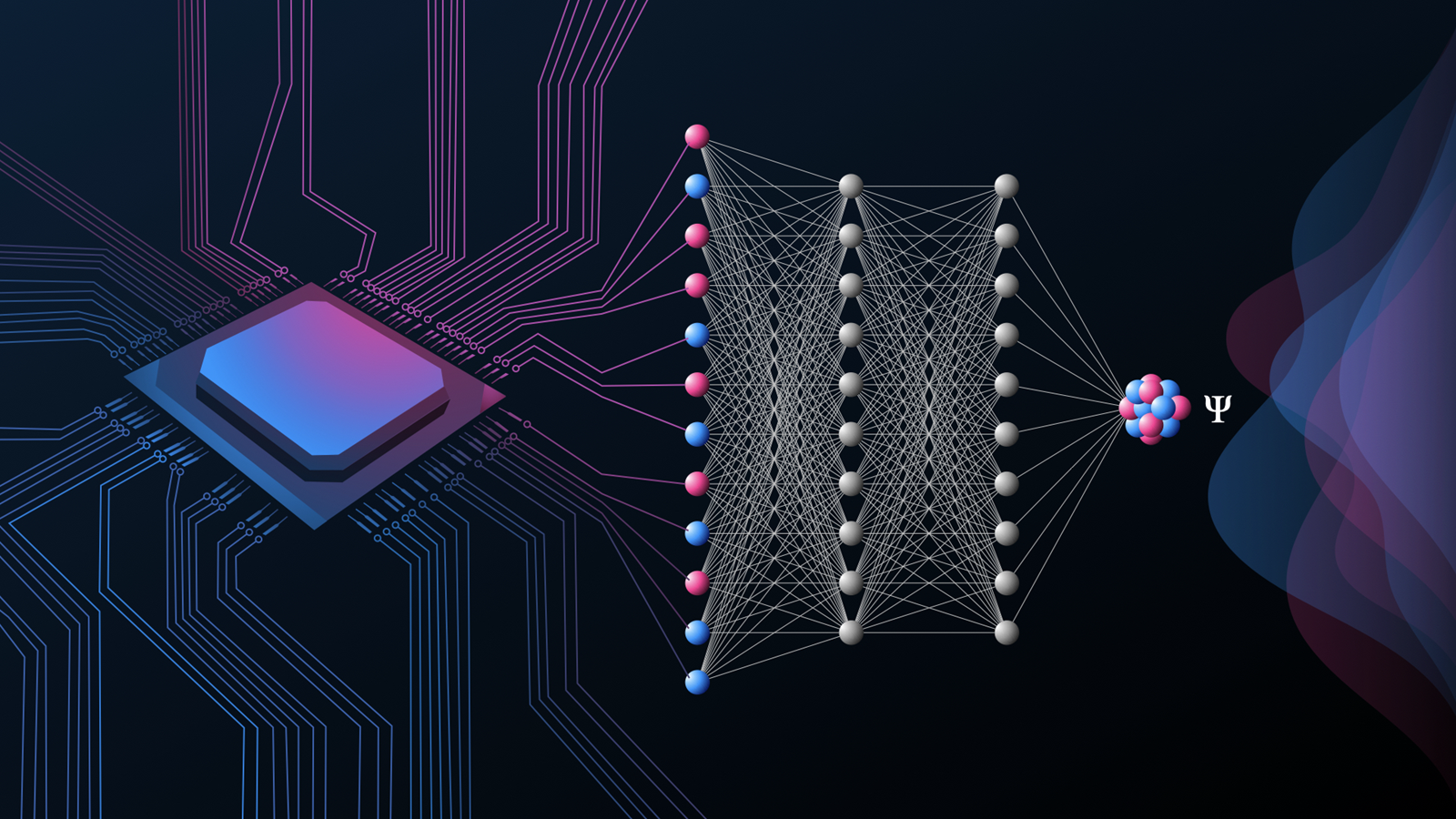
At the heart of every atom lies a tightly bound cluster of protons and neutrons — a system governed by some of the most complex interactions in nature. Understanding how these particles behave is one of the central challenges of nuclear physics. Now, a project called STREAMLINE is taking on that challenge using a powerful combination of artificial intelligence (AI) and supercomputing.
A collaboration of universities and national laboratories, including the U.S. Department of Energy’s (DOE) Argonne National Laboratory, STREAMLINE aims to solve what scientists call the nuclear quantum many-body problem — the challenge of predicting how many interacting particles behave collectively as a quantum system. It’s the challenge of calculating how dozens of particles influence one another at the quantum level, where the rules of physics differ from everyday experience.
“This project aims to solve the nuclear quantum many-body problem with high accuracy by leveraging machine learning techniques,” said Argonne scientist Alessandro Lovato, a lead investigator on the effort.
The problem is difficult because the number of possible interactions grows exponentially as more particles are added. Traditional methods quickly run into computational limits. Even the world’s most powerful supercomputers can handle only relatively small systems.
STREAMLINE changes that equation. By using machine learning — a form of AI — researchers can approximate these complex interactions much more efficiently. Instead of calculations that grow exponentially, the new methods scale more gently, allowing scientists to study much larger systems than before.
At Argonne, Lovato’s team is pioneering the use of neural networks — computer models trained on data to recognize patterns and make predictions — to represent quantum wave functions. A wave function is a mathematical description of a quantum system that encodes everything scientists can know about it. By replacing conventional equations with flexible neural networks, researchers can model systems that were previously out of reach.
The results are already striking. Where earlier methods could handle about a dozen interacting particles, the new approach can scale up to 100, opening the door to studying more realistic atomic nuclei.
“This was really a game changer,” Lovato said.
The implications extend far beyond nuclear physics. A better understanding of atomic nuclei helps scientists interpret experiments that probe the fundamental laws of nature, including studies of neutrinos — elusive particles that pass through matter almost undetected. It also informs models of neutron stars, the ultradense remnants of collapsed stars, where matter exists under extreme conditions.
In practical terms, STREAMLINE will produce quantities that experimental scientists can measure, such as the size, energy and structure of atomic nuclei. These results can then be compared with data from facilities such as the Argonne Tandem Linac Accelerator System (ATLAS), strengthening the connection between theory and experiment. ATLAS is a DOE Office of Science user facility at Argonne that focuses on nuclear physics.
The project is also highly collaborative. The Facility for Rare Isotope Beams at Michigan State University leads the recently renewed STREAMLINE 2 collaboration, which also brings together researchers from DOE’s Fermi National Accelerator Laboratory and Oak Ridge National Laboratory, Florida State University, North Carolina State University, Ohio State University, Ohio University and University of Tennessee, alongside Argonne.
Argonne combines deep expertise in nuclear theory with access to some of the world’s most advanced supercomputers, including systems such as Aurora. Housed at the Argonne Leadership Computing Facility (ALCF), Aurora is capable of performing over a quintillion calculations per second. These resources allow researchers to run the large-scale simulations required to train and apply machine learning models to quantum systems. The ALCF is also a DOE Office of Science user facility.
STREAMLINE also aligns with DOE’s Genesis Mission, an initiative focused on using AI to accelerate scientific discovery and innovation. By integrating AI directly into fundamental physics research, STREAMLINE demonstrates how machine learning can transform not just data analysis, but the way science itself is conducted.
Beyond its scientific impact, the project is helping shape the future workforce. The combination of nuclear physics, AI and high performance computing is attracting a new generation of researchers, equipping them with skills that are increasingly valuable across science and industry.
STREAMLINE represents a shift in how scientists approach one of the field’s hardest problems and a glimpse of what’s possible when advanced computing and human ingenuity come together.
As Lovato said, “The neural network doesn’t know anything about nuclear physics — but when we train it, it learns to behave like a quantum system.”
And that, researchers say, may be the key to unlocking the next era of discovery.
The Argonne Leadership Computing Facility provides supercomputing capabilities to the scientific and engineering community to advance fundamental discovery and understanding in a broad range of disciplines. Supported by the U.S. Department of Energy’s (DOE’s) Office of Science, Advanced Scientific Computing Research (ASCR) program, the ALCF is one of two DOE Leadership Computing Facilities in the nation dedicated to open science.
This material is based upon work supported by the U.S. Department of Energy (DOE), Office of Science, Office of Nuclear Physics, under contract number DE‐AC02‐06CH11357. This research used resources of the Argonne Tandem Linac Accelerator System (ATLAS), a DOE Office of Science User Facility.
Argonne National Laboratory seeks solutions to pressing national problems in science and technology by conducting leading-edge basic and applied research in virtually every scientific discipline. Argonne is managed by UChicago Argonne, LLC for the U.S. Department of Energy’s Office of Science.
The U.S. Department of Energy’s Office of Science is the single largest supporter of basic research in the physical sciences in the United States and is working to address some of the most pressing challenges of our time. For more information, visit https://energy.gov/science.
Related Stories
 AI News
UNC Artificial Intelligence: Innovate Carolina hosts AI workshop series to help students, professionals build workplace skills
57 minutes ago
 AI News
Experts weigh costs, benefits of using artificial intelligence in education
1 hour ago
 AI News
PRESS RELEASE: European Union Begins Enforcing Sweeping Artificial Intelligence Act
2 hours ago
 AI News
AI
3 hours ago
 AI News
No, AI doesn’t mean the end of mathematics
3 hours ago
 AI News
AI is revolutionizing weather forecasting
3 hours ago
 AI News
Dartmouth to Host AI at 70 Conference in October
4 hours ago
 AI News
Stowers Institute expands Artificial Intelligence Initiative, appoints second AI Fellow
5 hours ago